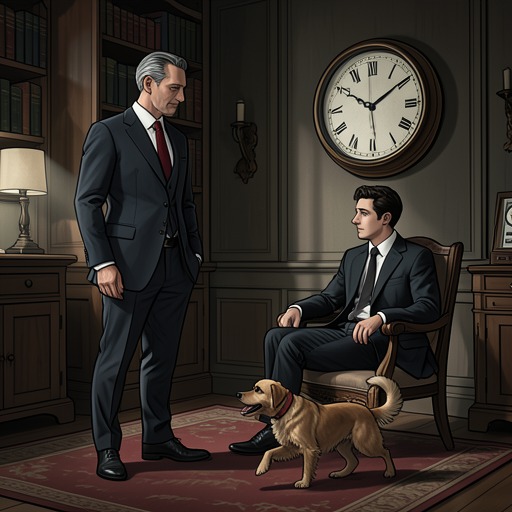
The father’s relationship with Agnes McShera
The Greatest Beer Run Ever: A Memoir of Friendship, Loyalty, and WarThe relationship between Agnes McShera and Francis (Frank) McGahern began as a late attempt at marriage and grew into a household alliance whose balance of power was never settled. They shared a strong identification with the Church and a sense of distance from the world around them, but their wilfulness took different forms. Agnes eventually established her authority in the home, while her husband continued to demean and challenge her; even so, she defended him fiercely against outside criticism. Their marriage also reshaped the narrator’s place in the family and intensified tensions among the children.
Background and Courtship
Agnes came from a large family in Drumboylan, where the richer grass of County Roscommon gave way to the rushes and shallow soils of County Leitrim. Her family included a sister married to Larry O’Hara, a quiet and gentle small farmer; two sisters who became nuns; a younger sister who was a nurse; brothers who remained on or left the family farm; and a brother who became a Dublin bus driver. Another brother was in America, while the youngest, Tommy, was a respected local tradesman and small building contractor. Agnes was described as the plainest member of a handsome family, but also as intelligent, strong-willed, and charming.
When young, she joined the household of a stockbroker in Manchester and made herself indispensable. She travelled with the family to places including the Bahamas, the West Indies, and South Africa. During the approach of war, she also helped her brother obtain work as a gardener in the Manchester household; when the stockbroker told him he was expected to enlist, the brother left by boat from Liverpool that night. Agnes remained abroad and returned home on holidays during the 1950s. It was then that she met and fell in love with the narrator’s father.
She was more than ten years younger than he was and dressed with a stylish but understated sense of appearance. Their temperaments were opposite, yet both were wilful and strongly identified with the Church. They looked down on the world from which they had come and that surrounded them. Agnes’s cultivated appearance could also be misread: when Tom Leddy called unexpectedly and mistook her for the housekeeper, he committed, in the narrator’s account, a serious social offence. After years of failed attempts at marriage, Francis (Frank) McGahern nevertheless began to delay just when an attractive prospective wife was within reach and no obstacle stood in the way. The narrator thought Agnes may have had to give him an ultimatum.
The Engagement and the Narrator’s Objection
Francis (Frank) McGahern called the narrator into the dayroom while he was covering for the barrack orderly, presenting the question as something that concerned the whole family. He asked how the narrator would feel if he replaced his dead wife with someone else and whether there would be any objection. The question revived the earlier conversation in which he had spoken of how much the narrator missed his mother and said he would have cared for her even if she had remained an invalid. The narrator answered angrily that this had nothing to do with his mother, who was dead.
The exchange continued around the idea that family members were affected whether they lived at home or away. The narrator said he had no objection to the marriage and considered his father lucky to have found someone, but refused to be drawn further into the decision. He left the room. He did not know how his father presented the confrontation to Agnes, or whether he told her about it. What he did know was that she disliked and distrusted him from the beginning, and that the two of them gradually came to regard one another as enemies.
The engagement took place in Sligo. In addition to exchanging a ring, Agnes and Francis (Frank) McGahern received special permission to exchange vows before a priest. This was unusual even at the time: the vows were as indissoluble as marriage vows, but conferred no rights. The ceremony therefore gave their commitment an unusually solemn religious form without changing its legal status into marriage.
Influence in the Household
Agnes’s effect on the family became clearest in the way attention and authority shifted around her husband. She was well read and clever, and had a rare capacity to give one person her undivided attention. In her company, the narrator’s ordinary remarks seemed to acquire interest; only gradually did he realize that his confidences were being carried to his father. Her attention made her an effective intermediary, but also a source of distrust for the narrator.
The younger children, Dympna and Frankie, were unsettled by the new arrangement. They had been shielded, through their youth and the presence of the older siblings, from the worst excesses of the household. In the preceding years their father’s freedom to do as he pleased had been more limited, and they had enjoyed ordinary liberties. As he flourished under Agnes’s infatuation and absorbed the attention around him, the twins received less. In subtle ways, Agnes restored his former power and dominance: the household again revolved around him. She used praise and flattery to shape Dympna’s and Frankie’s responses, withdrawing that support when they did not respond as she wanted. The twins had already lost the close attention they had received from Breedge and Rosaleen, who were then in London and had for years been the only parents the twins had known.
Margaret and Monica reacted differently. They were charmed by Agnes, but earlier experience had made them withdrawn and watchful. They were studying hard in order to make their own way out of the house. The narrator could see some of what was happening but felt unable to intervene; his own time in the household was interrupted by his return to training college. Thus Agnes’s influence did not simply create a new marriage within the family: it redistributed attention, revived old patterns of paternal power, and left the children responding according to their different histories.
Conflict, Home, and Inheritance
By Christmas, the initial gaiety of the household could no longer conceal its poisoned atmosphere. Francis (Frank) McGahern’s aggression and Agnes’s subtler control pressed on Dympna, who became sullenly submissive apart from bursts of high spirits that seemed unnatural. Frankie was openly confrontational and disturbed; his father’s threats, scolding, abuse, and sarcasm made matters worse. Agnes defended herself through passive aggression and proved stronger in that contest. When her husband’s most extreme threats were tested, they proved to be bluffs. She drew more of her own local family into the household, yet became fiercer in defending her husband against outside criticism.
The narrator and his father could conceal their temperamental differences while working together on the land. His father was unusually friendly in a bluff, jocose, and forced manner. Instead of trying to draw his son back into country life, he began talking of selling the place and moving to Dublin. The narrator thought the proposal impractical: Agnes’s mother and family were nearby, and he doubted she would welcome a move to a city neither spouse knew. But after the narrator returned to Dublin, his father sent him a letter enclosing a for-sale advertisement for a large, run-down property above a greengrocer’s on the North Strand. The proposed move marked another instance in which the father’s plans could not safely be dismissed as talk.
For years, Francis (Frank) McGahern had threatened to leave Agnes and live with his daughters. She eventually called his bluff; by doing so, she established her place and dominance in the household with ruthless efficiency. Yet her authority did not make the relationship conciliatory. Within the position she had secured, she allowed him to undermine and demean her, while defending and protecting him more fiercely than before. The combination made her power both real and difficult to read: she could withstand his attacks within the household while remaining his defender outside it.
Her security was also threatened by a plan she did not know about. Francis (Frank) McGahern intended to disinherit her, but an Act of Parliament had been introduced to prevent men in his position from doing so. In a letter to the narrator, he complained that the law had made his will useless and that, on his death, his property would go to one person, Agnes. He described her pension as reasonable provision already in place and said he would have preferred to spend his remaining days far from certain people. When the narrator insisted that Agnes should receive everything, his father approached the narrator’s brother, with greater success, arguing that the McGahern name should pass with the inheritance. He made the narrator executor of the will, a decision that caused trouble after his death. The relationship thus ended in no simple victory: Agnes secured a domestic position and a legal claim to property, while her husband continued to manoeuvre over the future of his estate.