World War II
The Greatest Beer Run Ever: A Memoir of Friendship, Loyalty, and WarWorld War II is the distant but pervasive force shaping the childhood world recounted by John McGahern: it is heard about in rumors and prayers, but felt most concretely in immobilized cars, scarce fuel, altered transport, and the changing contents of the family table. The memoir makes the conflict legible through such domestic particulars rather than through a campaign history. War reaches the household as constraint and interruption, then recedes unevenly, leaving its mark in remembered objects and routines.
A Distant War in a Small World
The war first appears across a landscape with little access to news. In the house overlooking a bog near Cloone, there is no electricity or television, very few radios, and newspapers are shared between households. Each locality seems to inhabit its own small world; the war across Europe arrives as a distant rumor. One excited visitor bursts into the house waving his arms and announcing that German planes are dropping bombs on England. The report is vivid, but the children’s immediate lives remain bounded by school, family, and the bog beyond the house.
That distance does not make the war emotionally remote. At Augharan School, where Mrs McCann’s beatings make each day miserable, the child silently prays after the Rosary that a German plane will stray over England and drop a bomb on the school while the pupils sleep. The prayer joins a child’s fear of school to the language of a conflict he cannot influence. The war’s imagined reach becomes, in his mind, a possible escape from a local authority that adults rarely challenge. Its military reality remains beyond his understanding; its power to furnish a desperate wish is immediate.
Restrictions and the Family’s Separation
Wartime restrictions alter the family’s movement at a moment already marked by illness and separation. When Susan McGahern is hospitalized at Mater Hospital in Dublin for tests and treatment after a breast cancer diagnosis, the children do not know where she is. She later returns briefly to the barracks for the birth of Dympna, then leaves again while the baby is cared for by Bridgie McGovern. One sharp memory of that interval is a journey with his father in Packie McCabe’s car to bring Susan and the baby home from a nursing home in Boyle. All private cars have been taken off the roads because of the war; his father’s small Ford rests on blocks in a barrack shed. The car can be used for this journey, but it belongs to a world of restricted movement, not ordinary motoring.
The journey has its own intimate, incongruous detail. Susan carries Dympna wrapped in a white shawl, while the baby and Packie McCabe, who is unmarried, are both red-haired. Laughter about their matching hair passes among the adults, though the boy cannot understand it. The war does not explain Susan’s illness or the family’s uncertainty about her whereabouts, but its restrictions shape the means by which the family can reunite. Private vulnerability and public emergency occupy the same small scene.
Fuel, Transport, and Work
Scarcity reaches beyond the family car into the local economy. On the narrow-gauge railway, the trains have to run on low-grade coal from the Arigna coal mines. The journey from Aughawillan to Ballinamore can be so slow that walking the four miles of sleepers might be quicker. Yet the train remains a rare social outing: people arrive in their Sunday clothes, exchange greetings on the platform, and talk and laugh aboard. On a steep incline, passengers sometimes climb down while the empty carriages slip back and wait for the engine to gather steam for another attempt. The railway is at once an inefficient means of transport and a shared public occasion, its wartime fuel shortage built into the journey itself.
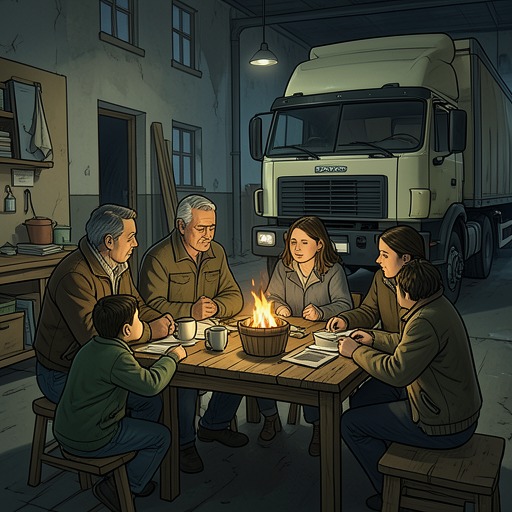
Fuel scarcity also prompts enterprise. Uncle Pat buys an old lorry, strips it down, and, with mechanic Billy Keegan, converts it into a travelling sawmill. A large circular saw sits on a steel platform above the chassis, allowing the machine to move to woodland and turn trees into firewood on site. With no chainsaws, trees are felled by crosscuts and levered onto the platform. The operation works for a time among plantations and small woods near estates including Rockingham and Oakport. It is an ingenious response to expensive, scarce fuel, but not a lasting solution: trees become dearer, the mill breaks down, the workers are poorly supervised, and the end of the war makes the venture untenable. Pat loses his savings in it. Wartime pressure produces invention, but invention does not guarantee security.
The War’s Seasonal and Political Imprint
At the family’s home, the seasons continue their familiar work even as the war determines what can be done with the land. By autumn the tarred boat lies upside down on timber beneath a sycamore, while the father begins to erect a windmill intended to bring electric light to the barracks. Corn has been reaped and stacked, turf is home, and potato digging is about to begin. Later, during the continuing war, the narrator helps with the potato crop: he carries water in iron barrels, watches workers spray the furrows, and helps rinse the barrels and machines. The account gives no claim that these ordinary tasks are caused by the conflict; instead, harvest and wartime constraint coexist, each occupying its place in the same rural year.
The war also shapes the performance of public life around Rockingham. Every year Sir John Maffey, the British Ambassador, attends the estate’s pheasant shoot, a high point for the barracks. Armed detectives come from Dublin to protect him. When the narrator brings them tea, he sees revolvers lying among ledgers on the dayroom table while the detectives play cards. His father and the guards, except for the barrack orderly, attend the shoot and the grand ball at Rockingham House. The episode places the war’s security apparatus beside an established social ritual: weapons and protection enter the dayroom, while the estate’s annual gathering proceeds. The memoir records this conjunction without turning the rural scene into a battlefront.
Easing and What Remains
As the war in Europe draws to a close, rationing begins to ease. In Mahon’s shop the narrator is given a white loaf: only six have arrived by train, and Mrs Mahon has kept one for his mother. He has not seen white bread for years. He carries it home excitedly to show Katie and then takes it upstairs to Susan; that evening everyone receives a slice and eats it in wonder. The loaf makes the end of wartime scarcity tangible at the scale of a household. It is not an abstract announcement of victory but a rare food shared at home.
Other routines have shifted by then. The narrator buys the provisions the household needs, carrying his mother’s list and travelling with the jennet and cart. Susan no longer takes the train into town. The war’s ending loosens one pressure, but it does not restore an untouched earlier life: her health remains fragile, family responsibilities have changed, and the household’s movements have been reorganized. Across the memoir, World War II is therefore both a distant European event and a sequence of local material conditions. The car on blocks, coal-burning train, improvised sawmill, armed detectives, and precious loaf give the conflict its remembered scale: not a single decisive scene, but a pressure registered in ordinary things.