the gate of heaven
The Greatest Beer Run Ever: A Memoir of Friendship, Loyalty, and WarThe gate of heaven is both a landmark in the afterlife Susan McGahern described to her children and the focus of John McGahern’s attempt, as a boy, to make that world physically reachable. It joins domestic faith to landscape: first a mother’s vivid account of what lies beyond the sky, then a child climbing toward the sun, and finally a recognition that the passage to heaven cannot be made by climbing alone.
A world made imaginable
Religious belief was woven into the daily pattern of family life. Prayers began the morning; work and conversation stopped at the Angelus bell at noon; the Rosary closed the day. The worlds beyond this one were not remote abstractions in such a household. Heaven, hell, purgatory and limbo were discussed as possible future realities, nearer in the family’s talk than America or Australia.
Susan McGahern made heaven especially tangible for her son. She spoke of it with the affection and specificity with which she named wild flowers: above the family, the sun shone in heaven; beyond the sun stood its gate. Past the gate were the thrones and mansions of God, the Virgin Mary, angels and saints, and then the gardens of paradise, where time ceased in lasting joy in the presence of God. Her hope was that the family would live there together. In this account, the gate is not merely an entrance: it marks the threshold between the known earthly world and a promised happiness shared beyond it.
The sun helped give the teaching a visible form. At Easter, Susan McGahern showed the children its shining rays and explained them as heaven rejoicing in Christ’s resurrection; if clouds hid it, she said that it danced behind them all the same. In the evening, the setting sun could seem close enough to touch, resting among the whitethorns on the hill behind the house. Religious instruction and the ordinary sky thus met in an image a child could watch, interpret and try to approach.
The child’s ascent
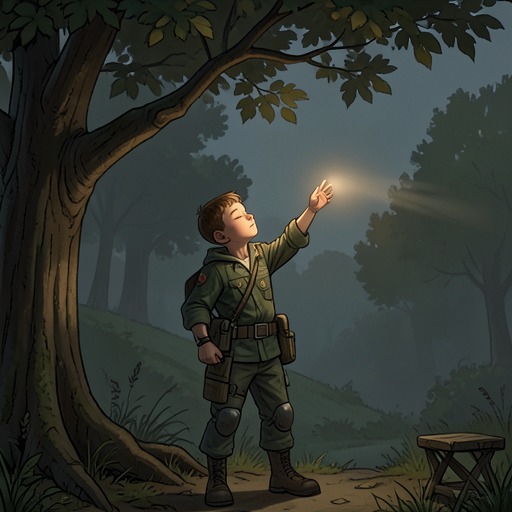
John McGahern turned the image into a plan. If he could climb the hill while the sun rested in the whitethorns, he believed he could walk through it to the gate of heaven. The attempt began as strenuous physical effort: the slope seemed like a terrible staircase, and he had to claw and drag himself through the rushes. Yet every step appeared to bring the sun nearer.
After pushing through a hole in a hedge, he rolled into a dry drain. The sun still seemed to await him when he reached the whitethorns, but on rising he found it far away, on another hill, with a broad plain of wheaten sedge between them. Exhausted, he crawled or fell back into the drain and slept. He woke in darkness to voices calling his name and stars overhead. The family scolded him, then responded with laughter and wonder when they learned where he had hoped to go. The landscape had not opened into heaven: the apparent nearness of the sun had been a mirage, and the boy had reached the limits of his strength rather than the gate.
The episode preserves the force of the child’s belief without turning the attempt into a supernatural crossing. Its decisive correction is that reaching heaven requires passing through death. The gate remains real within the religious teaching, but the boy cannot enter it by treating the sun as a path across the hills. The gap between spiritual promise and physical distance becomes the scene’s central discovery.
Prayer in the household and church
The image also belonged to repeated acts of prayer, not only to the boy’s solitary ascent. After a moonlit walk with Susan McGahern to collect milk, the two returned home, fed the fire, drank tea with bread and jam, and knelt together to say the Rosary. Among the invocations was the sequence of sacred titles ending in the gate of heaven. In that small house, made warm by firelight and prayer, the phrase joined an established devotional language to a night of unusually intense closeness between mother and son.
Church ceremonies extended that language through the year. John McGahern remembered the Stations of the Cross during Lent and the feast of Corpus Christi, as well as the church’s seasons of Christmas, Easter, Ash Wednesday, Pentecost, Ascension Day and All Souls’ Day. The church gave an impoverished community an introduction to ornament, ceremony, sacrament and mystery. Its rites offered a shared route through suffering and joy, and the story of Christ gave structure and meaning to the year. For John McGahern, the Church was his first book: its ceremonies taught through images and actions before printed words could do so.
Meaning and limits
The gate’s significance rests in a contrast. Susan McGahern’s teaching made the afterlife intimate and imaginable, while the boy’s attempt exposed how far that world lay beyond bodily reach. The sun could look close, and a prayer could name the gate, but neither appearance nor devotion made the passage available to a child climbing a hill. The scene therefore holds faith and physical experience together without collapsing one into the other.
That religious inheritance also formed part of a larger moral landscape. John McGahern understood the Church’s truth as an authority beyond human bullying, one to which his father, despite his power within the family, also had to submit in public. The gate of heaven belongs to this imaginative and devotional world, but its importance is not limited to a picture of paradise. It is an image through which a child learned to connect the visible sky, his mother’s hope, household prayer and the boundary between life and death.