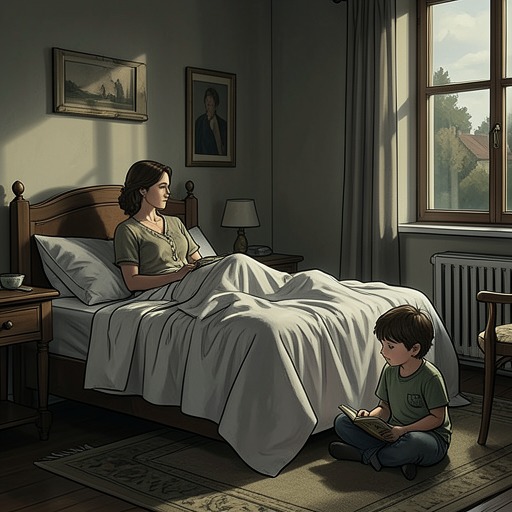
“The world of the dying is different”
The Greatest Beer Run Ever: A Memoir of Friendship, Loyalty, and War“The world of the dying is different” is John McGahern’s formulation of the gulf between a dying person and those still absorbed in ordinary life. It makes that gulf perceptible through everyday scenes: familiar work and small acts of living become, to the dying, signs of a happiness that can no longer be reached. The phrase also exposes how a family may continue its routines by denying what it knows, leaving the ill person alone with a truth that others cannot openly acknowledge.
Illness and uncertainty
The expression takes shape against the uncertainty surrounding Susan McGahern’s illness. At the beginning of it, Francis (Frank) McGahern had asked a Dublin doctor whether his wife should give up teaching and what her chances of recovery were. He had already written at the illness’s outset and received a detailed report; John McGahern describes his later letter as defensive and slightly bullying in tone, while also suggesting that this manner was characteristic of his father.
As Susan returned to school for short periods, her own letters registered a different kind of uncertainty. She wrote that she had been in bed for several days, was improved but still suffering, and might feel better if the weather and sunshine improved. She suspected that the cancer had returned. Yet her stomach pain and recurring constipation and diarrhoea were presented to her as an unrelated illness from which she could recover if she made the effort. She asked Francis to write again to the doctor, not knowing that he had already contacted him secretly. The contrast between her fear, the family’s explanations, and the medical inquiry gives the phrase its immediate human ground: information about illness is present, but it is not shared with the person most affected in a way that allows her to face it with others.
Ordinary life made unreachable
The passage then widens from Susan’s particular illness into a reflection on dying. Before the feared time arrives, people may imagine it briefly and put the thought aside in order to meet the demands of the day. Once it does arrive, however, the ordinary world changes its meaning. A waitress pouring coffee, a builder laying blocks, a girl opening a window, or men collecting refuse belong to a life that had once gone mostly unnoticed. For the dying, even its meanest forms can appear as an unobtainable happiness.
The allusion to Achilles speaking to Odysseus sharpens this reversal. The dead are not offered as enviably released from life; the passage recalls the preference for earthly existence, even in servitude, over lordship among the dead. In this context, ordinary tasks are not incidental background. They mark the boundary between those who can still take part in the world and the person who can only watch it continue.
Denial, faith, and isolation
The memoir describes the dying as marked both by their own knowledge and by the world they are losing. Other people continue with their lives, and the presence of someone dying threatens the comforting illusion that this continuity will last indefinitely. The knowledge is therefore hidden, obscured, or denied. It may surface as a joke, where laughter briefly accommodates the collision between what is inevitable and what remains difficult to imagine; plans are not knowingly made around someone understood not to be there in the future. Pious reassurances, in the narrator’s image, settle like dust or chaff over what is actually happening.
Susan’s faith could give her strength, but it also became a source of accusation when Francis charged her with losing faith in God. The memoir does not treat faith as an answer that cancels physical suffering or the pain of leaving those who depended on her and whom she loved. After forty-two years in a world where many people loved her, Susan had no one with whom she could communicate that loss. The phrase thus identifies not only a difference in physical condition but a failure of communication: others remain nearby, yet their denial leaves the dying person without a shared language for what is happening.
Narrative significance
The sentence shifts the memoir from the practical arrangements surrounding illness to an account of what those arrangements cannot contain. Questions about teaching, prognosis, and substitute teachers belong to the continuing work of family life; the reflection on dying reveals the cost of treating that life as though it could proceed unchanged. By moving from particular scenes to a general statement, and then returning to Susan’s faith and isolation, the passage makes the ordinary world newly strange without turning her illness into an abstraction. Its central contrast is between the visible persistence of daily life and the dying person’s knowledge that this life is becoming inaccessible.