“We come from darkness into light…”
The Greatest Beer Run Ever: A Memoir of Friendship, Loyalty, and War“We come from darkness into light…” is a governing reflection on childhood, knowledge, and mortality in the memoir. It gives the child’s bewilderment a larger shape: early life begins in partial darkness, but understanding gradually brings power and even joy, without removing the knowledge that life ends.
Meaning and Structure
The expression opens a meditation that moves from birth toward death and then turns back to the limited understanding of childhood. The narrator writes, “We come from darkness into light and grow in the light until at death we return to that original darkness.” Darkness is therefore both an origin and an end; childhood’s light is real, but incomplete, because children lack the power and understanding to make sense of the world around them.
That limitation is not presented as permanent. A child’s long, changing day absorbs even catastrophe, the reflection observes, and growing understanding gradually alters what can be known. Knowledge is far from comforting when it reveals that each day brings people closer to death. Yet the passage holds dread and affirmation together: understanding itself is a form of power and joy, and love of the world becomes more precious because its glory is so brief.
Childhood Under Secrecy
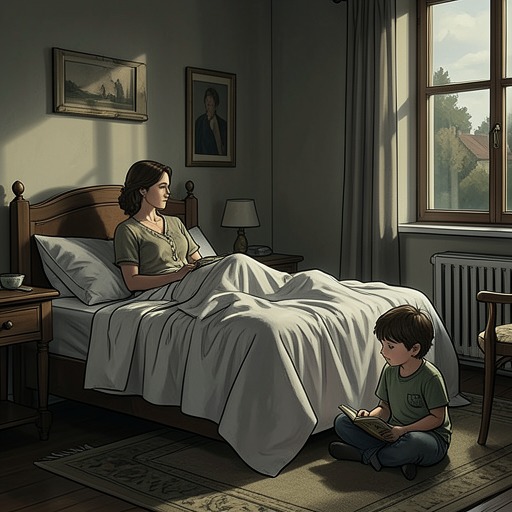
The idea of childhood as partial darkness is grounded in the narrator’s account of being seven during a long stay in the barracks. The children did not know where their mother was or what had happened to her; their father told them not to ask and to pray instead. Their mother, undergoing tests and treatment for breast cancer at Mater Hospital in Dublin, wrote that the narrator was beginning to resist being put off about her whereabouts and that the prospect of coming home was helping her recover.
She returned briefly, carrying the baby Dympna in a white shawl on the journey home from a nursing home in Boyle. The narrator remembers that journey sharply, but recalls little of the short time she spent with the family afterward. She soon left again, with Dympna staying with Bridgie McGovern, and the children still did not know where their mother had gone. The contrast between a precise image and a larger gap in knowledge makes the passage’s distinction tangible: childhood contains light, but what it illuminates is partial and vulnerable to secrecy.
Memory and Later Understanding
The memoir also marks the difference between what the child knew and what the adult narrator learned later. Margaret and Monica had gone to Aughawillan School on the day the rest of the children were taken from Corramahon. Only years afterward did the narrator discover that Maggie had agreed to care for Margaret, while their father insisted the girls remain together. When their mother died, the two girls were intercepted before reaching home and stayed with another household through the funeral, unaware of what had happened. The adult account restores the circumstances that the children could not understand at the time.
That reconstruction is part of the memoir’s acknowledged dependence on other people’s memories and help. The narrator thanks Rosaleen, Margaret, Monica, and Dympna for reading and correcting the manuscript, assisting with letters, and bringing two important scenes back into the light after they had slipped from memory. The language of illumination thus fits not only the account of growing up, but also the later work of recovering what childhood and memory had obscured.
Darkness, Loss, and Retrospective Judgment
The reflection’s movement toward death also resonates with the narrator’s account of the father’s death. The news brought grief and loss alongside relief; the narrator understood these feelings as bound up not only with the dead man, but with years spent entangled in a relationship neither wanted. His life, from which the past had been rigorously shut out, is described as a life of darkness. The passage does not claim that understanding resolves this history: even with more knowledge of him than of anyone else, the narrator cannot say he has fully understood him.
Across these reflections, darkness names more than the unknown facts of childhood. It marks mortality, the limits of understanding, and a family life shaped by concealment. Light is not a denial of those conditions: it is the gradual arrival of knowledge, the capacity to love the world, and the possibility of recovering parts of the past. Because that light is temporary, the passage makes both knowledge and love more precious.