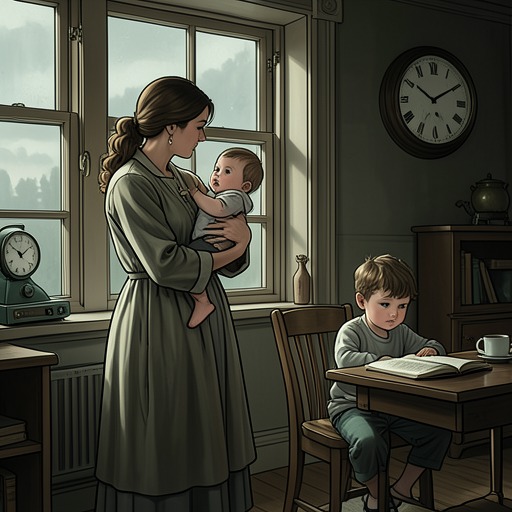
Faith as the support of a mother
The Greatest Beer Run Ever: A Memoir of Friendship, Loyalty, and WarFaith is a refuge for Susan McGahern, but not a promise that suffering will be removed. In John McGahern’s memoir, belief inhabits the daily rhythms of family life—morning prayers, the Angelus, the Rosary, church ceremonies—and becomes a source of endurance when illness and separation narrow her world. Its quiet inwardness contrasts with her husband’s public religiosity, and its strength is finally shown not as an escape from human pain but as a way of meeting it.
Faith in the Rhythms of Daily Life
For Susan and her children, religion was not confined to church or to moments of crisis. Prayers were said each morning; work and conversation stopped at noon when the Angelus bell sounded; the day ended with the Rosary. The realities of heaven, hell, purgatory, and limbo were spoken of so often that they seemed closer than distant countries. This repeated practice gave faith a place in the ordinary structure of time, making it something lived together rather than merely professed.
The family’s religion also took bodily and domestic forms. During a severe bout of whooping cough, John was passed three times beneath a neighbour’s jennet, mule, or donkey in a folk cure performed in the name of the Father, the Son, and the Holy Ghost. He remembered the cold night, frost on the ground, and stars overhead; most powerfully, he remembered the happiness of being restored to his mother and walking with her again to Lisacarn. The episode joins religious language to a practical, local rite, while its emotional consequence is reunion with the person whose care mattered most to him.
At home, prayer belonged to the same intimate world as warmth and food. After a walk together, mother and son fed sticks to the fire, drank tea with bread and jam, and knelt in the red light to say the Rosary. In such scenes faith does not stand apart from the household’s material life. It gathers ordinary gestures into a shared ritual, giving the child a sense of safety and belonging.
A Private Trust in the Face of Illness
When cancer treatment took Susan away from her home and children, faith became a means of enduring both physical hardship and separation. Her letters describe treatment as difficult and unpleasant, but she does not complain. While in hospital she makes friends with nuns and other patients, borrows money from her husband to meet the bills, and promises to repay it when she returns to teaching. Later, while lodging in Dún Laoghaire, she assures him that her spending is limited to board and tram fare. Her practical efforts and religious trust appear together: neither replaces the other.
In a letter explaining how she understands her illness, Susan writes, “God has given me near-perfect health for forty years,” and says that the loss of that health must have some inscrutable purpose that tests her faith. She places her trust and prayer in God alone. The memoir sets this confidence beside her husband’s effort to obtain a medical outlook: Francis McGahern writes to a doctor asking whether his wife should give up teaching and what her chances of recovery are. The medical questions seek an answer about prognosis; Susan’s faith supplies a way to live amid uncertainty, not a competing diagnosis.
Her letters also show that this trust is neither passive nor a denial of family feeling. After her husband pushes her too far in a dispute over the children, she places herself beyond human jurisdiction and turns to God, then insists that the children should not be blamed for her illness. She says she did for them what any mother would do and was happier for having done so. Faith gives her language for endurance, but it also enables her to defend the children and interpret her own care for them without accepting the accusation that they caused her sickness.
A Dream of Priesthood and Reunion
The bond between mother and son becomes entangled with a shared religious imagination. After Susan befriends Mrs Flanagan, whose son Paddy has been ordained, the possibility of John becoming a priest takes hold. In his childhood vision, ordination would let him bless his mother, live with her in the priest’s house, and give her Communion each morning. After her death, he would remember her in the Masses he celebrated until they were reunited in heaven. The imagined future has an unmistakable limit: it provides no place for his father or sisters. The adult memoir leaves open whether the dream belonged to Susan, to John, or to both, showing how faith shapes their closeness while also revealing the child’s intense wish to keep his mother near.
Susan corrects him when he says that he loves her most of all, reminding him that God must come first. That correction does not diminish their attachment; it locates their love within a religious order she takes seriously. The dream of priesthood thus serves two purposes: it offers the child a form for imagining service to his mother, and it gives their separation and eventual reunion a sacred horizon.
Resilience, Decline, and the Limits of Consolation
In Aughawillan, Susan’s belief continues to accompany practical work. She tends a flower garden, and her son remembers its roses and other flowers becoming more secure behind reinforced fences. Even as her health worsens, she interprets her earlier good health as a gift and the present illness as a test. The memoir describes her faith and love as a hidden strength through the happiness of those days. The garden’s care and her religious trust are not presented as cures; they are forms of attention and perseverance within a life increasingly constrained by illness.
A note of despair enters her letters when she reports that she is still suffering after returning to school. She suspects that the cancer may have returned, but those around her explain her stomach pain and bouts of constipation and diarrhoea as an unrelated illness from which she can recover. The contrast between her suspicion and the explanations offered to her makes the faith she has relied upon more complex: religious trust persists, while the possibility of renewed cancer is obscured by other people’s reassurances. When her father accuses her of losing faith, John’s adult account rejects the implication that belief should erase pain. Her faith may have strengthened her, he observes, but it could not take away the human anguish of losing the people she loved and depended on.
Ritual, Memory, and the Memoir’s Judgment
The memoir distinguishes Susan’s inward trust from the religious display of her husband. He walks to the front of the church in uniform and kneels in a prominent seat; she slips quietly into one at the back. The difference is not between belief and unbelief, but between religion as outward authority and faith as private reliance. That distinction is reinforced by the narrator’s later account of church ceremonies: the Stations of the Cross, the feast of Corpus Christi, and the cycle of the year gave him beauty, mystery, and a form of authority beyond his father’s rule. He calls the Church his first book, but this wider religious inheritance does not cancel the particular force of his mother’s example.
After Susan’s illness and death, prayer becomes a way for John to continue addressing the lost relationship. He imagines her in heaven, close to God and walking in the gardens with the angels and saints, but recognizes that she would have no need of his prayers if she were already there. The tension between doctrine and longing remains unresolved. Faith offered Susan a refuge and gave her family rituals through which love could be expressed; it could not prevent illness, separation, or grief. The memoir’s deepest claim is therefore measured: belief sustains a life without making that life painless.