River Shannon
The Greatest Beer Run Ever: A Memoir of Friendship, Loyalty, and WarThe River Shannon shapes the narrator’s passage between home, family, and solitude. It is at once a working landscape altered by engineering, a route that can be missed or crossed, and a place where a boy can claim an independence unavailable to him on land. Its changing meanings gather around bridges, navigation signs, and the small boat that carries him away from the demands of the barracks.
A River on the Road to Cootehall
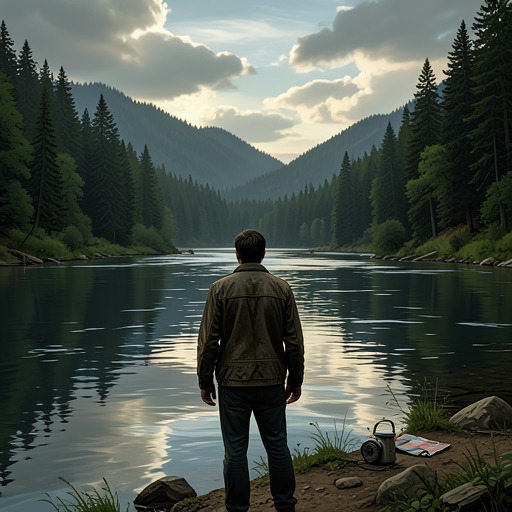
On his journey toward Cootehall, the narrator rests on a bridge over the Shannon and looks upriver at the huge rocks piled along its banks. The stones had been blasted when the river was deepened and widened for the Shannon Hydroelectric Scheme: the waterway’s appearance bears visible marks of a project that changed its course and scale. He has also heard about the French engineers who worked on the scheme, some of whom married local women who later went with them to France. The river’s transformation is therefore tied not only to engineering but to connections that carried people out of the district and across national borders.
The crossing is one landmark in a journey that proves more complicated than its directions suggest. After the bridge, the road runs straight to Tinker’s Cross, but the narrator sees no sign of his father ahead. He misses the Cootehall turn at Drumboylan and, tired and afraid he is lost, recognizes the bridge and post office at Knockvicar from earlier excursions in the tarred boat. He has traveled in a wide circle. Yet the mistake also leaves him with a distinct achievement: he has made the journey alone, and by the time he reaches Cootehall he no longer wants to meet his father. The river and its familiar crossing help him orient himself, but the road beside it has let him discover an independence he did not set out to claim.
Crossing into a New Home
The Shannon is also part of the family’s move from Aughawillan to Cootehall. The loaded lorry travels through Fenagh, Keshcarrigan, and Leitrim village before crossing the shallow, angry river at Battlebridge and entering the narrow roads beyond. The crossing belongs to a procession of specific places and obstacles: the hens cluck among the furniture, the vehicle jolts over potholes, and the family passes landmarks associated with earlier journeys before reaching Cootehall. The river is not an abstract boundary but a stretch of water the family must physically cross as its household is carried toward a new home.
At the barracks, the river remains in view as part of the place the family has arrived in. The lorry turns up the avenue of sycamores; beyond the barracks stand the navigation signs at the entrance to Oakport, with the slow river, glittering lake, and distant woods completing the landscape. That sequence joins the river to the threshold of the new residence. It also makes the move more than a change of address: the family enters a different geography, one that will give the narrator a route into a freer life outside the house.
The River as Private Territory
In the summers at the barracks, the narrator sets nightlines for eels and rows as far as Knockvicar. Sometimes one of his sisters accompanies him to hold the lines. If they have a few coins, they stop to buy biscuits and yellow fizzy lemonade, making the pause at Knockvicar a small shared pleasure before they turn the boat home. His father approves of the fishing because it costs nothing and because he prefers fish to meat. The same activity thus serves the household’s practical needs while opening a space the narrator can inhabit on his own terms.
The boat becomes a means of escape from work and prayer whenever the river allows it. The narrator comes to love its red and black navigation signs, reeds, rushes, and drowning lilies, as well as the changing light, wildfowl, and circles made by feeding fish. He also recalls the two islands of Oakport, fields sloping toward the water, and a spring well at the edge of the woods whose water is clear and cold. Wild mushrooms gathered nearby are roasted with butter and salt; in the evenings, the hounds at Oakport can be heard being fed. These details place the river within a larger, closely observed landscape, but they culminate in the value that distinguishes it from the surrounding farm and household: on the water, he can be completely alone.
Routes, Freedom, and Return
The river’s significance rests on a contrast between movement directed by others and movement the narrator can choose. On the journey to Cootehall, he follows instructions, loses the road, and uses familiar water crossings to recover his bearings. During the family’s move, the Shannon is one stage in a collective passage. Later, rowing and fishing turn it into a recurring route of his own, extending as far as Knockvicar and back. The same landscape can therefore carry uncertainty, family change, and private freedom without losing its material particularity.
That freedom is not wholly separate from family life. His sisters sometimes come along, his fishing pleases his father, and the river’s navigation signs and banks remain embedded in the world around the barracks. But the boat takes him beyond the immediate demands of land-based work, and the possibility of being unregarded matters more than any single catch or excursion. The River Shannon is consequently both a feature of the family’s geography and an intimate counterspace: a place reached by familiar routes, yet valuable because it lets the narrator be alone.