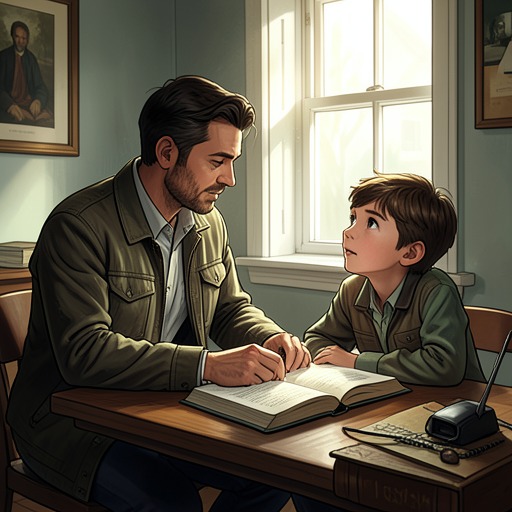
Sean and Brother Placid’s teacher–student relationship
The Greatest Beer Run Ever: A Memoir of Friendship, Loyalty, and WarBrother Placid, the headmaster, is both an exceptional teacher and the adult whose intervention makes it possible for Sean to continue his education. He recognizes the promise in a pupil whose school attendance is repeatedly interrupted by farm work, then carries that judgment beyond the classroom to Sean’s father. Their teacher–student relationship is consequential not because it is described through prolonged intimacy, but because Placid’s attention and advocacy alter the practical terms of Sean’s future.
A teacher who notices
Brother Placid replaces Brother Damien as principal. A handsome Kerryman and a good footballer who plays for the town team, he is also fond of drink; even after a heavy late-night session in Joe Lowe’s, he can appear sparkling the next morning. These details place him within the social life around the school, but the memoir’s emphasis is on his work as a teacher. His eyes, seen behind thick spectacles that he habitually polishes with a white handkerchief, can glint with humour, encouragement, or disapproval. The shifting expressions suggest an alertness to pupils rather than a remote, fixed authority.
That attention becomes decisive when Sean’s third-year examination results are particularly good. Brother Placid checks his attendance and notices a recurring absence: several weeks missed in both spring and autumn. Sean explains that these are the seasons of the bog and the potato field. The explanation makes the obstacle concrete. His schooling competes not with indifference to learning but with work on which the family depends. Placid responds by telling him he could win a university scholarship in two years if he worked, but that this prospect would be undermined if he continued to miss substantial parts of the school year. He links talent to a realistic condition—regular attendance—rather than treating good results as enough on their own.
Advocacy beyond the classroom
The relationship moves from assessment to intervention during the year the family has conacre in Coxhill. On a bitterly cold evening in late October, Brother Placid cycles out to the potato field, where Sean’s father is digging and Sean is picking. Placid talks agreeably with both of them for a while, then asks to speak to the father privately. They walk towards the road and remain there for a long time. Sean tries to listen but is too far away to hear what is said.
The scene keeps the substance of the conversation from the reader, but makes its consequence visible. Sean’s father returns slowly and says nothing for a long time while Sean continues picking and dragging buckets to the pit. At last, he reports that the Brother thinks he may be able to make something of Sean if Sean is prepared to work. He tells him to go back to school the next morning and says he will manage somehow on his own. Placid has not simply praised a pupil; he has spoken directly with the parent whose permission and willingness to bear the cost determine whether that pupil can remain at school.
Schooling against an earlier prospect
The father’s decision marks a sharp change from the prospect Sean faced only a year earlier. Then, Sean had needed all his wiles and determination to prevent being put into a job as an accounts clerk and general factotum at a hardware store in a small town close to Dublin. The return to school does not erase the economic pressure behind that alternative: the potato harvest and bog work remain part of the family’s circumstances. Instead, Placid’s intervention helps secure room for education within those demands. The contrast between the clerk’s job and the possible scholarship gives the meeting its force: a future that had threatened to close is opened again, although it still depends on work and persistence.
The meaning of the relationship
Sean’s retrospective account presents these school years as the beginning of an adventure that has not stopped. Cycling each day towards Carrick becomes an anticipation of intellectual pleasures; the fear and drudgery associated with school recede, and learning helps him know and love the world. The Brothers, in the narrator’s formulation, take him in and give him tools. Brother Placid’s role in that larger change is specific: he sees the connection between Sean’s examination results, his absences, and the labour pulling him away from school, then acts on that understanding with the family.
The memoir remembers the period with gratitude, as years of luck, privilege, and grace. That retrospective valuation gives the relationship significance beyond a single successful conversation. Placid’s authority could have remained a matter of examinations and attendance; instead, he uses it to make a case for Sean’s continued education, and the father agrees to bear the burden of letting him return. The private conversation by the road is not reported, and the book does not disclose its words. Its importance lies in the change that follows: the next morning, Sean is to go back to school, and the life gathered in his own hands has a chance to widen through study.