Susan McGahern and Pat McManus’s sibling relationship
The Greatest Beer Run Ever: A Memoir of Friendship, Loyalty, and WarSusan McGahern and her brother Pat McManus shared a relationship shaped by quiet, sustained practical care. In earlier years Susan helped Pat and their sister Maggie establish themselves in Ballinamore; when serious illness left Susan vulnerable, Pat and Maggie worked to secure her future and helped make a new home possible. Their support stands in contrast to the suspicion and distance that marked Susan’s dealings with her husband, Francis (Frank) McGahern.
Family history and reciprocity
Susan’s education had depended on family sacrifice. Her scholarship took her to boarding school in Carrick-on-Shannon, but it did not cover every expense, and the family had to scrape together the money for what remained. Her older brother Jimmy could not take up the scholarship: his father was ailing, and he was needed at home. The family did not complain about what it cost to keep Susan in school; their pride in her was enough. Once Susan began teaching, she helped Pat and Maggie establish themselves in Ballinamore. The three siblings lived together for years in the rooms behind and above their shop on High Street, near the railway station, until Susan married.
That earlier pattern of Susan helping her siblings later turned into a practical network organized around her illness. Pat and Maggie used their local connections to find Susan a school closer to Ballinamore, where they could assist her. Her posts at Beaghmore School and in the bog of Cloone and Carrigallen were too far away. The seriousness of her illness pushed the siblings past their customary reluctance to press their own needs: while Susan was still in hospital, they helped obtain an offer of a permanent position at Aughawillan, a two-teacher school on a hill three miles from Ballinamore. A house and farm at Corramahon, only a ten-minute walk from the school, were also for sale.
Securing work and a home
The siblings’ help was not merely a matter of finding an opportunity. Pat and Maggie, along with people they enlisted, made the appointment workable. A small station, Garradice Halt, lay between the house and school, with trains to Ballinamore. The priest agreed to hold the teaching position until Susan left hospital. When she was later offered her former post at Lisacarn School as well, she chose Aughawillan. Her decision to make that move was a consequential assertion of her own plans: in a letter to Francis, whose tone was usually conciliatory, she was blunt that Aughawillan was what concerned her now.
Pat’s part in confirming the appointment was specific. On the morning the school reopened after summer holidays, he drove Susan to the priest’s house. Pat insisted that she make an offering of five pounds to Father McEntee, the priest who welcomed her. The money matched the fee paid to the surgeon for her operation, but the appointment customs of the time also involved unofficial payments to priests. Susan and her siblings understood that this local expectation had to be met. After signing the necessary forms, she went on to the school for her first day back.
The purchase of Corramahon was less straightforward. Francis initially objected because it required spending money and because he suspected Susan’s family of influencing the move, though he also saw the farm as an investment. He privately sought medical advice about whether Susan should give up teaching and about her chances of recovery, but did not share the resulting report with her. He went ahead and bought Corramahon, largely using the proceeds from selling his homeplace at Gowna. Susan first saw the property during a brief release from hospital. Pat met her train at Dromod, and she stayed with him and Maggie in their Ballinamore shop. Her visit was too short for a trip to the barracks; she said it would be too hard to leave once she was there. Francis did not come to see her, although Cootehall was only eighteen miles away.
Pat’s continuing care
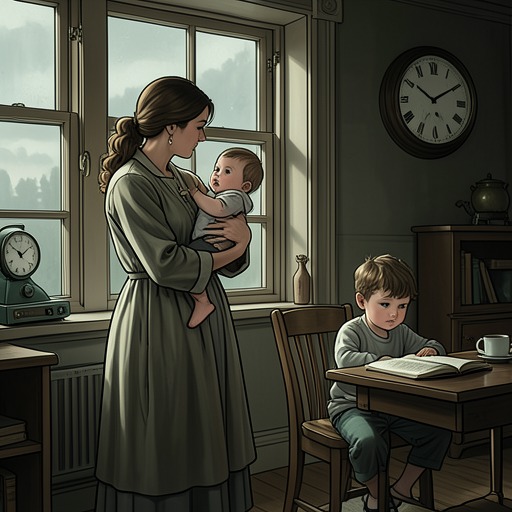
On the morning Aughawillan School reopened, Pat again provided transport, taking Susan from Ballinamore to the priest’s house. During the work to make Corramahon habitable, she stayed at the shop and Pat drove her to school each morning. After school she walked to the house to oversee the work and lay the fires; late in the evening Pat collected her in his hackney car and brought her back to the shop. The routine joined her teaching and the preparation of a home to the siblings’ own daily labor. It also allowed Susan to resume work gradually, as her doctors had advised.
When Corramahon was ready, Susan asked that the narrator spend the first week with her before the other children and Bridgie joined them. Pat came to the barracks in his car to collect him, and they drove straight to Aughawillan. The reunion with Susan was overwhelming for the child, who drew back at first and then ran into her arms. Pat’s role in this passage is brief but significant: he made the journey that carried the child back to his mother and helped turn the new house from a place Susan had first encountered alone into a family home.
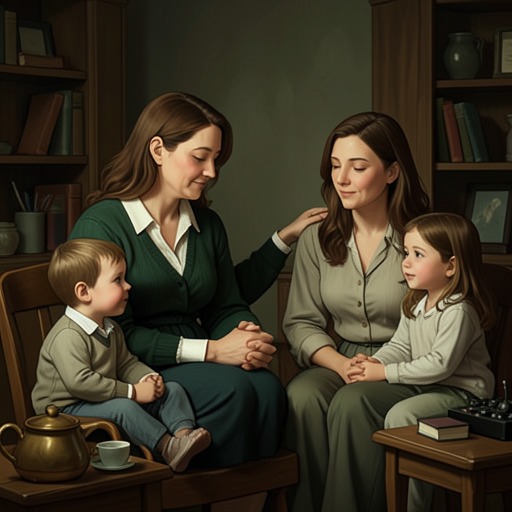
Pat’s help continued beyond the move. Between his hackney runs he came out to Aughawillan to do odd jobs around the house and on the land. Maggie cycled out on Wednesday half-days with sweets, bread, and fruit from the shop; the siblings’ support was therefore collective, but Pat’s regular practical work and transport made him a central presence. Even Jimmy offered Susan a stripper cow until milking-cow prices fell. These acts were modest in scale, yet they directly answered the demands of a household being rebuilt around a mother returning from serious illness.
Contrast and significance
Francis suspected that Susan was still giving money to her siblings, but the account identifies that suspicion as unfounded. By this stage, the direction of assistance had reversed: Pat and Maggie were helping Susan. The difference between what Francis imagined and what the siblings actually exchanged is central to the relationship. Their help consisted of transport, work, lodging, local contacts, and small provisions—not evidence of a scheme to take from him. The memoir sets such ordinary gestures against the depth of Francis’s suspicion, presenting family affection as something expressed through useful acts he failed to understand.
The siblings’ support also mattered because Susan faced illness without the security of uncomplicated marital care. Her first sight of Corramahon was of a bare house standing alone in a field, and after teaching there for a day she had to return to hospital for treatment. Pat and Maggie’s assistance did not remove that hardship, but it gave her a school near family, a home of her own, and practical help through the difficult transition. Their relationship is therefore marked by reciprocity across time: Susan had once helped Pat and Maggie establish their lives in Ballinamore; when her health and independence were threatened, they used the same family bond to help her establish a life at Aughawillan and Corramahon.