Susan McGahern’s death
The Greatest Beer Run Ever: A Memoir of Friendship, Loyalty, and WarSusan McGahern’s death is the point at which a family’s prolonged uncertainty becomes an announced fact: she died at a quarter to three, and her children learned the news by telephone at Cootehall barracks. The memoir traces the loss through more than that final announcement. It shows symptoms suspected but softened or concealed, care reorganized around her bedroom, and a narrator who understands death both through his mother’s particular suffering and through the ordinary world that continues beyond it.
Illness and the uncertain prognosis
In a letter to a doctor in Dublin, Francis McGahern asked whether his wife should give up teaching and what her chances of recovery were. He had already written at the beginning of her illness and received a detailed report. The narrator describes the later letter’s tone as defensive and slightly bullying, while also recognizing it as characteristic of his father. When Susan subsequently asked him to write to Dr Corcoran, he was reluctant because he had already contacted the doctor secretly. The exchange establishes a troubling division between medical knowledge, family decisions, and what Susan herself was able to know.
For a time, there were intervals of improvement. Susan could return to school after days in bed, and, when she felt better, spent evenings in the garden with the children. But her letters began to register despair: “I was at school today after a few days in bed. I am improved but still suffering and it seems I must suffer on – maybe if the weather improved the sunshine might help. God is great.” The tentative hope in the weather and the final assertion of faith sit beside the admission that suffering continues.
Susan suspected that the cancer might have returned. The people around her, however, treated her stomach pain and recurring constipation and diarrhoea as an unrelated illness from which she could recover if she made an effort. The memoir presents this reassurance as part of a broader evasion: the dying person’s knowledge and the family’s explanations do not coincide. On one last visit, Francis came by bicycle and spent hours in grave conversation with Susan. She walked with him to the small iron gate, while the children were not allowed to accompany them. They never saw one another again. From then on, his contact with her was by letter; he also began writing to Maggie.
Care in the bedroom
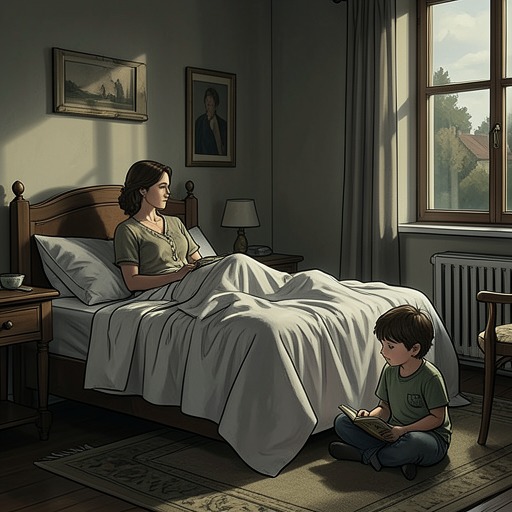
As Susan’s condition worsened, care became a strict household routine. A nurse came after Maggie had pleaded for help, and spent the morning cleaning and rearranging the bedroom. After the nurse and Dr Dolan spoke outside on the cinder path, the sleeping arrangements changed: the baby was to sleep with Katie, Rosaleen moved into her mother’s room, and a small bed was brought in for the narrator. At six in the morning Susan woke Rosaleen, who in turn woke him so he could light the fire. He boiled the kettle and carried hot water upstairs while the children helped their mother mix a white powder. Rosaleen later thought it was probably morphine; the memoir does not present that identification as certain.
The children’s closeness to Susan was also regulated. The nurse imposed a new strictness: the narrator could no longer go to his mother’s room as soon as he came home from school or stay there long. Susan slept much of the day. The garden that she and the children had tended, once a small fortress of flowers in the surrounding wilderness, remained intact but went untended; its smaller flowers were almost lost in the grass. These changes make the approach of death visible through altered rooms, routines, and absences rather than through a medical report alone.
The news at Cootehall barracks
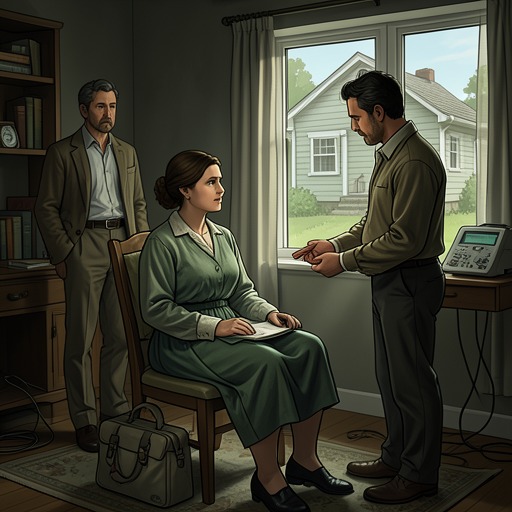
After the family moved into the barracks, the children were not sent to school for two days. On the third day, they were in the large living room when the telephone rang in the dayroom. Guard Cannon came up the long hall and knocked timidly to tell Francis there was a personal call. He went downstairs and shut the door behind him; Guard Cannon stayed with the children. When Katie asked whether the call was from Corramahon and he nodded, she burst into tears. The narrator began to weep uncontrollably with her. Susan was gone and would never answer to her name again.
At the children’s sudden grief, Breedge and Rosaleen began to laugh, then fell silent as Francis’s footsteps came slowly up the hall. He stood without speaking in the doorway before telling them, “The children’s mother died at a quarter to three. May the Lord have mercy on her soul.” The exact time gives the announcement its stark precision, while the prayer places the death within the family’s religious language. Guard Cannon grasped Francis’s hand and expressed his sorrow. The narrator’s grief continued, now joined by Breedge and Rosaleen. Francis asked Guard Cannon to find Packie McCabe to drive him to Aughawillan and to telephone compassionate leave to the Superintendent’s office later.
Death, faith, and the world left behind
The memoir sets Susan’s death within a larger account of what it means to be dying among people whose lives continue. The narrator writes, “The world of the dying is different.” Once ordinary scenes—someone pouring coffee, laying blocks, opening a window, or collecting refuse—can become emblems of a life from which the dying person is being separated. The passage makes the distance between the daily world and Susan’s bedroom part of the event: life goes on, but not for the person approaching death, and that knowledge is often obscured or denied. The narrator invokes Achilles speaking to Odysseus, including the words “Speak not soothingly to me of death,” to insist on the value of earthly life rather than consolation that diminishes its loss.
Faith remains important but cannot cancel the human cost. The narrator says Susan’s faith must have been a strength, even as Francis accused her of losing faith in God. Whatever strength belief offered, it could not remove the pain of losing those she loved and those who depended on her. At forty-two, after a life in which many people had loved her, she had no one with whom to communicate that pain. The death is therefore presented not as a purely private medical ending but as the collapse of a relationship at the centre of family life. Its finality is heard first in a telephone call, then in the father’s measured announcement, and afterward in the routines and absences through which the children must learn that their mother will not return.