The Church as refuge and counter-authority
The Greatest Beer Run Ever: A Memoir of Friendship, Loyalty, and WarThe Church is both sanctuary and counter-authority in the narrator’s life: a place where prayer and ceremony open beyond his father’s rule, and a moral order to which his father himself must answer. Its shelter is not simple or unqualified. Religious practice also governs daily conduct, and some clergy wield their authority harshly. The contrast lies in the difference between the Church’s expansive promise of meaning and equality and the violence exercised by people who claim to represent it.
A Presence in Daily Life
Religion reaches into the narrator’s childhood well beyond the church building. Prayers begin the day; at noon, the Angelus bell stops work and conversation in fields, homes, schools, shops, and streets; the Rosary closes the evening. Heaven, hell, purgatory, and limbo are discussed as more immediate realities than distant countries. The Church’s authority is thus embedded in the rhythm of ordinary life, shaping how time is marked and how the future is imagined.
That rhythm can be intimate as well as communal. At home, the family feeds sticks into the fire, takes tea with bread and jam, and kneels in the red light to say the Rosary. The sacred is not separated from domestic routine: prayer follows work and food, and the household’s small acts of warmth and worship share one space. The Catholic language of the Trinity also accompanies a folk cure for the narrator’s whooping cough. On a cold night, he is passed three times beneath a donkey, mule, or jennet in the name of the Father, the Son, and the Holy Ghost. The episode belongs to a world where religious belief and inherited practice meet in bodily, practical forms; the child’s return to his mother and their walk together to school give the ritual its immediate emotional consequence.
A Local Refuge and a Different Law
After the family moves to Cootehall, the church becomes an especially accessible refuge. Larger and richer than the church at Aughawillan, it has a stained-glass window above the altar donated by the King-Harmons. Its nearness matters: the narrator and his family can enter to pray on the way to the shop or the well. He understands it as an extension of the house and the barracks, yet one governed by different laws and a higher authority, and one that opens outward rather than closing in.
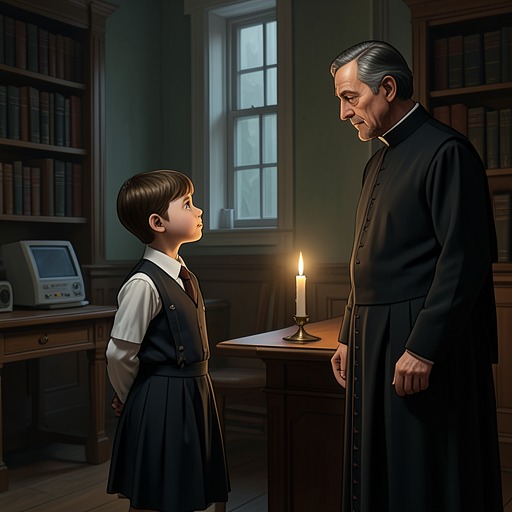
That outward movement sets the Church against the father’s household rule. The school, library, and river also offer refuge, but the narrator regards the Church as stronger than all three. His father, Francis (Frank) McGahern, is head of the Pioneer Association and a member of a sodality; the family attends both obligatory and non-obligatory ceremonies. The father’s public religious observance places him inside an order he cannot simply bend to his private will. The narrator sees that order as a limit on paternal power: his father must subscribe to it and continue to appear in the front seat of the church on Sundays. Against the darkness, violence, lies, and suppression of the barracks, the Church stands for light, understanding, freedom, and joy.
Ceremony as Beauty and Instruction
In a time of poverty, worship introduces the narrator to indoor beauty, ornament, ceremony, sacrament, and mystery. Even the altar flowers become memorable through their circumstances: red, white, and yellow tulips arrive by bus in plain brown cardboard boxes when flowers are otherwise scarce. His attention rests less on the grand Christmas and Easter services than on the Stations of the Cross during Lent and the feast of Corpus Christi. In the near-empty church at the Lenten devotions, rain and wind beat against the windows while three altar boys in scarlet and white move from station to station, carrying a cross and candles. The priest’s words echo in the dim interior. Small numbers and humble materials do not diminish the ceremony; they concentrate its effect.
Corpus Christi, by contrast, fills the village streets. Rhododendron branches from the Oakport Woods decorate the road margins; coloured banners and streamers cross the route; flowered altars stand at Gilligan’s, the post office, and Mrs Mullaney’s. The priests carry the Host beneath a gold canopy, stopping at the wayside altars as hymns accompany the procession. Girls in white First Communion dresses and veils scatter rose petals, while uniformed guards stand at the village entrances. For an hour, the Divine Presence leaves the tabernacle and travels the ordinary roads beneath the sky. The ceremony makes the village itself the setting for worship, bringing sacrament into the landscape and common life.
The annual cycle also serves as a form of teaching. As an altar boy, the narrator follows the story of Christ through Christmas, Ash Wednesday, Lent, Easter, Pentecost, Ascension Day, and All Souls’ Day. Before the printed word, he remembers, churches were the Bibles of the poor. The Church becomes his first book: its ceremonies give depth and meaning to both the year and human life, moving through suffering as well as ecstasy. That education is sensory and participatory, learned at the priest’s side through prayer, sacrament, music, gesture, and ornament, rather than through doctrine alone.
Authority, Discipline, and Contradiction
The Church’s claim to a higher moral authority is not identical with the conduct of every priest. In the Kilmore Diocese, teachers are required to conduct catechism classes after Second Mass, with enforcement varying by priest. Canon Reilly enforces the rule with particular severity: he waits at the church gates, returns children to class by the ear, accepts neither excuses nor argument, and has closed gaps around the church to make passage difficult. His authority reaches beyond his own parish. The church that provides refuge can also regulate movement and attendance.
The violence of discipline becomes still more stark in the schoolroom. After a poor boy confesses to breaking into the church poor box, Canon Reilly offers him a choice between being taken to the guards and receiving punishment at once. The boy chooses the priest’s punishment. Canon Reilly opens the small brown suitcase said to hold the viaticum and holy oils, takes out a length of electric flex, and beats him in front of the school before lecturing the pupils on the example. The sacred objects and the instrument of punishment occupy the same case; religious authority here does not protect the child from violence but administers it.
A different moral possibility appears when a young priest, temporarily replacing Father Glynn, speaks plainly about character assassination, backbiting, marital violence, child beating, dishonesty, and hypocrisy, and emphasizes humility, love, and charity of mind. Francis (Frank) McGahern objects by repeatedly dropping his heavy kneeler onto the flagstones, but the priest pauses, looks directly at him, and continues. The parishioners’ anger and their rejoicing when Father Glynn returns reveal the tension between Christianity as ethical challenge and religion as a source of judgment directed at other people. The contrast prevents the Church’s refuge from becoming an uncomplicated ideal: its authority can resist bullying, but it can also be used to enforce obedience or inflict punishment.
Prayer, Loss, and the Promise of Return
The Church’s most private refuge is prayer for Susan McGahern. When the narrator slips into the empty church, memories of life with his mother repeatedly displace the words he tries to pray. He imagines her in heaven, near God’s throne and walking through the gardens with Mary, angels, and saints, waiting for him beneath a cloudless sky. Yet catechism also teaches him that a soul already in heaven has no need of prayer, and he cannot imagine his mother deserving purgatorial fire. The effort to pray therefore exposes both his grief and the limits of religious formula: the Church gives him images with which to imagine reunion, while memory keeps returning in place of the prayer he intends to say.
His recollections of work, walks, and evenings with his mother acquire the quality of paradise after her death. The promise that one day he will say Mass for her remains a sustaining purpose, strong enough to help him resist his father’s attempt to take him out of school. The Church’s counter-authority is thus not only institutional. It is also the narrator’s inward allegiance to a bond with his mother and to a future shaped by service and remembrance. Its ceremonies have taught him how to imagine that bond continuing, even as the narrative acknowledges that longing, doctrine, and lived experience do not fit neatly together.