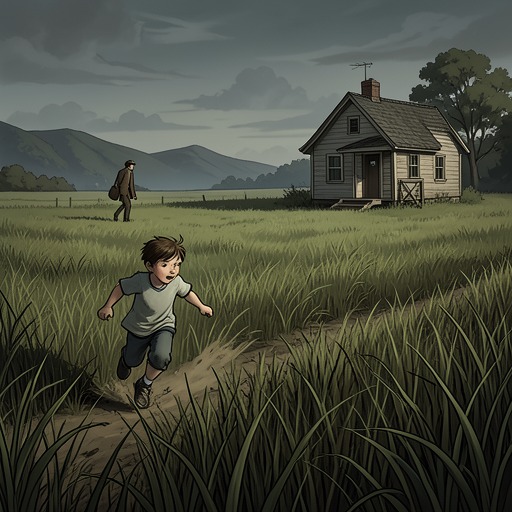
The Soil in Leitrim is Poor
The Greatest Beer Run Ever: A Memoir of Friendship, Loyalty, and WarThe Soil in Leitrim is Poor is the title and governing image of John McGahern’s memoir: a description of unpromising ground that becomes an account of how a place can endure, and how memory can preserve what family life tried to conceal. The land’s thinness is literal, but its significance is double. Poor soil limits what can grow; it also helped save the small fields and tangled boundaries from destruction. The memoir’s landscape and its recollections are joined by this paradox of vulnerability and survival.
The ground and its boundaries
The soil is sometimes no more than an inch deep. Beneath it lie daub, a blue-grey modelling clay, or compacted gravel, neither able to absorb the heavy rainfall. Rushes and wiry grasses nevertheless take hold, their roots helping keep the thin clay from washing away. The title makes this precarious surface the reader’s first measure of the place: not fertile farmland, but ground maintained through modest, persistent growth.
Between the lakes, small fields are enclosed by thick hedges, while narrow lanes wind beneath the Iron Mountains. Whitethorn, ash, blackthorn, alder, sally, rowan, wild cherry, green oak, and sycamore give the boundaries their substance and changing colour. Hawthorn blossoms in May and June; rowan berries catch the light from the lakes in September. The hedges shelter mice, insects, and small birds, and provide cover for sparrowhawks. In summer, woodbine and dog rose scent the evenings; foxglove, wild strawberry, primrose, fern, and vetch grow among the briars. The landscape is not simply a view behind human events: its plants, animals, paths, and seasonal rhythms have their own specific presence.
The book follows Otters along the lakeshore through traces rather than spectacle: beaten passes along banks and hedges, and quiet lawns speckled with fish bones and blue crayfish shells where an otter feeds and trains her young. Wild orchids and windflowers grow among rushes and wiry grasses; here and there, the thin-soiled country gives way to islands of rich green limestone. These details make a habitat legible through signs of use and life. The land’s apparent barrenness does not mean absence; it holds a dense, interdependent world.
A landscape that resists erasure
The title’s central reversal is that the soil’s very poorness helped preserve the fields. Elsewhere in Europe, old hedges and great trees were levelled for factory farming; in this country, the ground was too poor to invite the same transformation. The landscape’s survival is therefore neither a triumph of abundance nor an escape from change. It is an unintended consequence of limitation. A quality that makes cultivation difficult becomes a protection for the old pattern of fields, hedges, and lanes.
The lanes link houses scattered sparsely across the fields, branching and joining like streams before reaching a main road. Some pass beneath hedges so overgrown that the trees meet overhead, making a green tunnel punctured by points of light in summer. This network has no single commanding centre: it is made of small connections between homes and fields. Its persistence gives the memoir a spatial counterpart to recollection, which also moves among particular scenes and relationships rather than unfolding as a simple, unbroken account.
Memory, silence, and later knowledge
The memoir distinguishes childhood experience from what its narrator learned later. Its acknowledgments credit Rosaleen, Margaret, Monica, and Dympna with reading and correcting the manuscript, helping with letters, and bringing two important scenes back into view after they had slipped from memory. The act of remembering is thus presented as partly shared: family members help restore what one person’s recollection has lost. The book’s account of the past is not treated as a flawless record formed in childhood, but as a reconstruction shaped by documents and other people’s knowledge.
One early rupture was the absence of Susan McGahern. At seven, John McGahern and the other children did not know where their mother was or what had happened to her. Their father told them not to ask, directing them instead to pray. Susan McGahern wrote from the Mater Hospital in Dublin that Sean was beginning to understand more and would not be put off as easily as the others, and expressed hope that she would soon return. She had been diagnosed with breast cancer and remained in hospital for tests and treatment. Her brief return to the barracks for the birth of a baby girl brought a vague, delirious happiness that the adult narrator could barely recall; the sharp image he retained was of her carrying Dympna in a white shawl on the journey home. After about a week, she was gone again, and the children still did not know where she had gone.
A separate family separation became intelligible only many years later. Margaret and Monica had gone to Aughawillan School on the day the other children were taken from Corramahon. John McGahern later learned that Maggie had agreed to keep her godchild, Margaret, while their father insisted that the two girls must not be separated. When Susan McGahern died, the girls were at school; someone intercepted them before they reached home, and they stayed with the Bradys through the funeral without seeing the hearse pass. Afterward, their father demanded that Maggie take the two youngest children instead. When she refused the changed arrangement, he took Margaret and Monica from her, and all seven children were together again. The account’s delayed explanation shows how a child can live through an event without knowing its causes, and how later testimony alters the remembered scene.
Return and the meaning of endurance
John McGahern returned to live among these lanes thirty years before writing of them, beginning a life with his wife and hoping to make a living from the small fields while he wrote. The choice of place was not inevitable: they could have settled elsewhere, and his preference mattered less if his wife did not like the people or the landscape. His return connects the childhood country to an adult home, without suggesting that attachment erases difficulty or makes the land materially generous.
The memoir’s final reflection on his father likewise refuses an easy resolution. On learning of his father’s death, John McGahern was caught by grief, loss, and relief together. He could not say that he fully understood a man whose life had so rigorously shut out the past and who had made demands while giving little. Against that darkness, he remembered Susan McGahern’s faith and her love for the children as a hidden strength that helped them survive the worst years. The title’s poor ground therefore carries more than a local description: it gathers a memoir’s repeated attention to what is fragile, difficult to know, and nonetheless capable of lasting.