The writer’s vocation as an alternative vocation
The Greatest Beer Run Ever: A Memoir of Friendship, Loyalty, and WarThe writer’s vocation as an alternative vocation begins as a private possibility formed in solitude, then becomes a practical choice and, finally, a public life. For John McGahern, writing offered a way to imagine many lives without surrendering his independence to the priesthood he had once regarded as his destiny. The vocation did not arrive with a clear plan for becoming an author: it began as a dream whose power lay precisely in the freedom it gave him before he knew how to realize it.
The first imaginative opening
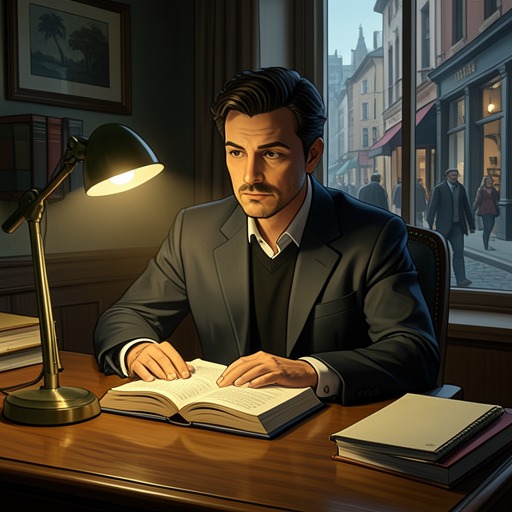
While John McGahern was the only one using The barrack boat, he would take it onto the river. If he did not fish, he rowed into an inlet among reeds and drowning leaves and read. Coming out of a book, he would return to the drone of flies, a fish splashing, saws working deep in Oakport Estate, and distant sounds from farms. Across those days and months, the idea gradually formed that a writer could create a priest, soldier, teacher, doctor, or airman more vividly than any single life could contain. Writing promised not one chosen identity but the imaginative possibility of inhabiting many lives.
The prospect was compelling before it was practical. John McGahern had no idea how books came into being, or how such a life might be achieved. That ignorance did not weaken the dream; it allowed it to remain open, a freedom rather than an obligation. At first, the idea was kept entirely to himself. Its secrecy marked the distance between the inward certainty of the dream and the knowledge that it would seem outrageous or laughable to other people.
An alternative to the priesthood
This new vocation took shape against an established religious ambition. As examinations approached, John McGahern knew he was likely to do well. A scholarship might take him to Maynooth even though he had not attended a diocesan seminary; he also expected that he could enter colleges serving the foreign missions. In his understanding at the time, ordination fixed a man in a lifelong vocation: wherever he was ordained, he would celebrate Mass throughout his life.
That prospect was bound to an intimate promise. He had promised his mother that he would say Mass for her, and becoming a priest had seemed a way to honor that promise while keeping death and judgment at bay. In retrospect, he recognized how his imagined priesthood made a kind of escape from death: it required, in his phrase, a death in life. The writer’s dream displaced that earlier ideal, but did not immediately dissolve its emotional claims. He wondered whether writing was itself an impossible dream, a newly dressed-up way of approaching the world. Even so, it served its first purpose: it set him free.
Teaching as the means to write
The eventual decision to train as a teacher joined practical security to a private ambition. When John McGahern received a call to the teachers’ training college, he accepted at once. The State paid for board and tuition and guaranteed employment, unusually valuable assurances when jobs were scarce. His father, Francis (Frank) McGahern, was relieved by the choice and spoke of his own responsibilities to the large family. John McGahern understood that financial help for university study might have been unavailable or offered so grudgingly that it could not be accepted.
He did not tell his father the real reason for choosing teaching. The profession offered short teaching hours, long holidays, and freedom from having to worry about money: the conditions he needed in order to write. He partly eased his guilt about turning away from the priesthood by thinking of teaching as his mother Susan McGahern’s profession, sometimes called the second priesthood. That explanation did not remove his confusion or the force of the promise to his mother, but it made the new path livable. The idea first formed in The barrack boat now seemed clear, even though he still had no notion how to bring it to completion.
The choice also belonged to a country marked by departure. In 1953, Ireland was in a decade in which half a million people emigrated, most of them to Britain; the emigrants were largely young, poorly educated, and ill prepared. John McGahern described his own cohort as a silent generation, disappearing without the public imprint of earlier waves of departure. The contrast gives his decision to build a writing life through teaching a particular setting: the dream was pursued amid scarcity, uncertain prospects, and the mass movement of people away from home.
Reading, work, and first publication
The private vocation matured through reading as well as writing. Among young people interested in books, writing, and ideas, the strictures imposed by Church and State could be privately laughed at. John McGahern’s reading changed from a search for stories to a search for books that acted as mirrors, reflecting aspects of his own life and the society that had formed him while retaining their differences and uniqueness. Reading thus became more than pleasure: it sharpened his sense of how individual lives could be both singular and patterned.
For a long time, nearly everything he wrote was discarded. Eventually enough survived to be shaped into a first novel. He showed it to Jimmy Swift, who liked it and sent it to his brother Patrick Swift in London. Patrick Swift was editing X with David Wright, and Wright published extracts in the spring of 1960. The prose attracted publishers’ attention. John McGahern regarded the speed of this early recognition as extraordinary luck: he knew little about the business or politics of literature and encountered few of the usual barriers of rejection.
Faber and Faber was among the publishers who approached him. By then, he believed the first novel was too flawed to show, but offered to write another. On the strength of its first chapter, the publisher gave him a contract for The Barracks and persuaded him to enter the manuscript for an important prize, which he won. The achievement brought the long-secret life of reading and writing into public view. His photograph appeared in newspapers, and Maggie, Jimmy, and Pat were delighted by the news and by the local interest it aroused. Some teachers looked at him and his teaching with suspicion, as though publication had made him no longer one of their number, though the routines of school soon reasserted themselves.
Memory, family, and the limits of resolution
The memoir’s account of becoming a writer sits within a larger act of remembering that is not presented as solitary or complete. John McGahern thanked his sisters Rosaleen, Margaret, Monica, and Dympna for reading and correcting the manuscript, helping with letters, and restoring two important scenes that had slipped his memory. The writing life therefore includes the work of others: family members help recover what the first-person narrator could not independently recall.
That dependence on recovered detail matters in a story where knowledge often arrives late. As a child, John McGahern was not told where his mother was while she was in Mater Hospital for tests and treatment after a breast-cancer diagnosis. Susan McGahern wrote that he was beginning to understand more and would not be put off as easily as the other children. He retained a sharp memory of travelling with his father to bring her and the new baby home, but only a vague, deliriously happy recollection of her brief return before she left again. Much later, he learned why Margaret and Monica had been kept at school on the day the other children were taken from Corramahon: his father had been arranging where the children would live, and someone intercepted the girls before they reached home. Such distinctions between remembered scenes and later understanding give the memoir’s vocation a documentary dimension without making memory seem complete.
Nor does writing finally settle the conflict that shaped the family. When news of Francis (Frank) McGahern’s death reached his son, grief, loss, and relief arrived together. John McGahern understood that his reaction concerned both the father who had died and the years of an unwanted, entangled relationship in which the father made demands, gave little, and needed to dominate. He still could not say that he fully understood him. The vocation that began as a way out of inherited ideals became a means of giving difficult lives form, but not of claiming to master every silence or explain every person. Its alternative lay in the act of seeing and shaping what had once been private, confused, or hidden.