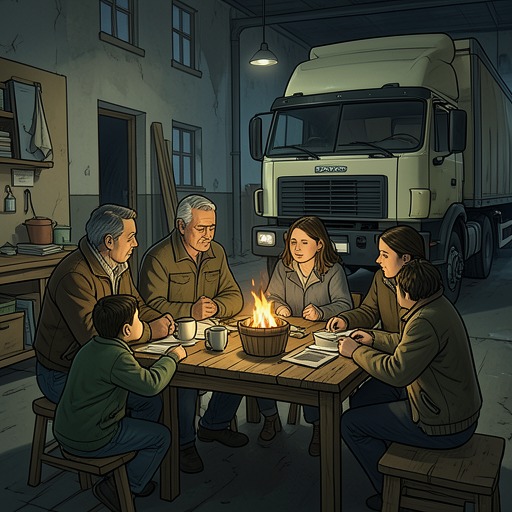
Wartime shortages in Ireland during World War II
The Greatest Beer Run Ever: A Memoir of Friendship, Loyalty, and WarWartime shortages in Ireland during World War II appear in the memoir not as a distant political backdrop but as constraints carried into journeys, farm work, and ordinary meals. With private cars off the roads and fuel scarce, travel depended on bicycles, a slow railway, and a horse and cart; local people also adapted machinery to turn timber into firewood. The effects were material, but they changed the texture of daily life as well: an exceptional car journey to bring Susan McGahern home from hospital, a train ride that could be slower than walking, and a white loaf shared in wonder all register the war’s presence in domestic memory.
Restrictions on Travel
All private cars had been taken off the roads because of the war. Francis (Frank) McGahern’s small Ford stood on blocks in a shed at the barracks, turning a vehicle that might otherwise have provided transport into an unusable possession. When Susan was brought back from the nursing home in Boyle with the newborn Dympna, the narrator travelled with his father in Packie McCabe’s car. The journey was memorable partly because it was unusual: Susan carried the baby in a white shawl, and the adults laughed that both baby and driver had red hair. The child did not understand the joke, but retained the scene of the trip home.
The restriction also shaped movement between Aughawillan and Ballinamore. On Saturdays, the narrator often went to town by train with Susan, setting out from the small stone station rather than walking up the hill past Mahon’s shop. The narrow-gauge line ran to Ballyconnell and Belturbet, connecting with the Dublin–Sligo main line at Dromod; a branch from Ballinamore served Drumshanbo and the Arigna coal mines. Yet the existence of a railway did not guarantee swift travel. Because of the war, trains ran on low-grade Arigna coal, and the four-mile walk along the sleepers to Ballinamore could sometimes have been faster than taking the train.
Fuel and Improvised Work
The railway’s slowness made its limitations part of the journey itself. On a steep incline, passengers sometimes had to climb down and walk to the top while the empty carriages slipped back down the track. The engine then waited for steam and tried the hill again. The delay was met without complaint: the narrator remembers muted clapping and a shovel waved in victory when the train finally reached the top. The route could still be a social outing rather than simply a means of transport. People gathered on the platform in their Sunday clothes, greeting one another; firemen lodging at Aunt Maggie’s waved their shovels from the engine. Scarcity slowed the journey, but did not empty it of company or occasion.
Fuel was also scarce and expensive in farm life. Uncle Pat bought an old lorry, stripped it down, and, with mechanic Billy Keegan, converted it into a travelling sawmill. A large circular saw sat on a steel platform above the chassis and was driven by the lorry’s heavy engine. Instead of bringing timber to a fixed mill, the machine could go to where trees were for sale and turn them into firewood at the edge of a wood. The arrangement answered a practical need with equipment already at hand: trees were felled with crosscut saws and levered onto the platform, since chainsaws were not yet in use.
The travelling mill worked for most of its short life among the plantations and small woods of Roscommon, including those around Rockingham Estate, Woodbrook, and Oakport Estate. Leitrim had few trees, while the larger estates offered timber that could be processed where it stood. Three large workmen, all members of the Ballinamore tug-of-war team, operated the saw. The narrator thought the idea may have been his father’s; Francis probably helped buy the trees and supervise the work, and the machinery fascinated him. The account preserves both the ingenuity of the conversion and its limits: the enterprise lasted only a short time, even as it moved from site to site.
The Farm and Household Calendar
Wartime restriction coexisted with the recurring work of the agricultural year. As the days turned golden, corn was reaped, tied into sheaves, and stooked; the turf had been brought home and stacked, while the digging and pitting of potatoes would begin soon. A tarred boat had been taken from the water and left upside down on lengths of timber beneath a sycamore. Nearby, Francis began erecting a windmill intended to bring electric light to the barracks. These details do not make every seasonal task a consequence of wartime shortage, but they show the household’s working environment: transport and fuel were constrained while farming, storing turf, and preparing for winter continued.
The restrictions could also be seen in the means of getting around the farm. At Aughawillan, Francis came by bicycle on a late, dry evening to confront Susan about spending and decisions made without his consent. The blue Ford remained on blocks in the barracks shed. He was usually remembered arriving at night by bicycle, the carbide lamp between the handlebars, his cape and pull-ups glittering with rain. The episode is principally a domestic confrontation, not a scene about fuel policy; nevertheless, the parked car and the bicycle make the wartime limit visible within the family’s ordinary movements.
Scarcity Eases
As the distant war in Europe drew to a close, rationing began to ease, and a loaf of white bread made that change concrete. On a day Susan was absent, the narrator received one at Mahon’s shop. Only half a dozen had arrived by train, and Mrs Mahon had kept one for Susan. The child had not seen white bread for years; he carried the loaf home excitedly, showed it to Katie, and took it upstairs to his mother. That evening, everyone received a slice, eating it in wonder.
By then the narrator was doing more of the household’s errands. Susan no longer travelled to town by train, and he bought the provisions the house needed, using her list when he had difficulty in the shops. The small rationed loaf belongs to the same world as the grounded Ford, the coal-fired train, and the converted lorry, but it marks a change in direction: restrictions were beginning to lift. The memoir measures that change through an everyday object, not an announcement. Scarcity becomes legible in what had been missing for years, and relief arrives as a loaf carried home and divided among the family.