Clancy farm shack confrontation
The GuiltyThe Clancy farm shack confrontation is the turning point in Will Robie and Jessica Reel’s investigation: a search for a suspected serial killer becomes an ambush that leaves Reel unconscious and reveals Victoria as an armed opponent. The scene’s danger is prepared by a pattern of killings whose similarities suggest a connection to the Cantrell murders, even as important differences complicate that theory.
Background and the Linked Killings
The shack is approached in the course of an investigation that Reel initially described as a casino inquiry, but then clarified was tied to her assignment to the Violent Criminal Apprehension Program. Robie recognized that the program dealt, among other matters, with serial killers, and asked whether she had come to Cantrell to hunt one. Reel connected the investigation to Sherman Clancy and Janet Chisum, while explaining that eight other killings across four states over nine years shared a recurring pattern.The victims had been killed roughly in pairs: an older man who paid a younger girl for sex, followed by the man’s death from a slit throat in his car and the girl’s death from a bullet to the head. Her body was then discarded in water. The paired circumstances made the Cantrell cases appear linked to the earlier crimes, but did not settle how closely the killings followed the same sequence. In the Arkansas cases, four years before the conversation, the interval between killings was unusually long; Reel calculated that the other cases were spaced roughly eighteen months apart and suggested the four-year gap might matter. She also asked whether the earlier cases had a long delay between the girl’s murder and the older man’s. Wurtzburger said those intervals had not been as long as in the Cantrell case, preserving a significant difference within the apparent pattern.
Entry and Ambush
At the shack door, Jessica Reel checked the structure’s only entrance and exit, ruling out a back door. Will Robie answered her signal with a countdown, lowering three fingers one by one. When the last finger dropped, Reel kicked the door open and sprang inside; Robie followed, and they began sweeping the room. The entry is presented as a controlled team action, but its careful timing cannot protect them from what is waiting within.
Their sweep stops at the sight of Tyler sitting in a chair in the middle of the room. Robie freezes. The child recalls to him another image of a boy reaching for his father, a memory that arrives involuntarily and strikes him with the force of a physical blow. Reel calls out to bring him back to the immediate danger, but his momentary paralysis has already left an opening.
A shot rings out. A grunt and gasp follow, then a body falls. When a light comes on, Robie sees Reel lying unconscious and bleeding on the floor. The scene’s tactical balance has reversed: the agents entered expecting to search the shack, but Robie is now disoriented and Reel is incapacitated, leaving him exposed to whoever has taken control of the room.
Victoria’s Reveal and the Reversed Trap
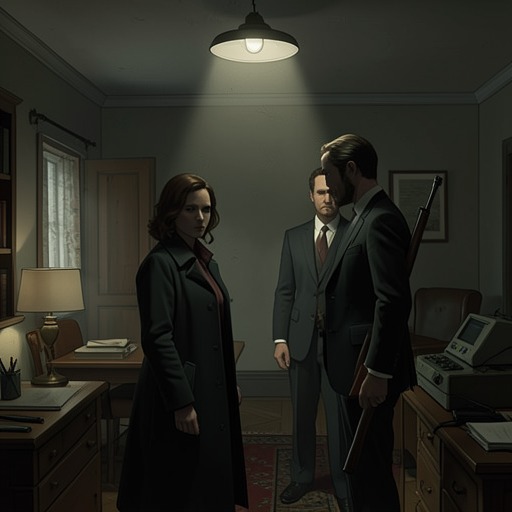
The figure in the corner is not Henry Barksdale but Victoria, holding a gun. A battery-operated camping lantern illuminates her as she steps forward with a tight smile and demonstrates how completely she has anticipated Robie: she knows he carries a second weapon at the small of his back. When he hesitates, she points her gun at Reel and threatens to kill her. Robie puts down both weapons and kicks them toward Victoria; she then orders him to do the same with his partner’s. The investigators who entered the shack to find a suspect have become disarmed captives, while Tyler remains seated in the middle of the room.
Victoria explains that she knew the agents suspected her father and had discovered the shack because they had kept her informed about the investigation. She had also prepared a fallback: if Robie and Reel did not come, she would return beaten and disheveled with Tyler, claim she had been kidnapped and assaulted, and rely on his inability to speak to prevent him from contradicting her. She says she would have killed the agents another time. Her plan makes the shack more than the site of a sudden ambush: it is the point where their investigation, which she has monitored and manipulated, closes around them instead.
Asked whether she killed the other people being investigated by the FBI, Victoria confirms that she did. She describes the killings as practice and says she considered killing older men who paid for sex and young women who were stupid and greedy to be time well spent. She accounts for the four-year gap before the Cantrell murders by explaining that she met Robie’s father, married him, became pregnant, and had Tyler. The recurring pattern that first linked the cases therefore concealed a change in Victoria’s circumstances, not a change in her responsibility. Robie names what her justifications cannot erase: she committed murder.
Narrative Significance
The confrontation fuses the local inquiry into the Cantrell murders with the FBI’s wider investigation, turning a pattern of linked killings into a direct encounter with the person behind them. Its decisive reversal is not simply that Victoria is present, but that she has watched the investigation closely enough to prepare both an ambush and a fallback account. The shack thus becomes the point where Robie and Reel’s investigative advantage collapses: the evidence has led them to the truth, but not to control of the scene.