Collateral damage
The Guilty“Collateral damage” is the official label assigned to the death of a little girl killed by Will Robie during a mission abroad. In the message he receives, her identity is compressed into a clipped report: “UNCLEAR. HIS DAUGHTER. CLASSIFIED AS COLLATERAL DAMAGE.” For Robie, the phrase does not contain or resolve what happened. It turns a child’s death into a category, while leaving him alone with the knowledge that his own shot killed her.
Classification and Euphemism
The label arrives after Robie has learned that a maid carried out her role and escaped, and that the people communicating with him are trying to put a positive spin on the operation. He asks what happened to the girl; the answer identifies her as the target’s daughter but classifies her death as collateral damage. The response gives him information, but its bureaucratic form also presents the death as something that can be named, filed, and moved past.
Robie immediately recognizes that the classification is being used to soften the event. He is poised to send an angry reply, then puts the phone away and leans against the plane’s inner wall. His silence is not acceptance. The term’s official authority collides with his own insistence that the girl was a person who died because of him, not merely an incidental cost attached to a completed operation.
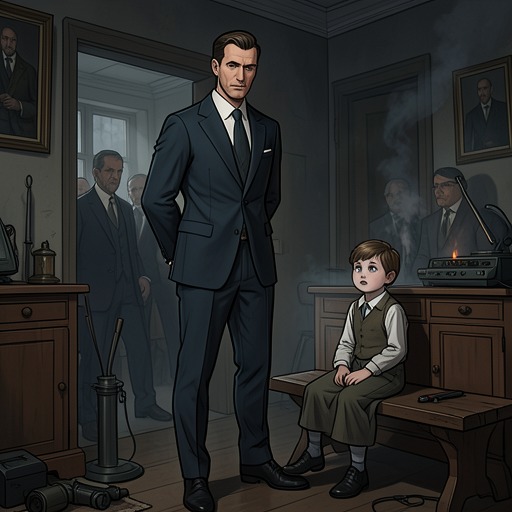
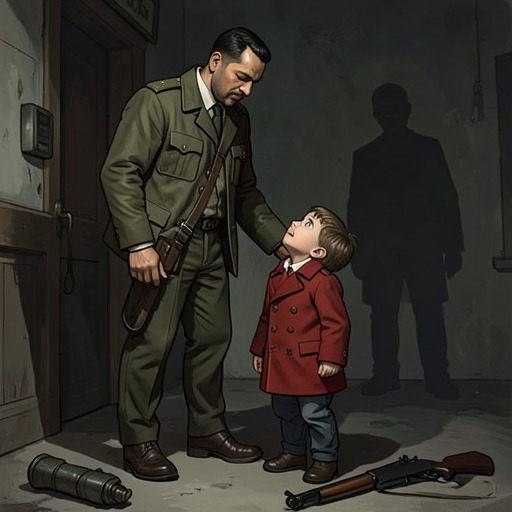
The phrase’s force lies in this contrast. The message is brief and impersonal; Robie’s memory is painfully particular. He sees the little girl’s curly dark hair and remembers that she looked surprised as she died, running toward her father at the moment he was killed. The classification reduces the event to a result, but his recollection restores its immediate human circumstances. Nothing, he knows, can bring her back.
The Mission’s Aftermath
Robie’s reaction makes clear that the label cannot function for him as absolution. He recalls that he once came close to killing a child but did not pull the trigger, an incident that nearly cost him his career and his life. This time, he did fire. The distinction between the earlier near-miss and the present death gives his guilt its particular severity: the feared outcome is no longer hypothetical, and a child has actually been killed.
His body registers the crisis before he can master it. As the jet hits rough air, he bends over and vomits, though he understands that the turbulence is not the cause. He hunches forward, thinks of the girl, and looks at the callused finger trained to pull the trigger. The man accustomed to remaining unflappable is coming apart. Against this physical and moral reckoning, the classification offers no comfort: it can describe the operational status of the death without changing his responsibility for it.
Robie imagines the official record as a form filed away somewhere, with a line noting that on that day in a foreign land he shot the target and the target’s daughter. The image makes the distance between institutional record and personal knowledge stark. A form can preserve that two people died; it cannot preserve what the child’s face means to him or make the account feel complete. The operation is over, but the phrase marks no equivalent ending for the person who fired the shot.
From Official Account to Self-Accusation
The language of collateral damage recurs as Robie’s crisis develops. Later, standing halfway across the Arlington Memorial Bridge and looking down at the Potomac, he recognizes that during another mission he saw a child where there was no child. He had hallucinated, and the expected cold zero never came. The face in the water brings him back to Sasha: he had taken her image and changed her gender, moved her far away, and supplied her with another father, giving himself a reason not to shoot.
This recognition deepens the earlier wound without erasing the difference between the two missions. In one, Robie killed a child; in another, he perceived a child who was not there and failed to act as he expected of himself. His mind’s substitution offers neither a reliable safeguard nor a stable explanation. He realizes that he can no longer be entirely sure of his own perceptions, or fully rely on himself. The official label addresses the first death from the outside; it cannot account for the inner collapse that follows.
When Robie later tells his father about his recent work, he describes both failures in plain terms: he killed someone he should not have, then saw a boy and an old man who were only in his head. The disclosure shows how far the incident has travelled beyond the mission report. What began as an official classification has become part of a difficult personal confession, joined to the hallucination that has unsettled his confidence in his work.
Narrative and Moral Significance
The expression operates simultaneously as a factual classification and a contested moral description. The girl is indeed an unintended death in the mission’s outcome, but Robie refuses to let the category stand in for the person or settle the question of responsibility. The tension is not that the official phrase denies that she died; it is that its concise, administrative wording cannot carry the weight of what he remembers and believes he did.
The episode also establishes a contrast between procedural completion and human consequence. Robie’s trigger pull is done, and the operation has ended; the official response can be recorded and the next assignment anticipated. Yet he cannot simply move on as if no one had died. His imagined file and the recurring face expose the limits of institutional language: a label can organize an account of violence, but it cannot make that account morally sufficient for the person who remembers the victim.
As the story returns to the death through Robie’s later recognition and his strained conversation with his father, “collateral damage” becomes a point of pressure between public explanation and private responsibility. The term names how the institution classifies the girl; Robie’s persistent self-accusation refuses to let the classification become the last word.