Cycle of abuse
The GuiltyThe Cycle of abuse is presented through two contrasting accounts of fathers and sons: Will Robie’s childhood under a violent, demeaning father, and Billy Faulconer’s decision not to treat Little Bill as his own father treated him. Together, their stories make abuse both an inherited pattern and a pattern that can be interrupted. They also distinguish physical injury from the deeper damage of humiliation, emotional withdrawal, and family separation.
Two inherited histories
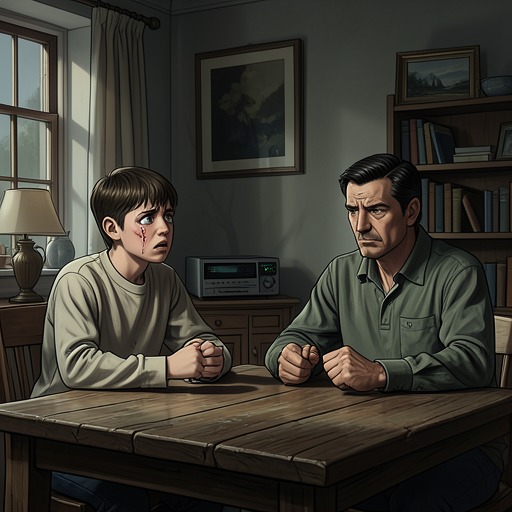
Billy describes violence as something passed from one generation to the next, but not as something that must be repeated unchanged. He tells Will Robie that his own father beat him, then names the acts he deliberately did not carry forward: he never punched Little Bill, struck him with a switch or tree branch, or broke a beer bottle over his head. The concrete list makes Billy’s childhood abuse severe and specific; it also gives substance to the limit he says he set for himself as a parent.
Billy does not claim that he never struck his son. He says he swatted Little Bill on the backside a couple of times when the boy was small. That qualification matters: Billy’s account is not a declaration of perfect or violence-free parenting, but a comparison between what he did and the more brutal treatment he remembers receiving. He says he had told himself he would never do to his children what his father had done to him. The cycle is therefore represented not as a simple repetition in which every abused child becomes an identical abuser, but as a legacy that can be confronted through deliberate limits.
Billy also places his experience in a social frame when he says that many fathers beat their children. His remark treats such violence as familiar, even ordinary, without making it harmless. Will Robie answers that children already have enough to deal with without being beaten by someone who is supposed to love them. Their exchange sets Billy’s learned sense of what is common against Will’s insistence on the contradiction at its heart: abuse comes from a person whose role should entail care.
Will Robie’s childhood and its aftermath
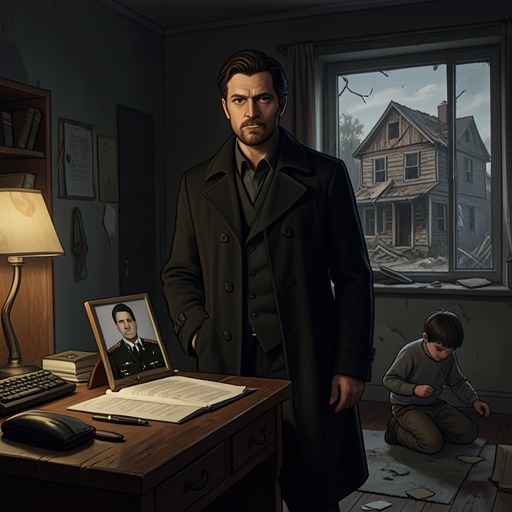
When Jessica Reel asks what began the conflict between Will Robie and his father, Will describes not one defining incident but years of them. His father had returned from the Vietnam War and, in Will’s account, was exceptionally tough, unwilling either to ask for or give quarter. Will says that his father beat him for the slightest thing. The pattern is described as repeated household experience, not a single blow that can be isolated from the rest of their relationship.
Will identifies verbal degradation as the part that hurt most. His father made him feel worthless and convinced him that he would never amount to anything. Will says that nothing he did to please his father was ever good enough. Physical punishment and belittling thus work together in his account: the beatings are explicit, but the words shape how he understands himself and whether trying to win his father’s approval is worthwhile.
Eventually, Will says, he stopped caring. He felt nothing toward his father and no longer regarded him as a father, but as someone he had to live with until he was old enough to leave. His account links the abuse to emotional estrangement and to his desire to get out of Cantrell. It does not suggest that leaving erased the history; rather, the conversation with Jessica Reel brings that history into view years later, when he is asked to explain the break between them.
The mother’s departure and unresolved blame
Will’s mother is central to his account of what made life in the household bearable. He says she loved him, while hating his father more, and that she was the only thing that made life in Cantrell tolerable. After she left, Will says, that source of comfort was gone. The sequence connects the father’s conduct not only to a damaged father-son relationship but also, in Will’s telling, to the loss of his mother’s presence.
Asked whether he feels that she abandoned him, Will immediately rejects the description. He insists that his father caused her departure and, when Jessica Reel presses him on it, repeats that she left because his father made her. The exchange exposes a distinction between the observable fact of her leaving and Will’s certainty about why she left. Reel asks whether he knows that explanation for a fact; Will does not answer the question directly. Instead, he sits up and turns the conversation toward the investigation, naming the need to speak to Sara Chisum, find Pete Clancy, and identify the man in a photograph.
That redirection leaves the family history partly unresolved rather than settling it through an explanation. Will’s certainty that his father was responsible coexists with the unanswered question Reel raises. His abrupt return to practical tasks also shows how quickly a conversation about childhood can give way to the urgent work in front of him; it does not establish that the old conflict has been resolved.
Interruption, not erasure
Billy’s story offers a counterpoint to Will’s without making the two childhoods interchangeable. Both men describe fathers who beat their sons, but Billy focuses on what he chose not to do to Little Bill, while Will describes the harm he suffered and its effect on his attachment to his father. The contrast gives the idea of breaking a cycle a precise scale: Billy identifies particular acts he refused to repeat, rather than claiming to have undone the past or repaired every consequence of it.
The moment is also a conversation between old friends, not an abstract lesson. Billy asks Will what made him leave, and Will’s account answers with years of violence, words that diminished him, and the departure of the mother he loved. Billy’s disclosure that his own father beat him establishes a point of recognition between them. Will responds by affirming that a child should not have to endure abuse from someone meant to love him. Their exchange makes room for both shared experience and difference: Billy describes a boundary he set in his own parenting, whereas Will describes the lasting estrangement produced by his father’s treatment.
The concept’s force lies in that distinction. Inherited abuse may shape what a parent considers normal, as Billy’s reference to many fathers suggests, but it does not dictate an exact repetition. His refusal to use his father’s most brutal methods marks a break in the pattern, even as the limited account of his parenting does not support claims that all violence disappeared. Will’s story, meanwhile, shows why stopping particular acts matters: the damage in his account extends beyond the blows to worthlessness, emotional withdrawal, and a family divided by departure. The two accounts therefore hold together the possibility of interruption and the persistence of harm.