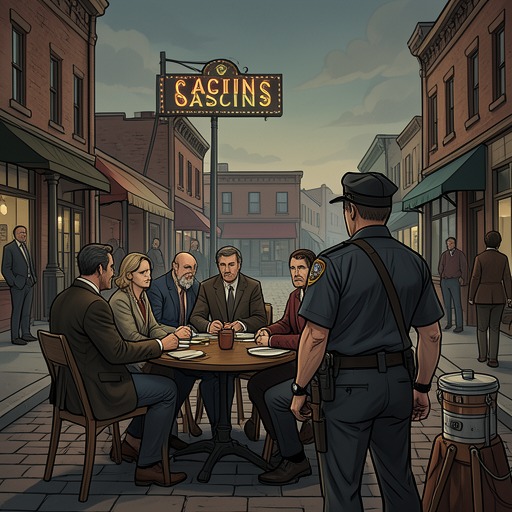
Dan Robie's Prosecution for Sherman Clancy's Murder
The GuiltyDan Robie’s prosecution for Sherman Clancy’s murder unfolds amid a widening investigation into killings across several states. The central dispute is whether Dan alone could account for the crimes or whether Clancy’s death and the murders of the Chisum sisters belong to a larger pattern.
The Multistate Pattern
The investigation’s broader frame emerged when Jessica Reel disclosed that she was assigned to the Violent Criminal Apprehension Program, whose work included serial-killer cases. Will Robie asked whether she had come to Cantrell hunting a serial killer; she confirmed that this was a fair description of the investigation and identified Sherman Clancy and Janet Chisum as its local connection. The FBI was examining eight other killings in four states over nine years, organized roughly in pairs: an older man who had paid a younger woman for sex was found with his throat slit in his car, while the woman was shot in the head and left in a body of water.
The Case Against Dan Robie
The pattern offered a way to test the accusation against Dan Robie, but it also exposed a difference between the earlier cases and the Cantrell murders. In the other linked pairs, the younger woman and older man had been sexually involved for payment, and the interval between their deaths was shorter. In Cantrell, the killings were farther apart. Jessica Reel calculated that the other cases had occurred roughly eighteen months apart, while the Arkansas murders were four years before the investigation; she considered that longer gap potentially significant rather than proof that the cases were unrelated. The pattern therefore supplied both a connection and a question: whether the shared victim profile and methods outweighed the unusual delay.
That uncertainty shaped the argument over Dan’s prosecution. At a meeting about the case, defense attorney Toni Moses pressed Aubrey Davis on whether he genuinely wanted the real killer found. Davis affirmed that he did, but maintained that Dan remained charged with murder and was the only credible suspect. Will Robie answered with the accumulating body count and the fact that the attacks had nearly killed him and Reel. He was convinced that Sherman Clancy’s murder and the murders of Janet Chisum and Sara Chisum had been committed by the same person. If the crimes were linked, Moses pointed out, Dan could not have killed Sara: he was in prison when she died.
Davis did not accept the linkage as established. For him, Dan’s exclusion depended on the premise that one person had committed all the murders, and he treated that premise as a substantial uncertainty. The prosecution thus remained active even as the serial-murder theory threatened to overturn its central case. The competing positions were not simply guilt against innocence: they turned on whether similarities across cases could support a single perpetrator strongly enough to displace the local suspect.
The immediate legal turn came when Moses told Will and Reel that the judge had set bail for Dan and that he had paid it. Dan was expected to leave the jail in about twenty minutes. Will and Reel waited across the street; when Sheila Taggert emerged from the jail, Dan followed in the chino pants, white shirt, and loafers he had apparently worn at his arrest. Will began to get out of the car, but Victoria Robie arrived first, leapt from her Volvo, hurried to Dan, and wrapped her arms around him. Reel read the embrace as a sign that guilt was not Will’s alone to feel. The release did not resolve the charge, but it changed Dan’s immediate circumstances from detention to reunion with his wife.
By the time Will and Reel reached The Willows, Victoria’s Volvo stood outside. Priscilla met them in the foyer with Tyler in tow, placing Dan’s return within the household even as the murder investigation remained unsettled. The sequence leaves the legal and familial consequences side by side: Dan is out on bail, yet still accused; his family can receive him, while the theory that might clear him remains contested.
The Confession That Reframed the Case
The prosecution’s central uncertainty is resolved only later, when Victoria Robie explains how she anticipated Will Robie and Jessica Reel’s investigation. She knew they suspected her father and had discovered the shack, and she had kept informed about their inquiry. If they had not appeared there, she planned to return battered and disheveled with Tyler Robie, present a credible story of kidnapping and assault, and rely on his inability to speak to prevent him from contradicting her. Her account turns the family reunion outside the jail into a bitter contrast: the wife who embraced Dan after his release was concealing a calculated effort to manipulate the investigation and kill Will and Jessica.
Asked whether she had committed the other murders under FBI investigation, Victoria acknowledged that she had. She described the older men and younger women in the paired killings as people she considered fit to be removed from the world, revealing a motive rooted in her own condemnation of them rather than an effort to clear Dan through the courts. The confession makes the FBI’s pattern more than a persuasive theory: the recurring victims and methods point back to Victoria, while Dan’s prosecution had placed suspicion on the wrong person.
Victoria also accounted for the interval that had complicated the linkage. After the Arkansas killings, she met Dan, married him, and became pregnant with Tyler; she said those events took time. The four-year gap Reel had identified as potentially significant therefore marks a period of change in Victoria’s life, not a break in the sequence of killings. In retrospect, the prosecution’s unresolved question—whether the Cantrell murders belonged to the same pattern—becomes the key to recognizing the crime behind Dan’s charge and the danger concealed within his household.
What the Prosecution Leaves Unresolved
The revelation of Victoria Robie’s guilt settles the reader’s question of who committed the linked murders, but the available account does not establish that Dan Robie’s charge was formally dismissed or that he was cleared in court. That distinction matters: the prosecution’s case had been challenged through a theory of shared authorship, while the confession supplies the decisive answer beyond the competing inferences debated by Toni Moses and Aubrey Davis. Dan’s release on bail changed his custody, not the charge itself; the narrative resolves the hidden identity of the killer without documenting the legal conclusion of Dan’s case.