Dan Robie’s PTSD
The GuiltyDan Robie’s PTSD is not presented as a diagnosis made during his life, but as a retrospective explanation for how war altered him and helped transmit violence through his family. The account links his father Adam Robie’s untreated trauma after World War II to Dan’s childhood, and Dan’s own Vietnam-era experience to the abuse he inflicted on Will. Its significance lies in Dan’s recognition that understanding this inheritance does not erase his responsibility for repeating it.
Adam Robie’s War and Its Aftermath
Dan describes his father as a decorated Marine who fought across the Pacific, including at Guadalcanal, Kwajalein, Guam, Iwo Jima, and Okinawa. Adam’s company suffered a seventy-percent mortality rate, and he received nearly every medal awarded to combatants. Yet after returning home, he put the medals in a box and rarely spoke about the war. Dan says Adam had once been a farm boy from Arkansas who hoped to play baseball for the St. Louis Cardinals and marry his childhood sweetheart. Neither future came to pass: she had married someone else, and Adam married another woman before Dan was born.
In Dan’s account, the silence surrounding Adam’s wartime experience reflects the era’s failure to recognize or address its psychological effects. The term PTSD was not used for World War II veterans, Dan says, and soldiers were expected to resume civilian life as if the war had not happened. He later understood that Adam’s combat experiences had changed him permanently. Adam seemed to treat Dan as an enemy, attacking him with his fists and words; he also played cruel mind games and once called his son by a Japanese name, as if reliving the war. Dan left at seventeen, describing his departure not as a confident break but as a retreat from a father who could still hurt him.
From Inherited Violence to Fatherhood
Dan recalls that he wanted to prove a person could fight in a war and return home without becoming what Adam had become. His own return from the Vietnam War offered no simple contrast: veterans came back not to welcoming parades but to hatred, disgust, or indifference. Dan ultimately concludes that war changes those who fight it, including himself and his father.
He connects that history to his treatment of Will. When he yelled at or roughed up his son, Dan could picture Adam doing the same to him. He had told himself he would never abuse his own child, yet another part of him repeated the behavior he had suffered. Dan insists that Adam’s treatment of him was worse, but he does not present that comparison as a justification. He calls himself weak for becoming the kind of father he had resolved not to be, and recognizes that most veterans do not treat their children as he and Adam did.
The account places Dan’s conduct beside a different response to inherited abuse. Billy tells Will that his own father beat him, but that he chose not to strike his son with a fist or a branch or break a bottle over his head. This contrast does not define Dan’s PTSD, but it makes clear that suffering in one generation does not inevitably dictate what a parent does to the next.
Disclosure and Consequences
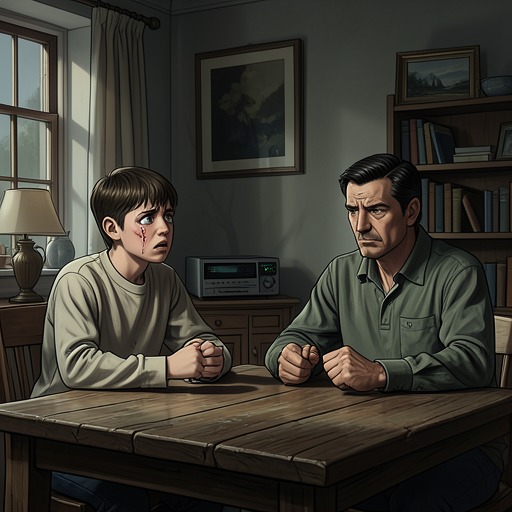
Dan’s explanation emerges in a conversation with Will and Jessica Reel. It gives context to the estrangement between father and son, but it does not undo the harm Will experienced. Dan’s hands tremble as he speaks, and he falters while naming the conflict between the promise he made to himself and the violence he repeated. The scene makes disclosure an act of accountability as well as remembrance: Dan identifies the pattern and admits his part in carrying it forward.
The family history also resonates with Will’s own crisis after a mission in which he killed a little girl. He condemns himself for the death, recalls an earlier moment when he had come close to killing a child but did not fire, and wonders whether the loss of trust in his own judgment means he must leave his work. Later, he tells Dan that on a recent mission he killed someone he should not have and, on another, saw a child and father who were not there. These events are Will’s, not Dan’s symptoms; their connection is the story’s larger concern with the lasting psychological costs of violence and with what a parent’s history can mean for a child.
Meaning and Limits of the Diagnosis
Dan’s account names PTSD as the term that would now be applied to Adam’s condition, and he accepts that the war changed his father. It also presents Dan’s own military experience as part of the history through which he understands his conduct toward Will. The narrative does not offer a clinical assessment of Dan, nor does it reduce his abusive behavior to a diagnosis. Instead, it holds two facts together: wartime trauma and silence help explain the family’s history, while Dan remains responsible for having repeated violence against his son.
The explanation therefore complicates, rather than absolves, the inheritance of abuse. Adam’s suffering was largely unnamed; Dan can finally describe the pattern, but recognition arrives after it has shaped his relationship with Will. By making the account part of their conversation, the story turns previously hidden family history into something the next generation can witness—and potentially refuse to repeat.