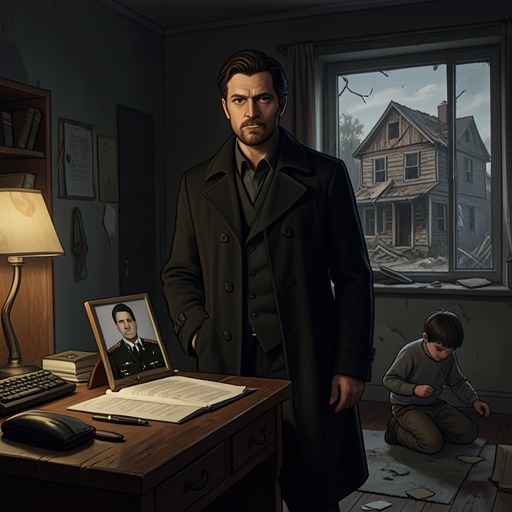
Daniel Robie
The GuiltyDaniel Robie’s arrest for the murder of Sherman Clancy transforms Will Robie’s distant family history into an immediate criminal case. A judge in Cantrell and the father Will has been away from for years, Daniel is both the person accused of killing Clancy and a figure whose position gives the accusation local weight; the investigation eventually places the case beside a pattern of killings elsewhere.
Identity and Background
When Blue Man tells Will that his father has been arrested for murder, the news initially arrives without much explanation. Clancy is dead, he knew Daniel, and evidence points to Daniel as the killer. The sparse facts make the accusation a rupture before they make it a comprehensible case: Will can focus only on the fact that the man under arrest is his father.
Daniel’s rise in Cantrell gives the charge a history Will did not know. When Will left, his father had a small law practice whose fees were often paid in barter and which barely kept a roof over the family. Little Bill Faulconer tells him that Daniel has been a judge for about ten years, a transformation that marks how much the town and Daniel’s standing in it have changed during Will’s absence.
At the proceeding, Daniel appears in an orange prison jumpsuit, shackled at the waist, hands, and feet. His white hair is neatly combed, his chin shaved, and his posture remains bolt upright as he is escorted to the counsel table. Once unshackled, he sits alone, his large, veined hands balled into fists on the worn wood. The contrast between the imposing judge Will remembers as a public authority and the prisoner sitting across from prosecutor Aubrey Davis makes his changed status visible without erasing his presence.
The Charge in a Wider Pattern
Daniel’s case becomes part of a broader inquiry when Wurtzburger explains that he is assigned to the Violent Criminal Apprehension Program, whose work includes serial killings. The investigation is not simply a review of the death of Sherman Clancy: Wurtzburger connects Clancy’s murder and the killing of Janet Chisum to eight other deaths in four states over nine years. The disclosure widens the frame around Daniel’s arrest, placing a local accusation within a pattern investigators are trying to test.
In the other cases, the victims were killed roughly in pairs and shared a recurring backstory: an older man paid a younger woman for sex; the man was later found with his throat slit in his car, while the woman had been shot in the head and thrown into a body of water. The repeated pairing and methods give investigators grounds to compare the cases, but do not by themselves establish that every pair is connected in the same way.
The chronology complicates the apparent pattern. The Arkansas murders occurred four years before the Cantrell killings, whereas Jessica Reel calculates that the other cases had been spaced roughly eighteen months apart. She identifies the four-year interval as potentially significant and asks whether earlier cases also had a long delay between the woman’s murder and the older man’s. Wurtzburger says they did not. That difference makes the gap between the deaths of Janet and Clancy a point of uncertainty rather than a simple match.
Daniel’s possible motive is likewise uneven across the two Cantrell deaths. Will Robie acknowledges that his father had a motive to kill Sherman Clancy, but Wurtzburger counters that Daniel had no motive to kill Janet. Reel further probes whether the older men and younger women in the other cases were sexually connected and whether payment was involved. These questions keep the investigation from treating resemblance as proof: the case against Daniel concerns Clancy, while the broader series and the distinct circumstances of Janet’s death complicate any single explanation.
Daniel Robie in the Killer’s Account
The investigation’s wider pattern eventually becomes personal in a way the case against Daniel alone had not shown. When Will asks whether the person confronting him killed the other people the FBI had been investigating, she admits that she did. Her explanation makes the recurring victim pattern part of her own justification: she regarded the older men and younger women as people the world was better off without. The admission identifies a killer behind the other deaths, but it does not establish that Daniel knew of or took part in them.
The killer also gives the four-year interval between the Arkansas murders and the Cantrell case a biographical explanation. During that span, she says, she met Daniel, married him, became pregnant, and had Tyler Robie. Daniel thus enters her account as a decisive point in the chronology of the killings: family life occupies the gap that had seemed anomalous to the investigators. The disclosure links his private history to the series without resolving what he understood about her crimes or how the murder of Sherman Clancy fits into her account.
This shift in perspective changes the meaning of Daniel’s arrest without clearing him of the accusation against him. The inquiry that had begun with evidence pointing to a judge who knew the dead man opens onto a killer who describes multiple murders and folds Daniel’s marriage and the birth of their child into her explanation of the timing. Daniel remains the subject of a separate charge concerning Sherman Clancy; the killer’s confession supplies a broader context, not a verdict on that case.
The Family as Cover and the Limits of the Record
At the shack, the killer explains that she had followed the investigation closely: Will Robie and his partner had kept her informed, and discreet inquiries had told her that they suspected Daniel Robie and had found the place. She had prepared a fallback in case they did not appear. She planned to return battered and disheveled with Tyler Robie, claim that she had been kidnapped and assaulted, and rely on Tyler’s inability to speak to prevent him from contradicting her. The plan makes the family’s circumstances part of her practical cover: a child who could not dispute a story becomes, in her calculation, a witness she could control.
That account sharpens Daniel’s place in the plot without establishing his knowledge of the crimes. He is the killer’s husband and Tyler’s father, and their marriage and child explain the interval she had described; the evidence does not show that he knew she was using their family as cover or that he participated in her murders. His arrest remains tied to Sherman Clancy’s death, while her account exposes a separate pattern of killings and the deception she was prepared to use to protect herself. The distinction leaves Daniel at the center of two entangled histories without making them the same case.