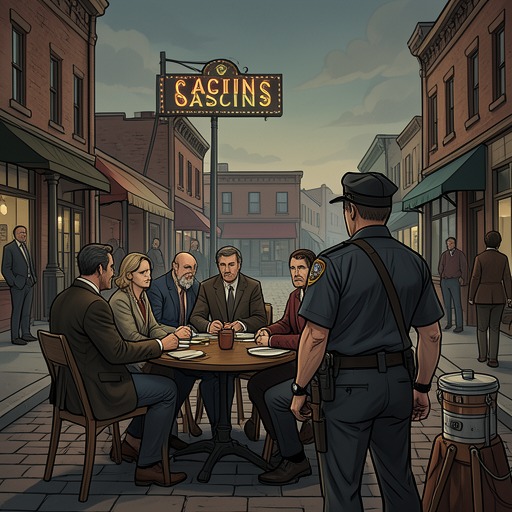
Nelson Wendell
The GuiltyNelson Wendell’s importance lies in the distance between his public stature as a powerful energy executive and the abuse concealed behind a secluded shack. His role emerges through photographs and testimony: he was among the wealthy men whose connections to the exploitation of children tied local families, property, and money into a buried history of harm.
Identity and Exposure
Wendell had chaired Coastal Energy and was described as one of the richest men in Mississippi, perhaps in the entire South. That status makes the discovery of the photographs more than a private family scandal: the images connect a figure of regional economic power to children brought to an isolated shack on Sherman Clancy’s property. Under pressure, Pete Clancy identified Wendell as the man pictured with the children and said his father had a deal with the person who took the photographs. The account places Wendell at the center of the arrangement, while leaving the precise terms of that deal unstated.
The photographs reached Wendell’s son only after Wendell had died. His son said that seeing them made him want to vomit and to kill his father, but also explained that Wendell’s death had occurred on an operating table during surgery for an aortic aneurysm; no autopsy was performed. That sequence separates the exposure of the abuse from any possibility of a criminal reckoning with Wendell himself. Cassandra’s account adds that Sherman Clancy was well paid for his services and began blackmailing Wendell some years after the arrangement began. She learned of the blackmail when Clancy told her who was buying the farm: Coastal Energy, the company Wendell had chaired.
The Shack and Its Afterlife
Pete’s account linked Nelson Wendell to the secluded shack behind Sherman Clancy’s property: Clancy had made a deal with the man who took the photographs and let him bring children there. Years later, Victoria revealed the arrangement’s grim physical aftermath. She had buried her father beneath that same shack, identifying it as the place where he had brought children to be abused by Wendell. The location thus held both the concealed history of exploitation and the body of a man who had profited from it.
Victoria said she learned of her father’s conduct only after the fact, describing him as someone who made money from other people’s misery. Her confession does not establish that Wendell faced any consequences; instead, it shows how the abuse and its profits remained entangled in the Clancy family’s history, while Wendell’s death had already foreclosed a reckoning with him.
A Posthumous Figure
Wendell enters the account through other people’s evidence rather than through a scene of his own: Pete identifies the man in a photograph, Cassandra recounts the later blackmail, and Victoria supplies the history of the shack. These separate disclosures make his identity emerge piece by piece, first as a name attached to an image, then as a wealthy executive, and finally as a participant in a concealed system of abuse and payment. The form matters: Wendell is already dead when the photographs reach his son, so no direct confrontation or testimony can complete the picture. What remains is a portrait built from the people and places his conduct implicated, with gaps in the record marking the limits of any reckoning.
The Limits of the Testimony
Pete’s identification came during an armed interrogation: Will Robie held a suppressed pistol to his forehead and tightened it when Pete hesitated. Pete named Wendell as the man pictured with children, identified him as Coastal Energy’s chairman, and described Sherman Clancy’s secluded shack as a place where Clancy let the photographer bring children. But when Jessica Reel asked whether Wendell liked children, Pete could only answer, “Guess so.” The distinction matters: Pete identifies Wendell in the photographs and describes the arrangement around the shack, but his brief, frightened account does not specify exactly what Wendell did there.
The story’s portrait of Wendell therefore rests on converging but secondhand disclosures rather than his own testimony. Pete recounts his father’s deal with the photographer; Cassandra describes Clancy’s later blackmail; and Victoria identifies Wendell as the man for whom the children were brought to the shack. Together, these accounts make his place in the abuse harder to dismiss, while leaving the precise terms of the arrangement beyond what the surviving testimony establishes.