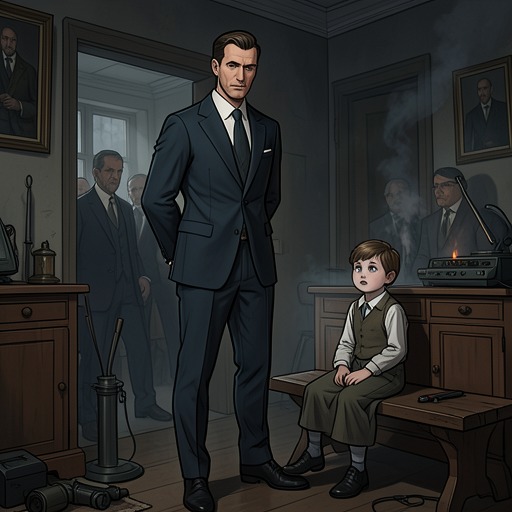
Responsibility, guilt, and self-blame
The GuiltyResponsibility, guilt, and self-blame form a recurring moral problem for Will Robie: he condemns himself for harm he caused, takes on blame for harm he could not have prevented, and must learn to distinguish accountability from the belief that every loss was his to avert. The novel gives that conflict physical force in the aftermath of a child’s death, then returns to it through Will Robie’s painful reckoning with Laura Barksdale and his estranged father, Dan Robie. Its resolution does not erase the past; it makes moving forward a shared choice rather than a denial of responsibility.
Guilt After the Mission
After a mission in which a little girl was killed, Will Robie learns that the girl’s father had also been the target and that the operation’s official explanation classified the daughter as collateral damage. That language cannot settle the question for him. He keeps returning to the child’s face and to the fact that she died because of what happened. The discrepancy between an institutional label and a human death makes his guilt more than a question of whether the outcome was intended: for him, the consequence remains morally real even if it was unintended.
The event also strikes at a line Will Robie had previously managed not to cross. He had once come close to killing a child but had not pulled the trigger; that earlier incident nearly cost him his career and his life. This time, he understands himself as having done what he once stopped himself from doing. His repeated self-accusation turns the loss into a verdict on his own identity, not merely a professional error. Looking at his callused trigger finger, formed by years of practice, he wonders whether the time has come to leave the work behind.
The crisis deepens when Will Robie recognizes that, on another mission, he saw a child where no child was present. He had apparently hallucinated, an unprecedented failure for him, and his expected state of cold zero never came. On the Arlington Memorial Bridge, with the Potomac below, he sees how the imagined child had been transformed in his mind from Sasha into a boy with another father, giving him a reason not to take the shot. He also realizes that his scope was aimed above the man’s head, a detail that should have alerted him that something was wrong. His hands tremble, and he fears that he can no longer rely completely on his own perception. Placed on leave and barred from returning to the field until he gets his mind straightened out, he confronts a crisis of both competence and moral trust in himself.
Responsibility and the Limits of Blame
The novel puts Will Robie’s self-judgment beside a more general account of personal responsibility. Sheila Taggert argues that people must take responsibility for their own lives and live with the choices they make. Jessica Reel observes that Sheila Taggert speaks from experience, and Sheila Taggert acknowledges that experience accumulates with time. Their exchange presents choice as consequential without implying that a person can control every circumstance or outcome.
That distinction becomes urgent when Will Robie revisits what happened to Laura Barksdale. Laura Barksdale tells him that her father discovered her plans, beat and raped her, and locked her in her room. She escaped long enough to go and see what had happened to Will Robie, but he had already left. Will Robie says that, had he known what her father was doing, he would have broken into the house and taken her away. Laura Barksdale rejects that explanation: she says he should have known, should have rescued her, and chose to leave. Her accusation makes visible the distance between his intention and the consequence she experienced. He remembers trying to reach her through letters and phone messages, but learns that her father intercepted them. Those efforts were real, yet they did not reach her or change what she endured.
Will Robie’s remorse therefore concerns more than a missed opportunity. He tells himself that everything might have been different if he had gone into the house and taken Laura Barksdale away from Cantrell instead of driving off to begin a new life. He calls his departure abandonment, while also allowing that this may be how she saw it. Jessica Reel pushes back against the conclusion that he must carry the whole burden: Will Robie cannot live someone else’s life for them, she tells him, when living his own is already difficult enough. Her response does not deny Laura Barksdale’s suffering or Will Robie’s absence. It challenges the leap from regret over his own choice to the claim that he was responsible for every subsequent part of another person’s life.
Confession, Repair, and the Future
The same tension between harm and responsibility reaches Will Robie’s relationship with Dan Robie. When Will Robie explains that his last two missions have gone badly—he killed someone he should not have and then saw a child and an old man who were not there—he cannot finish saying everything he had planned. The disclosure makes his professional crisis part of a difficult conversation with his father, but it also echoes the larger pattern: he is trying to speak plainly about failures rather than conceal them behind his competence.
Dan Robie, in turn, admits that he had reasons to be proud of his son but was also jealous of the life Will Robie had, a life Dan Robie felt he had never had. He says that one part of him wanted to ruin it and make it more like his own. He does not claim expertise in explaining himself; instead, he names the jealousy and the lost years. He explains why he is speaking now: Will Robie came back to help him, nearly died doing so, and had asked him for the truth. In this exchange, accountability means more than remorseful words. Dan Robie recognizes that Will Robie’s actions made a truthful reckoning possible, and answers that trust with a confession.
The exchange does not promise that the years can be restored. Dan Robie calls them wasted, and his son’s response does not dispute that loss. Instead, Will Robie asks him to look forward. When Dan Robie wonders what he has left, Will Robie names Tyler Robie and then himself. He tells his father that they are both sorry for something but need to move on together. They hold on to each other, while Jessica Reel turns away to give them privacy. The ending makes reconciliation an action in the present: the past remains painful, but neither man has to face the future alone.
Narrative Significance
Across these episodes, the novel treats guilt as a force that can clarify moral stakes but can also expand beyond what a person can fairly own. Will Robie’s insistence that an unintended death still matters resists the comforting distance of an official classification. His fear after hallucinating recognizes that his work depends on judgment he can no longer assume to be infallible. Yet the story also distinguishes that necessary accountability from self-condemnation that claims power over another person’s choices and history.
The family reckoning gives the distinction a relational form. Will Robie cannot undo leaving Laura Barksdale, and his explanations cannot undo what she suffered; nor can he control how she understands his absence. Dan Robie cannot recover the years he admits he helped waste, but he can finally tell the truth, and Will Robie can choose to answer with an offer of shared life rather than continuing estrangement. Responsibility here is neither a clean absolution nor an unlimited sentence of blame. It is the difficult recognition of one’s own acts, their consequences, and the limits within which repair remains possible.