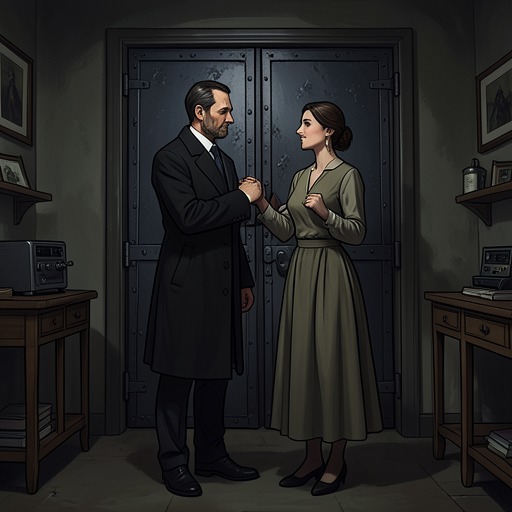
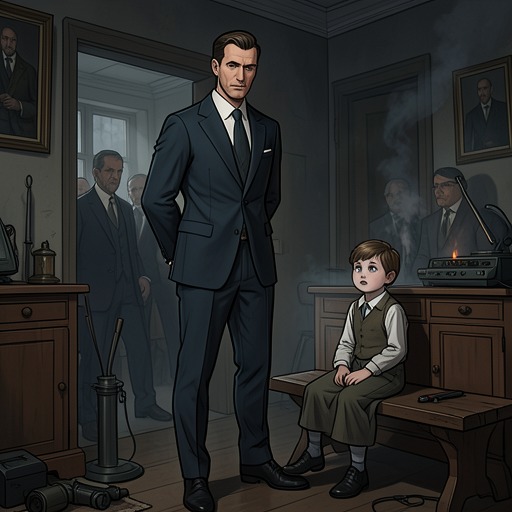
Robie freezes during the birthday-party assassination mission
The GuiltyWill Robie’s birthday-party assassination mission turns on a split second in which the trained sniper cannot pull the trigger. The target is killed by a backup team, but Robie’s failure to act—and the child he mistakenly believes he sees—ends his confidence in his ability to work in the field.
The Mission and Its Stakes
The operation is built around a carefully arranged sight line into the target’s home. Robie fires from a vacant building across the street, working a rifle through a window raised only two inches; a red line on the barrel marks how far its muzzle may extend beyond the glass. The dark night and sparse ambient light help conceal the weapon. The plan depends, however, on a maid being in exactly the right place. When the curtains part, she lingers at the window and seems to look toward Robie’s building. Her hesitation threatens the entire operation: if she freezes, the target may survive, while she and Robie could both die. The United States would disavow any connection to him.
The gathering is a birthday party for a powerful man in an impoverished country. Wealth has brought him limousines and a place among the country’s elite, but, as the narrative makes clear, his fortune came from plundering the country. That alone is not why Robie has been sent to kill him: the decisive cause is the target’s funding of terrorist activities that struck the United States and its allies. The target is celebrating his fifty-eighth birthday, though Robie’s mission is intended to make it his last. The contrast between the party’s display of wealth and the poverty around it frames the operation as both a political act and a lethal intervention.
As the party begins, Randy Gathers moves behind and to the right of Robie, using the same opening to watch the bullet’s path through his scope. The shot will take nearly five seconds to reach its target. There may be time for Gathers to call adjustments before it lands, but a miss could leave no chance for a follow-up: guests would scatter and the target’s people would rush him to safety. When the target arrives and takes his place at the head of the table, the operation reaches its prepared firing point. For all the planning, the decisive uncertainty is no longer the sight line or the timing, but whether Robie can complete the shot.
The Child and the Frozen Trigger
At the instant Robie is about to touch the trigger, a little boy runs across the room and raises his arms to the target. The man picks him up and cradles him against his chest. The apparent child transforms a planned killing into the prospect of killing a child as well: Robie’s finger stops a millimeter from the trigger. Gathers, crouched beside him, urges him to fire, but the command cannot break the hesitation. The mission’s decisive turn comes not from a missed calculation but from Robie’s refusal—or inability—to make the shot while the boy is in the man’s arms.
A shot rings out, and seconds later glass tinkles as the target falls from his chair, mortally wounded. Robie looks away from the optics and down at his finger: it never touched the trigger. The operation succeeds in killing its target, but not through the act Robie was ordered to perform. Later, Gathers explains that a backup team had been in place in case Robie did not take the shot. The distinction matters to Robie, who had been told that Gathers would fire if he failed; the backup’s intervention preserves the mission’s outcome while confirming that Robie himself froze.
Aftermath and Retrospective Meaning
The mission’s failure follows Will Robie beyond the party. On the Arlington Memorial Bridge, looking down at the Potomac, he recognizes that he had seen a child where there was no child and apparently hallucinated in the middle of an operation. His hands are trembling, and the “cold zero” he expected—the state in which he could act without hesitation—never came. What had seemed, in the moment, like a decision not to risk a child’s life now presents itself as a failure in his perception and control.
The professional consequence is immediate: Robie has been placed on leave and will not return to field work unless he can get his mind straightened out. He measures the crisis against the work that gives his life its shape; if he cannot do the job, he fears, he is nothing. The assassination’s outcome cannot settle that question. The target is dead, but Robie did not fire, and the backup team’s intervention does not restore his confidence in his own ability to act.
Looking into the water, Robie understands the image that interrupted him as a displacement of Sasha. He had taken her face, changed her gender in his mind, moved her a thousand miles away, and given her another father: a reason not to shoot. The revelation makes the apparent child both an imagined obstacle and the return of a loss he had not mastered. Robie also recognizes a contradiction in the scene as he remembers it: his scope had been aimed above the target’s head, so he should not have been able to see a child in the target’s arms. The mission thus ends not simply with a botched shot, but with Robie confronting how grief has entered the act on which his professional identity depends.
Extraction and the Backup Plan
The shot is followed not by a clean resolution but by the order to withdraw: the voice in Robie’s ear calls, “Egress, egress!” and Randy Gathers is already pulling him to his feet. The backup team has secured the target’s death, but Robie still has to be taken out of the firing position after failing to act. Later, opposite Robie on a bunk in their cramped quarters, Gathers nervously acknowledges that he had been under strict orders and apologizes. The contingency that saved the operation therefore marks a limit as well as a safeguard: the mission could continue without Robie’s shot, but its success cannot undo the moment when he could not fire.