Showdown at the Clancy Farm Cabin and Pearl River
The GuiltyThe showdown at Sherman Clancy’s farm shack and the confrontation associated with the Pearl River bring the murder investigation, Victoria’s hidden identity, and the Robie family’s long estrangement to a single crisis. What begins as a search for an expected gunman becomes an exposure of Victoria’s role in the killings; what seems likely to end with Will’s death instead turns on Tyler’s sudden scream and Dan’s intervention.
The investigation behind the confrontation
The danger at the shack is rooted in an investigation that had already widened beyond Cantrell. Wurtzburger disclosed that his assignment was with the Violent Criminal Apprehension Program, rather than simply an inquiry into casinos. Robie recognized that ViCAP handled serial-killer cases, and the agents confirmed that they were investigating a possible serial killer. Sherman Clancy’s death and Janet Chisum’s murder were linked, they explained, to eight other killings across four states during the preceding nine years.
Investigators described recurring similarities in the victims and circumstances: an older man and a younger woman were killed in roughly paired cases, with a paid sexual relationship connecting the pair. The repeated pattern gave the cases a possible common author, while differences in timing left questions open. Reel calculated that the killings had occurred at intervals of about eighteen months; the Arkansas murders, four years before, made the longer gap before the Cantrell cases noteworthy. She also asked whether the time between the woman’s death and the older man’s killing had been as long in the other cases. It had not been. The Cantrell deaths therefore fit an emerging pattern without matching it in every detail.
That uncertainty mattered to Will’s view of the case against his father. He conceded that Dan had a motive to kill Sherman Clancy, but pointed out that the motive did not extend to Janet. The investigation’s cross-state links raised a larger question: whether the Cantrell killings were separate acts arising from local grudges or part of the same sequence of paired murders. By the time Will and Reel reach the shack, that question has become inseparable from the danger waiting inside.
Entry into the shack
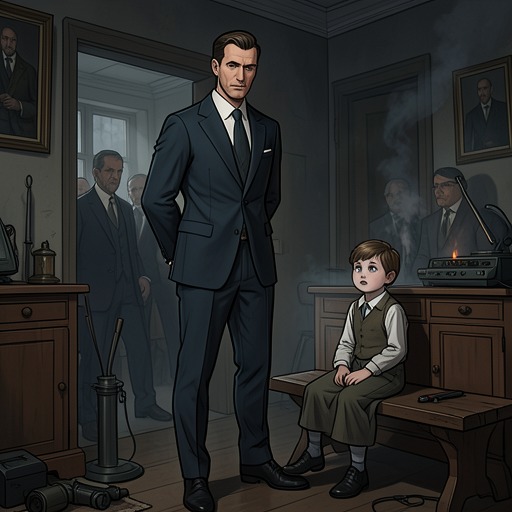
Reel checked the other side of the door and signaled that it was the only way in or out. Will answered with a silent three-count. When his fingers were down, Reel kicked the door open and entered; Will followed. They began to search the room, then stopped when they saw Tyler sitting in a chair in its center.
The sight arrested Will. He was reminded of the child reaching toward his father, and for an instant he could not move. Reel called out to him, but the moment of hesitation had already mattered: a shot sounded, followed by the sound of someone falling. When a battery-operated camping lantern illuminated the room, the armed figure was not Henry Barksdale, the person Will had expected to find. It was Victoria. The reversal changes the scene from a search for an assailant into a direct confrontation with someone inside Will’s own family.
Victoria kept her gun trained on Will as she spoke. Her exchange with him also revealed a connection to Laura Barksdale: when Will insisted that Laura was dead at the mental facility, Victoria answered that Laura was dead in many respects but not in one important sense, and gestured to the proof before him. The revelation arrives in a room where Tyler is present, though the exchange does not fully explain the relationship. Its effect is immediate: Will is forced to reconsider both the identity of the person confronting him and the story he believed about Laura.
Victoria’s account of the killings
Victoria confessed to befriending Janet and Sara Chisum and killing them. She rejected the idea that Janet’s talk of making money from powerful people’s secrets explained the sisters’ deaths as Will understood it. Instead, she said that she herself had been the person who would give Janet money. After Janet died, Victoria told Sara that Sara’s father might have been the killer, urged her to leave Cantrell, and offered to help her. Victoria presented that apparent sympathy as part of a deception: she had used Sara’s grief and uncertainty to direct her, then arranged to meet her away from the clearing.
Victoria acknowledged that Will and Reel’s presence when Sara was killed had complicated her plan. She also explained how she had tried to make the Range Rover appear connected to the crime. She had put a bullet into the vehicle and covered the hole with a New Orleans Saints sticker, then fired into the Rover in Sherman Clancy’s garage to suggest that it had been used. The disguise contained a personal mistake: Dan supported the Cowboys, not the Saints. Victoria admitted that she had little time to clean the truck before Will and Reel arrived, and that she used Tyler running beneath the hose to distract them while she washed both cars. The ordinary household activity had helped conceal a hurried effort to manufacture evidence.
When Will asked about the other cases under FBI investigation, Victoria claimed responsibility for those killings too. She connected the gap after the Arkansas murders to her meeting Dan, marrying him, and having Tyler. Her account joined the serial pattern to her family life: the interval was not a break in the story but, in her explanation, the time taken to build another identity and household. The FBI’s inquiry into repeated killings thus reaches directly into the home Will has returned to, making the apparent family refuge part of the concealment.
Escape, gunfire, and aftermath
Victoria had anticipated that Will might come to the shack because he and Reel had kept her informed about the investigation, and she had made discreet inquiries herself. She knew they suspected her father and had learned about the location. She described an alternative plan: if they did not appear, she would have returned looking injured and disheveled, carrying Tyler and claiming that both had been abducted and assaulted. Since Tyler could not speak, she expected no contradiction from him. Her statement made clear that the child had been built into the plan as protection for her story, not simply left outside the conflict.
The confrontation shifted when Victoria aimed at Will and referred to Dan. Tyler then screamed, despite having been silent for nearly three years. The sound disrupted the moment long enough for Will to seize a piece of wood and throw it at her. When Victoria was knocked against the lantern and the room went dark, Will grabbed Tyler and fled through the doorway toward the woods. Tyler’s cry changes the meaning of his silence in the scene: it becomes an unexpected act that helps Will protect him and escape.
The final exchange ends in another shot. Will expected to be hit, but discovered blood on his face that belonged to Victoria; she fell, and the gun dropped from her hand. Injured, Will lifted the screaming Tyler. When he looked to the side, Dan was standing with a pistol. Will had expected Reel, not his father. Dan lowered the weapon, dropped it, and crossed the distance to embrace his sons, using what little strength he had left. The reunion follows a fatal shot fired between father and son, giving the encounter both a physical resolution and a family one.
The showdown resolves the immediate threat while disclosing the larger pattern behind the Cantrell murders: the Chisum sisters’ deaths were part of Victoria’s confessed series, and her apparently domestic role had helped hide that history. Its ending also turns on interrupted expectations. The expected gunman is not at the shack, Tyler does not remain silent, and Dan arrives when Will thinks Reel will. Violence exposes the family’s buried truths, but the final action is not another accusation or escape: Dan lays down his weapon and embraces his sons.