Tyler Robie's non-speaking condition
The GuiltyTyler Robie's non-speaking condition is an ongoing, unexplained part of his life, not a silence the story resolves with a diagnosis or breakthrough. At two years old, nearly three, Tyler does not speak, but his family describes him as alert to the people around him and able to communicate through meaningful gestures. His scenes unsettle the assumption that speech is the measure of understanding: Tyler cannot answer in words, yet he recognizes kinship, expresses love, and senses others’ feelings.
Identity and Background
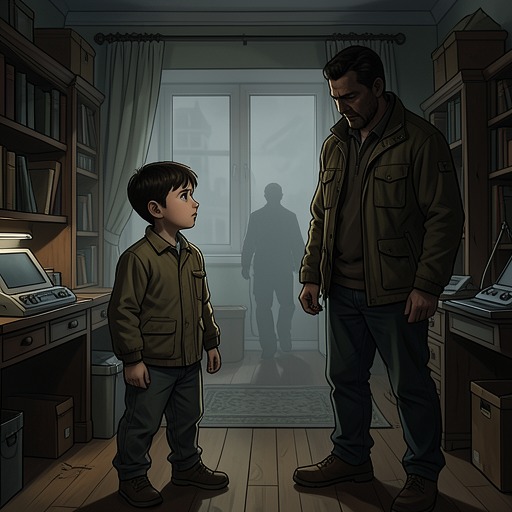
Tyler is the young son of Victoria Robie and Will Robie’s father, Daniel Robie, making him Will’s younger half-brother. Victoria tells Will that Tyler is two and will turn three in a couple of months. When Will hears the nickname Ty, he flinches: Tyler is also his own middle name. Victoria then gives him his full name, Will Tyler Robie, making the shared name a small but striking link between the adult returning to the family and the little boy who has grown up in his absence.
The condition is already part of how other people identify Tyler. A local acquaintance tells Will that the child does not talk, and Will confirms the point; later, when Jessica Reel sees Victoria and Tyler, Will explains that Tyler does not talk and has an issue. These brief descriptions show how readily his difference becomes public shorthand. The story also gives a more intimate account, however, in the gestures and family interactions that shorthand leaves out.
Medical Uncertainty and Daily Life
Tyler’s family has taken him to many doctors, but no one has found an explanation or a way forward. Victoria reports that an appointment has produced no breakthrough. When Will asks whether the cause might be physical, she says the doctors have found that Tyler has the anatomical equipment necessary for speech. Autism has also been considered and investigated, but the doctors remain puzzled; Victoria notes the range of forms on the spectrum and the continuing development of medical knowledge without claiming that Tyler has received such a diagnosis.
The distinction between being able to speak physically and actually speaking remains unresolved. Victoria says Tyler is otherwise perfectly normal, while Will observes that he seems intelligent and aware. Her account does not convert that awareness into a medical answer: the doctors have examined him, autism has been checked, and still the cause is unknown. His condition therefore persists as a concrete feature of family life rather than a problem the plot settles through diagnosis or cure.
It shapes ordinary routines as well as serious conversations. Victoria takes Tyler to a doctor, secures him in a booster seat, and gently presses down his cowlick before kissing his head. At bedtime, Priscilla tells Victoria that she has put him to bed and that he will not fall asleep until his mother kisses him on the head. These moments establish care as repeated, physical attention: a kiss, a hand on his hair, a parent coming upstairs. They show Tyler as a small child with familiar needs and attachments, not merely as the subject of an unanswered medical question.
Communication and Family Relationships
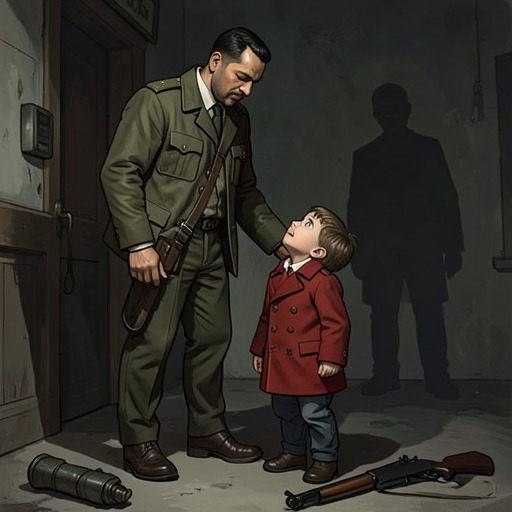
Tyler’s most revealing communication occurs when Victoria introduces Will as his brother. Sitting up in bed, Tyler looks at the newcomer with curiosity rather than fear, then reaches for his mother. Victoria points Will out and explains their family relationship. Tyler mouths the word brother, but no sound comes. The scene makes the limit plain without making it the end of the exchange: Tyler touches his chest and points toward Will.
Victoria interprets the gesture as Tyler telling Will that he loves him. She places her own hand on Tyler’s chest to show where his heart is, and Will follows the gesture, touching his chest and pointing back at his younger brother. The recognition is reciprocal even though it is not spoken. For Will, the encounter gives his return to the household an immediate personal dimension; for Tyler, the new family member is someone he can address through a sign his mother understands and teaches across the room.
Tyler’s communication is not presented as a single, isolated gesture. When Jessica Reel later identifies herself to him as Will’s friend, Tyler touches his heart and points at her. Reel is taken aback and glances toward Victoria, who explains that Tyler has officially included her among the people he loves. The repeated movement gives the gesture a recognizable meaning within the family and extends its reach beyond it. Tyler does not speak, but he is not simply unresponsive: he directs an affectionate sign toward both his brother and his brother’s companion.
Victoria also insists that Tyler understands more than people assume. Though he cannot communicate in a conventional way, she says, he sees what is happening and feels it, including other people’s sadness. When Will asks whether Tyler senses that she is sad, she agrees. Her account treats perception as part of his relationship with others, even when it cannot be measured by the presence of speech. The story does not supply a detailed account of how Tyler experiences emotion; it does show his mother resisting the idea that an inability to speak means an inability to notice or care.
Narrative Role and Significance
Tyler’s condition places uncertainty beside the family’s changing relationships. Will returns to a household where his father has built a new life with Victoria and their son, and the shared name first catches him off guard. Their bedtime meeting moves beyond that surprise: the word brother is mouthed but unheard, while the gesture toward the heart makes affection legible. Tyler’s condition is not the cause of Will’s estrangement from his father, nor does the evidence present it as something the story resolves. Instead, his presence gives the family’s bonds a quiet, particular form.
The contrast between local shorthand and close observation is central to his portrayal. Others repeat that Tyler does not talk; Victoria acknowledges the doctors’ uncertainty while describing a child who sees and feels; the gestures give that account visible form. The narrative does not provide Tyler with spoken dialogue or claim access to thoughts he cannot express. It allows the actions themselves—the reach toward his mother, the mouthed word, the touch to his chest, the point toward another person—to carry what speech does not. His non-speaking condition remains unexplained, but his relationships are not left blank.