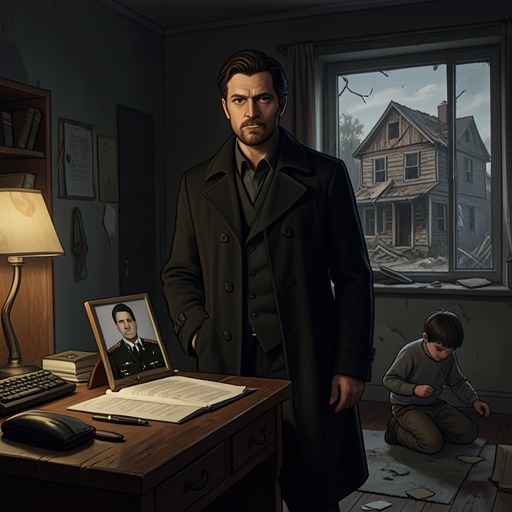
Will Robie–Dan Robie father–son relationship
The GuiltyThe father–son relationship between Will Robie and Dan Robie is defined by a long absence and a persistent argument over who abandoned whom. Will returns after twenty-two years carrying a grievance he has never been able to resolve; Dan receives him with anger and suspicion. Their exchanges turn on a painful contradiction: Will says he came because his father is in trouble, not to demand forgiveness, while Dan treats the return itself as too late to undo the past. The bond remains unsettled, but the course of the novel brings a guarded form of care into view, culminating in Will’s disclosure of a failure he has struggled to face alone.
Twenty-Two Years of Estrangement
Will tells Dan that, when he left, he had provided a phone number where he could be reached once he arrived at his destination. Dan never called. Dan’s account is different: he accuses his son of sneaking away in the middle of the night and calls him a coward who could not face things directly. The disagreement is not merely over a departure; each man treats the other’s behavior as evidence of a deeper failure of character. Will remembers offering a way to stay in contact, while Dan remembers being left behind.
Will answers the charge by turning it back on his father. He recalls that Dan left home at seventeen, lied about his age, and joined the Marines, then asks whether Dan ever returned home himself. Dan refuses to discuss it, insisting that it is none of Will’s business. The exchange exposes how little either man knows—or is willing to say—about the history that preceded their own rupture. Will wonders whether Dan’s father beat and insulted him, and whether that history might explain what Will experienced from Dan; the questions remain unanswered. The scene suggests a possible inheritance of hurt, but does not settle its origins or excuse its effects.
A Return Met with Force and Suspicion
Their reunion is physical before it becomes candid. After Will is admitted to see his father, Dan slams him against a brick wall and demands to know what he is doing there. Will breaks Dan’s grip, circles him, and wrenches his arm behind him without causing permanent damage. The encounter makes their estrangement bodily: Will has come into Dan’s space, but neither man can initially meet the other without a defensive show of force.
When Dan asks whether Will has come to vent or prove himself by beating him, Will rejects that explanation. He says he knows he is a man and needs neither violence nor his father’s recognition to establish it. Asked why he is there, he answers that Dan is in trouble and that he helps people in trouble, even those who may not deserve help. Dan sarcastically casts this as a Good Samaritan act. Will’s explanation is plain, but not sentimental: his decision to help does not depend on affection, reconciliation, or an assurance that Dan will respond well.
That distinction remains important when Will later says there is no love lost between them and that pretending otherwise would waste their time. Dan, in turn, acknowledges that he is glad Will is alive and that Jessica Reel was there to help him. Yet he wants Will and Jessica to leave, and plans to tell Victoria and Tyler to leave as well until the trial is over and matters return to normal. If he is convicted, he says, there would be no reason for them to come back; Victoria could sell the house and begin another life. Will is shocked by the plan and asks whether Dan has spoken to her. Dan’s decision is framed as an attempt to manage the family’s future under the threat of conviction, but it also pushes his son away just as Will has returned.
Help Without an Offer of Reconciliation
The practical reason for Will’s presence does not erase the personal history. Before Will leaves the jail, Dan warns him not to bother if he is trying to make amends: it is too late. Will takes his cue from his father and says nothing. His silence neither confirms that amends are his purpose nor withdraws the help he has offered. The relationship therefore resists a simple movement from estrangement to reunion. Will can act on a sense of obligation toward his father while declining to claim that the two have recovered affection.
Dan’s hostility also coexists with signs that the relationship still matters to him. He tells Will he is glad he is not dead, and later raises the account he gave Laura Barksdale: that Will had gone off without her. This brief reference returns the conversation to Will’s leaving and to the people affected by it, without resolving what Dan feels or what he wants from his son. Neither man offers an easy confession of love, and neither exchange closes the old dispute.
The Disclosure That Changes Their Conversation
A later conversation gives the estrangement a different kind of opening. Will describes the demands of his work: he must be nearly perfect, but on his last two missions he was far from it. He tells Dan that he killed someone he should not have killed, then, on a subsequent mission, saw a little boy and his father who were not there. Will struggles to continue; the words become muddled, despite having rehearsed what he meant to say. For a man accustomed to keeping control, the failed delivery is itself part of the disclosure.
The crisis behind this admission is specific and severe. Will had killed a little girl, though he did not intend to do so, and could not accept the organization’s classification of her death as collateral damage. He had once come close to killing a child but had not pulled the trigger; that earlier incident nearly cost him his career and his life. This time, the child was dead, and Will blamed himself. On another mission, he had apparently hallucinated a child where there was none; the experience made him question whether he could trust his own perception again. He had been placed on leave and understood that, until he could resolve what had happened, he would not return to field work.
Telling Dan these things does not amount to a declaration that their relationship is repaired. It does, however, mark a departure from the older pattern of accusation and guarded silence: Will brings his father an account of his own fallibility, including the fear that he can no longer rely on himself. Dan’s response is not shown in full in the available exchange; the conversation pauses under the ticking of the foyer clock before he speaks. The relationship’s significance lies in that precarious change of terms. Will’s return began as help offered to a father who had not called him for twenty-two years; it becomes, at least for a moment, an attempt to let that father see the person behind the professional control.