Will Robie—Tyler Robie
The GuiltyWill Robie—Tyler Robie is a newly revealed half-brother relationship whose first significance lies in the speed with which an abstract family fact becomes a personal bond. On returning to Cantrell, Will learns that Victoria is his stepmother and that Tyler, her two-year-old son, is also his father’s child. The encounter gives Will not just a new relative but a sibling he had never known existed; the relationship first takes shape through looking, naming, and a wordless exchange of affection.
Discovery and Kinship
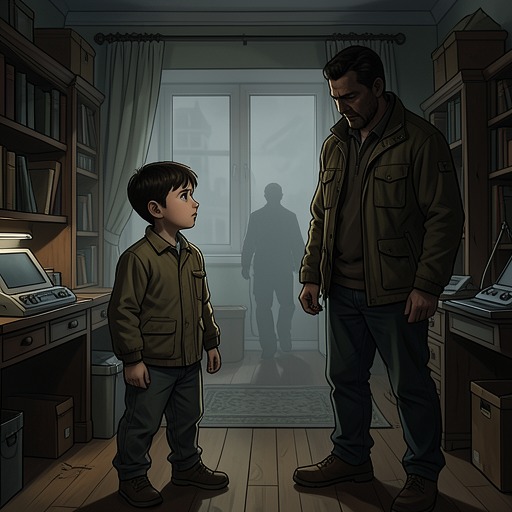
When Will meets Tyler, the child has not spoken and is watching him with a finger in his mouth. Will studies the boy and recognizes familiar features: he sees his father, himself, and something of Victoria in Tyler’s face. That mixture makes the newly disclosed relationship visible before it is fully explained. Tyler is recognizably connected to Will, yet is also a child shaped by a household and history from which Will has been absent.
Victoria confirms that Tyler is hers and Will’s father’s, making him Will’s stepbrother in the technical sense used during their introduction. The distinction is accurate but emotionally provisional. Will asks how old Tyler is and stiffens when Victoria says they call him Ty, a small reaction that shows the news registering in stages: first the child’s existence and parentage, then the intimate details of his name and age. Tyler is two and will turn three in a couple of months. The precise age places the relationship at its beginning: Tyler is very young, while Will has spent so long without siblings that he has no established experience of being a brother.
The First Meeting
The bedtime scene gives the relationship a more direct form. Tyler is sitting up waiting for Victoria. When Will appears, the child’s expression changes slightly, but not with fear; he is curious. He reaches toward his mother while continuing to look at Will. The moment holds both sides of the new arrangement together: Tyler’s secure attachment to Victoria and his attention to an unfamiliar man who is now being presented as family.
Victoria sits with Tyler and introduces Will as family, his brother, and his big brother. The repeated naming matters. The relationship is not left as a fact of parentage for the adults to understand; Victoria gives Tyler a simple familial place for Will, while giving Will a place in Tyler’s life. The designation of big brother also sets their difference in age and experience without requiring either boy to explain what that role will mean. At this point it is an invitation and an introduction, not evidence of a long-established bond.
Tyler appears to mouth the word brother, but no sound comes out. He then touches his own chest and points at Will. The exchange makes the limits of spoken language part of the scene without making speech the measure of whether the brothers can communicate. Will does not understand the gesture at first and looks to Victoria for its meaning. She explains that it is Tyler’s way of saying he loves him, linking the gesture to the child’s understanding of where his heart is. Tyler’s communication is mediated through his mother’s explanation, but the gesture itself is directed toward Will.
Gesture, Affection, and Recognition
After Victoria places a hand on Tyler’s chest, Will slowly puts his own hand to his chest and points back at Tyler. His response is not a spoken declaration; it follows the form the child has offered. Tyler immediately breaks into an enormous smile, and Will returns it. The sequence is small but decisive: Tyler initiates a sign, Will learns how to answer, and the child’s delighted response is met by a visible softening in Will.
The scene describes that smile as cutting through Will’s normally hardened shell, while Will’s mouth edges into a matching grin. The contrast gives the new relationship its emotional force. Will arrives as an adult accustomed to keeping himself guarded, but here he does not hold himself apart once Tyler’s gesture reaches him. The connection does not depend on a shared past or on conversation; it begins in reciprocal attention and a bodily sign each can recognize. The text presents this as an immediate response, not as proof that every difficulty of their unfamiliar family relationship has already been resolved.
The Meaning of a New Brother
Will reflects that he has never had a brother or any sibling at all; for a long time, it had been only him. The revelation is therefore not a routine addition to an already known family. He describes the realization of having another family, unknown until his return to Cantrell, as overwhelming. Tyler’s presence changes the shape of Will’s understanding of his family, while the bedtime introduction makes that change concrete: the boy in the bed is not merely his father’s young child but the little brother Victoria asks him to recognize.
The exchange also distinguishes biological connection from lived familiarity. Their common father establishes the relationship, but their first bond is made in the present: Tyler looks, reaches, and points; Will attends, asks for help understanding, and answers in kind. Victoria’s role is essential in naming the kinship and interpreting the gesture, yet the reciprocal sign belongs to the brothers themselves. The scene ends with Tyler settling back into bed after Victoria kisses his forehead, while the new connection has already altered Will’s guarded response. The evidence establishes the tenderness of this first encounter and the shock of discovering a sibling so late; it does not yet establish how their relationship develops afterward.