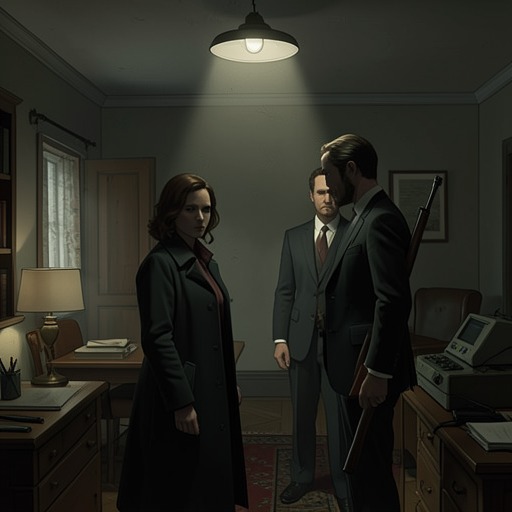
Will Robie's psychological crisis after Sasha's death
The GuiltyWill Robie's psychological crisis after Sasha's death marks the collapse of the certainty on which his work depends: he can no longer trust that his trained eye, steady hand, or judgment will tell him what is actually in front of him. Sasha's death does not remain a classified operational outcome for him. It becomes the face he cannot forget, the cause of a physical breakdown, and a question about whether he can safely return to the field.
The Death and Its Official Account
On the plane after the mission, Robie learns that the maid had completed her role and escaped, while the people communicating with him were trying to cast the operation in a positive light. He sends a message seeking an explanation. The reply identifies the girl as the target's daughter and classifies her death as collateral damage, but offers no clarity about what happened. That language supplies an official category, not an answer to the question consuming him.
Robie's mind stays with Sasha rather than with the report. He recalls her curly dark hair and the fact that she died as her father was dying. Whether or not he intended to kill her cannot alter the result: she is dead, and he believes his action caused it. He nearly sends a furious response, then puts the phone away and slumps against the plane's inner wall. The restraint does not settle him; it leaves him alone with the memory.
Guilt in the Body
The memory is immediate and physical. Robie closes his eyes, but Sasha's face seems burned into them; he imagines her surprise and the instant in which she ran toward her father. As the jet jolts through rough air, he vomits. The narration makes clear that the turbulence is not the cause: his body is reacting to the girl's death and to his own part in it.
His usual composure gives way. He hangs his head between his knees and looks at his callused trigger finger, marked by years of practice. The trained hand that ordinarily signifies control now becomes evidence he examines against himself. He has wondered when he would know that it was time to walk away from his work; after Sasha's death, that question acquires an immediate and personal answer. His repeated self-accusation refuses the comfort of the official label: in his own understanding, Sasha is dead because of him.
The Earlier Mission and the Broken Perception
The crisis is sharpened by an earlier mission in which Robie had also perceived a child at the moment of a shot. His blood pressure rises, his heart races, and his breathing turns to gasps. Sweat runs into his left eye, which he cannot wipe while maintaining his position. Just before his finger reaches the trigger, he sees a child. Randy Gathers orders him to fire, but the boy appears to be in his father's arms; Robie cannot bring himself to shoot through the child to reach the man.
A shot nevertheless rings out, and the man falls mortally wounded. Robie then looks away from the optics and down at his finger: it never touched the trigger. This is not simply a repetition of Sasha's death. In the earlier incident he did not fire, while the later death leaves him convinced that he did. The contrast makes the new guilt harder to contain, because the earlier episode had already shown how a child's image could interrupt his work and nearly undo his career.
On the Arlington Memorial Bridge, with the Potomac below him and no aircraft overhead because Reagan National is closed under nighttime noise restrictions, Robie recognizes that the earlier perception was a hallucination. He had seen a child where there was none, an experience he considers unprecedented for himself and perhaps for the Central Intelligence Agency. He also recognizes the specific substitution his mind made: it took Sasha, changed her gender, moved her a thousand miles away, and gave her another father. In that imagined scene, the child supplied a reason not to take the shot.
Leave, Distrust, and Unresolved Business
The discovery does not restore his confidence. Robie understands that his scope was aimed above the man's head, making the apparent child in the father's arms inconsistent with what he was actually targeting. His hands tremble, and he cannot dismiss the possibility that his mind could deceive him again. The crisis therefore reaches beyond remorse: he doubts the reliability of the very perception on which his work depends.
Robie has officially been placed on leave and will not return to field work unless he gets his mind straightened out. At the bridge, he considers the possibility that he may be unable to do so and therefore unable to do his job. The leave is both a consequence of the mission and a demand that he confront what happened; his status is no longer secured by his reputation as an unflappable professional.
Blue Man tells Robie that unresolved business may be involved and that the time off should be used to address it. He says Robie will be welcomed back if he resolves his issues, but not if he cannot, placing the decision substantially in Robie's hands. Robie sharply denies that the matter has anything to do with his father. Blue Man does not insist that it does, but says that if it does, it needs to be addressed, then hands Robie a file. The exchange links the immediate crisis to a possible older conflict without resolving that connection. Robie's leave thus becomes more than a pause from field work: it opens a path toward confronting the past, while leaving his return and his confidence in himself unsettled.