Will and Dan Robie's estrangement
The GuiltyWill and Dan Robie's estrangement is a twenty-two-year rupture that shapes Will Robie’s return to Cantrell, Mississippi. Its origin is not explained in the available account; what emerges instead is the cost of the distance, the secrecy that prolonged it, and the two pressures that finally make Will turn back: his father’s murder charge and his own inability to complete a mission. The estrangement is not resolved by the return. It becomes the past Will must confront if he is to move forward.
Identity and Duration
Will had not seen his father in more than twenty years when the thought of Dan suddenly broke through his concentration. Blue Man’s words brought Dan’s face into Will’s mind: a hard, unrelenting countenance he had believed he would never see again. The memory arrived with force, from a past Will had not been thinking about. At first, he wondered whether his father was dead; Dan was old enough that a heart attack or stroke might have taken him. The question makes the separation tangible: Will had been away so long that even his father’s continued life was uncertain to him.
The account gives the estrangement two measures. Will had not seen Dan for over twenty years, and after his return to Mississippi he understood that he had been gone for twenty-two years. The difference does not suggest a contradiction so much as the gradual precision with which the long absence becomes present to him. Cantrell had been Will’s entire world for the first eighteen years of his life. He later wanted no more of it and had no wish to return. By the time he did, the distance was not simply geographic: it had become a defining interval between the life he left and the person he had become.
The Life Built Away from Cantrell
Will’s departure was followed by a life that did not unfold as he had hoped. On arriving on the East Coast, he had imagined starting anew with Laura Barksdale, but that future did not happen. He arrived alone, confused, and angry. Later circumstances saved his life and future and set him on the path toward his career, but that new direction carried its own barrier: his work was so secret that he could not contact his father or seriously consider going home.
That restriction helps explain how the separation endured without supplying an unrecorded account of how it began. The distance was sustained by the demands of Will’s work, while his new life increasingly diverged from the home he had rejected. He thought of Dan several times over the years, but thinking of his father did not become contact. The estrangement therefore contains both absence and recollection: Dan was not erased from Will’s mind, yet secrecy kept that memory from becoming a relationship renewed through communication or a visit.
The Return and Its Catalysts
Dan’s being charged with murder changes the meaning of the old separation. Will had left Cantrell with no intention of returning, but the charge makes his father’s fate immediate and draws him toward a past he had postponed confronting. Will can believe that Dan is capable of violence; Dan had served in the United States Marine Corps during the Vietnam War era and had killed in war. Yet Will distinguishes killing from murder, even as he recognizes that his own successful missions could technically be described as murder. That uncomfortable comparison complicates the return: his concern for Dan is entangled with a question about the moral terms by which he understands his own life.
The other catalyst is Will’s failure to complete his last assignment. He cannot pull the trigger, and the narration makes clear that the little girl’s face was not what stopped him. With both his work and his father’s case pressing on him, Will decides that moving forward requires making at least a modest start on the decades-long disorder of his past. Going to Cantrell is difficult, but he knows the way. The journey is thus neither a simple homecoming nor a claim that the old conflict has been repaired; it is a deliberate turn toward what he had left unresolved.
Encounter and Narrative Significance
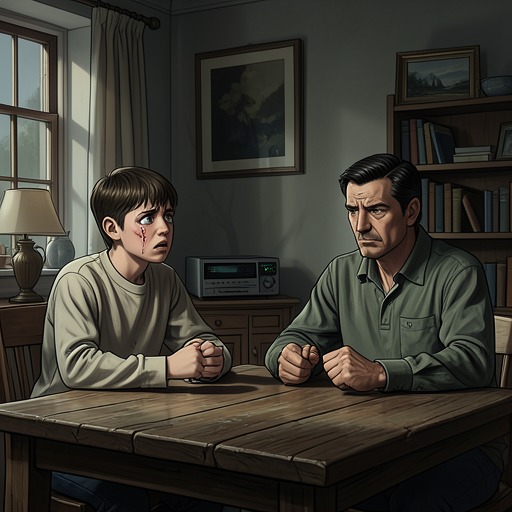
When Will and Dan meet again, their separation is visible in the small failure of the encounter. Dan continues to stare while Will looks away; then the van carrying his father disappears. Will remains on the street looking at the place where Dan’s face had been. He feels as though he is living someone else’s life, unable to reconcile the present scene with the fact that he has been away for twenty-two years. The meeting does not supply a conversation that could bridge the interval. Instead, the look exchanged and the van’s departure leave the distance exposed.
The estrangement functions as both a family rupture and a structural turning point. For years, Will’s secret work made return seem impossible; now his father’s arrest and his own professional crisis converge to make avoidance untenable. The repeated movement from looking away to going back gives the separation a particular shape: memory first intrudes without invitation, and Will then chooses to act on it. His decision does not establish that he and Dan reconcile, nor does it explain the original cause of their break. It establishes that Will can no longer treat Cantrell and his father as closed chapters. In this sense, the return begins not with restored closeness but with the recognition that the past remains active.