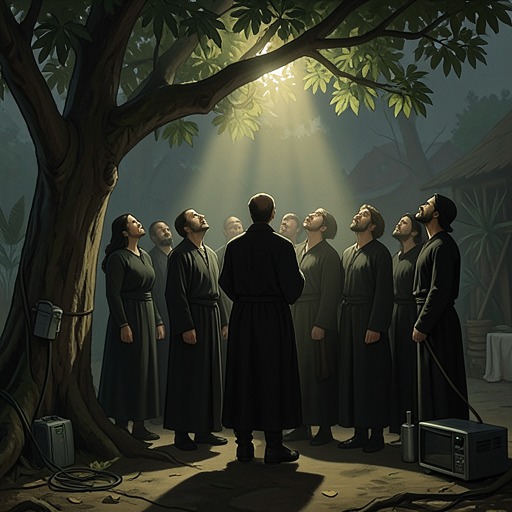
Academy Purification Isolation Period Rule
The Hanging GirlThe Academy Purification Isolation Period Rule presents solitude as a route to spiritual renewal, but Shirley’s experience reveals how the Academy’s language of voluntary purification can conceal severe control over a disciple’s surroundings and basic needs. Pirjo Abanshamash Dumuzi describes a month of isolation as a condition for joining the inner circle; in practice, Shirley is left without the food and water she expects, with no way to check what is happening outside. The promised passage from worldly distraction to rebirth thus becomes a test of what the institution can withhold while still calling the process a choice.
The Rule and Its Promise
Pirjo explains that Shirley must undergo the Academy’s purification process before she can take a paid recruiting position in its London office. The process requires a month in isolation, during which Shirley is supposed to forget worldly concerns and allow nature absorption to settle within her. Pirjo calls this becoming neutralized. She presents the requirement as routine, comparing it with the purification period Valentina underwent about a year earlier, and offers the job as a reason for Shirley to accept the separation.
The instructions promise a staged transformation rather than mere confinement. According to the first page of Atu Abanshamash Dumuzi’s manual, by the tenth day a disciple should feel liberated from ordinary, unnecessary distractions; by the twentieth, purified; and by the end of the period, reborn as a whole person living in harmony with nature and Atu’s wisdom of life. Pirjo says the manual contains Atu’s clear directions for the rituals, although it is written in someone else’s hand: she claims he dictated it word by word. She also says Atu may visit if Shirley has questions, tying the supposedly solitary practice to the authority of the Academy’s leader.
The Purification House
Pirjo takes Shirley to a newly finished purification house and emphasizes its careful construction and beauty. Its high, wood-clad room has a ceiling opening that admits light, pale wood, and colored tiles; the room is thermally built to retain heat in winter. Yet the same design that Pirjo presents as peaceful sharply narrows Shirley’s view of the outside world. The skylights sit about seven or eight meters above the floor, and there are no other windows. For weeks, she expects to see no changing landscape, only the yellowish walls and grey-speckled tiles.
The room’s furnishings and arrangements make the intended solitude concrete. Shirley has a small bunk, an unpadded chair, a round pinewood table, and a deck of cards with which to play solitaire. The toilet and shower are outside the room; Pirjo says clean clothes, towels, and bedding will arrive once a week, and that Shirley will receive three meals a day. She gives Shirley a small blue handwritten notebook containing the purification instructions. The Academy’s account is therefore not simply that Shirley will be alone: it specifies a managed routine, with food, washing, and supplies controlled by other people.
Voluntary Isolation and Its Contradictions
At first, Shirley struggles with the absence of ordinary diversions. She is sociable and has usually been able to fill time alone by listening to the radio, watching television, talking on the phone, or looking out a window. At the center she has sometimes spent time with friends. In the purification room, however, there is no contact with anyone and no incoming stimulation. Her limited materials are the Academy’s small blue bible, playing cards, and the opening overhead through which she can watch clouds. The silence turns her attention inward, and she begins to think about the unusual feeling of being privileged and appointed to represent the Academy in London.
That sense of recognition does not resolve the practical contradictions. Shirley expects the food promised by Pirjo and wonders whether she has missed the usual late-afternoon meal and communal meditation. As evening comes, she tries to explain the absence by supposing that the fast is part of the opening ritual, even though the manual does not describe one. When she reads further, she finds no procedure covering fasting, meals, laundry, or the other practical arrangements Pirjo had outlined. The gap between a detailed promise of care and instructions that say nothing about its delivery turns uncertainty into worry. Shirley herself reflects that the isolation was voluntary because she had not been forced into the room; the word becomes increasingly difficult to separate from the circumstances shaping her choice.
Deprivation and the Attempt to Escape
After three days, Shirley has run out of plausible explanations for the missing provisions. She can imagine Pirjo being ill on the first or second day, but cannot understand why nobody else would take over. The possibility that Pirjo has simply left her without help becomes harder to dismiss. Shirley had reassured herself that she could survive weeks without food, but when the water stops running, the danger changes. The separation is no longer only a ritual whose meaning she cannot verify; it threatens her ability to meet immediate physical needs.
The Academy’s soothing account of a place where the senses can rest is also contradicted by the room’s conditions: its limited view, lack of contact, and dependence on staff for food, water, and supplies leave Shirley with little information or control. Meanwhile, Pirjo’s private thoughts show that the encounter has another, more violent possibility. She considers having Shirley enter the office first, anticipating that Shirley might be paralyzed by shock, and thinks of fetching a cable kit from the garage to connect her to it. Pirjo doubts whether the electrical setup would work, but concludes that Shirley has to go. This is not part of the stated purification instructions; it exposes the threat behind Pirjo’s effort to manage Shirley’s departure and potential accusation.
Shirley’s response is practical resistance. As the sun bears down, she scratches at the wallboard, but after hours of effort has loosened it by no more than one and a half millimeters. She curses the craftsmanship of the timber circle team, whose work has made the construction too solid to shift easily. She then notices the drainpipe beneath the sink and decides to use the metal pipe to make a hole. The rule’s decisive significance lies in this reversal: a discipline advertised as voluntary and spiritually liberating becomes, for Shirley, an environment to escape, while the Academy’s promises of transformation stand against the immediate facts of deprivation and danger.