Alberte Goldschmid's Death in the VW Kombi Collision
The Hanging GirlAlberte Goldschmid’s death, initially classified as an accident, becomes the decisive crime at the center of Carl Mørck and Assad’s investigation when they reconstruct the collision as deliberate. Their reading of the road, the absence of skid marks, and Alberte’s position in a tree suggests that the driver saw her and accelerated into her. Yet the decisive vehicle and the driver’s identity remain unresolved: evidence points toward a specially adapted vehicle, possibly a VW Kombi, while Christian Habersaat’s earlier plywood discovery never became conclusive proof.
Background and the Accident Classification
When Carl Mørck and Assad revisit the scene, the old account of an accident still governs how others understand Alberte’s death. Kristoffer Dalby insists that the incident was recorded as an accident everywhere. The contrast between that settled public description and the investigators’ new theory marks the turning point: the physical details of the road, reconsidered together, make an unintentional collision increasingly difficult to accept.
The setting gives their reconstruction its first test. From the south, the road runs roughly six hundred meters toward the bend by the old couple’s farm, then continues about one and a half kilometers toward a tree along the fields. The stretch is open and flat. Carl observes that Alberte, if she was waiting with her bicycle at the far end, could have seen an approaching car clearly for the last five or six hundred meters. The distance matters not simply as scenery, but because it bears on what the driver could have seen and how much time there was to react.
The Reconstructed Collision
Carl tests the road by driving around the bend at speed. The tires screech, a sound he judges would have been audible inside the old farmhouse. But the recreation does not reproduce the evidence of the original collision: no skid marks resembling those made by his car were found. The absence of marks leads the investigators to conclude that the vehicle involved in Alberte’s death could not have taken the bend at the same speed. Their reconstruction instead places the acceleration after the bend.
The position of Alberte’s body strengthens that inference. Carl reasons that she stood on the side of the trees; otherwise, the impact would have thrown her in the opposite direction, away from them. From there, he argues, the driver could not plausibly claim not to have seen her. An inattentive driver might have missed the danger, Assad suggests, but Carl counters that Alberte could then have moved to the curb. Her failure to do so implies that she had no reason to fear the approaching person: something about the encounter may have directed her attention away from danger.
Carl imagines that Alberte and the driver made eye contact at the bend. In his reconstruction, she had left her bicycle on its prop stand and stepped toward the car, perhaps waving. He interprets her posture as expectant rather than frightened, and suggests that the driver accelerated only at the last moment, striking her and sending her into the trees. This is an investigative theory, not an independently witnessed account: the apparent welcome, the possible wave, and the timing of the acceleration belong to the scene Carl constructs from the surviving clues.
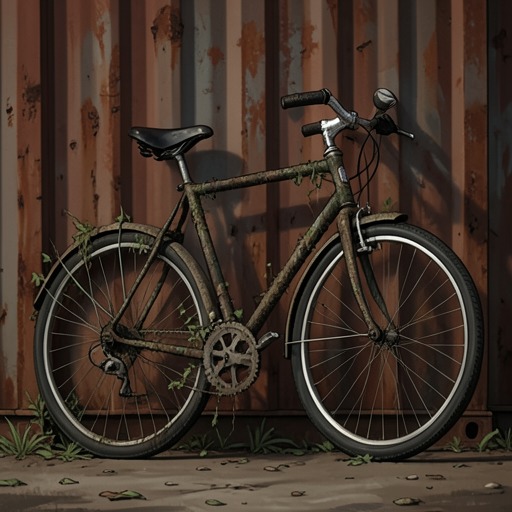
The bicycle appears to have been struck after Alberte. Assad suggests that it was hit just afterward and thrown into the air, landing farther to the right. Carl incorporates that into his sequence: the vehicle straightened after hitting Alberte, clipped the bicycle farther up the road, and continued past the yellow farm at a more ordinary speed before leaving toward Almindingensvej. The displacement of the bicycle thus becomes part of the proposed sequence, not a separate explanation for the fatal injuries.
The Body, the Trees, and the Missing Vehicle
The investigators also account for why Alberte’s body was not initially seen during the search. Although the trees had lost their leaves by the time of the investigation, ivy or another parasitic plant covered their upper branches, making the site less obvious than a bare canopy might suggest. The trees fork into numerous strong branches, and Carl places Alberte in a lower fork about four meters above the ground, hanging head down. He supposes that she rotated in the air before coming to rest there.
Christian Habersaat had found her while driving from the direction of the main road. In Assad’s reconstruction, he approached from the side where ivy most obstructed the view, which helps explain why the body was difficult to see and why its discovery depended on Habersaat noticing it from that direction. The tree is therefore both the place where the collision’s force left Alberte and a screen that complicated the initial investigation.
The force required to propel her into the branches also suggests to the investigators that the vehicle was specially adapted. Carl notes that a snowplow could have produced such an impact, but it was not winter; he also reasons that Alberte would have moved out of the way of so large and conspicuous a vehicle. A modified vehicle offers a possible explanation for the force without resolving the question of what actually struck her. The team considers a VW Kombi and the possibility that the object that lifted Alberte could have been removed and disposed of afterward. That possibility helps explain why an unusual vehicle might not have been found in searches across Bornholm or noticed on ferry-departure surveillance, but it remains a hypothesis rather than proof of the vehicle’s identity.
Habersaat’s Plywood Clue
A report by Christian Habersaat, dated November 24, 1997, records a fragment found six meters north of Alberte’s bicycle, almost in a straight line from the point where the bicycle was hit to where it landed. Technicians identified the material as birch and the glue remnants as consistent with plywood. Because no similar fragments were found in the collision area, they concluded that this piece did not come from the collision itself. The distinction is crucial: the fragment was discovered near the scene, but the first technical assessment did not connect it to the fatal impact.
Habersaat later compared the fragment with a birch board. Its thickness and layered construction led him to theorize that the fragment might have peeled from an outer layer while the board spent time in water; he estimated a board twenty to twenty-four millimeters thick, with the middle eighteen millimeters still intact. The analysis could not establish with certainty that the fragment came from that board, and Habersaat’s request for a comparison of the glue was not authorized. He nevertheless recorded his absolute theory that the board was involved in the collision, while acknowledging that flotsam was common on Bornholm and that matching wood types might be coincidence. His conviction therefore survives in tension with the limits of the evidence.
Timing and Significance
The chronology of Alberte’s meeting with the man she may have been expecting sharpens the mystery without solving it. After speaking with a rector couple about a trip to Østerlars, Carl concludes that Alberte met the man on November 7, rather than November 11, and had known him for less than two weeks when she died. Carl wonders what she could have done to provoke a fatal end to their relationship, but the available evidence does not establish either the man’s identity or the cause of any such hostility.
The reconstruction changes the meaning of small, previously disconnected details: a clear stretch of road, a bicycle left standing, a body lodged above ground, an absent pattern of skid marks, and a fragment of birch plywood. Taken together, they lead Carl, Assad, and Rose to agree that the case must be solved and to treat Alberte’s death as murder rather than accident. But the reconstruction also preserves uncertainty. The possible meeting, the driver’s intentions, and the specially adapted vehicle are deductions of differing strength, not a complete eyewitness account. The gap between a plausible sequence and proof becomes part of the event’s continuing significance: Alberte’s death is no longer an unexplained mishap, but the deliberate act of an unidentified driver whose apparent opportunity and means still have to be established.