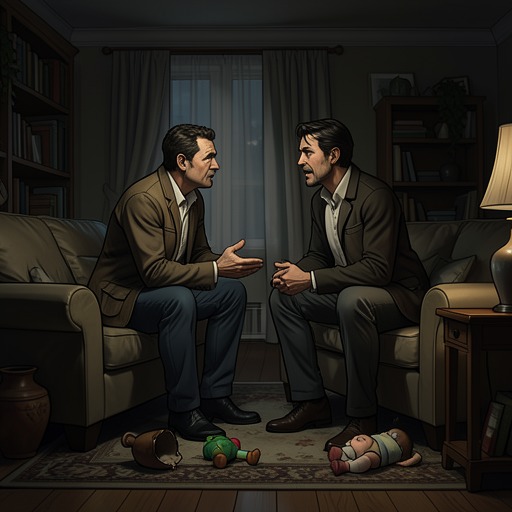
Bjarke Habersaat's suicide
The Hanging GirlBjarke Habersaat’s suicide is both a death and a belated clue: the note he leaves for his father points toward the hidden connection between the Alberte case and the family’s collapse. The discovery first confronts Carl Mørck, Assad, and Rose with the physical fact of Bjarke’s death; its meaning emerges only later, through June Habersaat’s account of what Bjarke knew and why he could not live with it.
The House and the Discovery
The house on Sandflugtsvej presents an image of carefully maintained provincial comfort. Set back from the road, with a French balcony, brass nameplate, and neatly mown lawn, it seems to announce prosperity through its smallest details. Yet only one name appears on the door: Nelly Rasmussen. She confirms that Bjarke lives there, but cautions the visitors not to expect him to be willing to talk. When Carl, Assad, and Rose enter, the polished exterior gives way to a room clouded by hash smoke and the smell of cellulose thinner.
Bjarke is naked in a large, worn armchair, his legs drawn up and a bottle of paint thinner in his hand. He has slit his wrists and is already dead. The scene is starkly at odds with the house’s display of order: the man inside has withdrawn from every ordinary expectation of care and conversation. Carl identifies the smell as a combination of hash and cellulose thinner, correcting Assad’s initial impression that it was cannabis alone. The medical officer later places the death at approximately four o’clock.
The Note and June’s First Reaction
The practical work of the investigation followed with startling speed: the police searched Bjarke’s room, seized his computer and the knife he had used to slit his wrists, collected technical data, and arranged the postmortem and removal of his body. Carl had smoked only five cigarettes by the time John Birkedal and an investigator appeared with a technician, carrying a scrap of paper sealed in a plastic bag. It bore just three words: “Sorry, Dad.” The note’s brevity made it moving to Carl, but also immediately puzzling. Bjarke’s mother, June, was alive to receive an apology; why, then, had he addressed it to his father?
Carl and his colleagues went to tell June that her son was dead and that he had taken his own life at approximately four o’clock. She absorbed the news in silence, drawing in her cheeks as if confronting her own reflection and the years it revealed. Then she repeated the time and explained that it was just after she had called Bjarke to tell him about his father. She tried to swallow, held her throat, and said no more. The timing linked the suicide to the call in the most immediate way, while the note’s address to his father left the investigators with a question the first notification could not answer.
Carl, Rose, and Assad stayed with June for half an hour. Rose held her hand until Carl indicated that she could let go, and the three began to leave. Before they were out of the living room, Assad challenged June with the mismatch he saw between her account of her failed life and the words Bjarke had left behind. He argued that Christian Habersaat could not be the only explanation for the family’s situation, and asked why Bjarke had written to his father rather than his mother. Carl pulled Assad away, but the question had already struck its mark: June was shocked not only that they knew of the note, but that she resisted believing it could belong to her world. Her reaction made the small scrap more than a farewell. It was evidence of an unresolved family history, and of a truth she could not yet face.
The Funeral and the Meaning of the Note
The explanation of Bjarke’s apology comes much later, when June is preparing to leave for his funeral. Asked whether he is only being buried now, she explains that his body had remained in Copenhagen for the postmortem; this time, as she speaks of the funeral, she sheds a real tear. The delay gives the burial a grim procedural shadow, while June’s tears mark a change from the stunned, guarded woman who first received the news.
June then recounts the secret that had bound Bjarke to the Alberte case. After returning to Listed, she put the plow back in her trunk. Karin Kofoed had seen her do it and later told Bjarke that June had borrowed the car and that Karin had seen her with the plow. By then the search for Alberte Goldschmid had begun. At the dinner table, Christian Habersaat told the family that he had found Alberte in a tree and that the discovery had left a terrible impression on him. June could tell that Bjarke had worked out what her actions meant. He never told his father, but, as June recalls it, he hated her for the secret and never let her down; instead, he kept the burden to himself. After June moved out a few months later, Bjarke could not remain under the same roof as Christian. He lived for a time with Karin and with June in Aakirkeby, before finding a place of his own.
June says they never discussed what Bjarke had understood. Her account transforms the note from a baffling farewell into an apology shaped by the family’s concealed past. She believed Bjarke could not bear the thought that Christian had killed himself over a case his son might have solved for him; “Sorry, Dad” was, in her understanding, Bjarke asking his father’s forgiveness. The note therefore points beyond grief at Christian’s death: it carries Bjarke’s knowledge of June’s connection to Alberte’s disappearance, his silence about that knowledge, and his sense that he had failed the father who remained consumed by the case.
Silence, Guilt, and the Case
June’s explanation remains an interpretation rather than a confession from Bjarke: she believes he apologized because he could not live with the thought that Christian Habersaat had died over a case his son might have solved. That distinction matters. Bjarke’s note establishes whom he addressed, but June’s recollection supplies the reason, drawing on what she inferred from his silence and their family’s separation. His death does not resolve every uncertainty about what he knew; it reveals how long the knowledge, or the suspicion of it, had shaped his life.
The apology also reverses the first impression created by the family’s losses. June had initially linked Bjarke’s suicide to her own phone call about his father, while the note seemed to point toward Christian. In retrospect, she sees both deaths joined by Alberte Goldschmid’s case and by the secret Bjarke never disclosed to his father. His silence had spared Christian an accusation, but left Bjarke alone with the knowledge. The suicide thus turns a few words recovered from a room into the belated sign of a family history organized around concealment, loyalty, and guilt.