Bjarke’s wooden figure
The Hanging GirlBjarke’s wooden figure is a carved object whose importance lies less in any documented explanation of its making than in where it appears and whom it resembles. Found among objects from Christian Habersaat’s home, it prompts Carl Mørck to reconsider the case: the figure, attributed to Bjarke Habersaat, seems to share features with Frank Brennan, the man the investigators are seeking. It does not solve the mystery by itself, but turns an apparently incidental household object into a link between the Habersaat family and the Alberte Goldschmid investigation.
Identity and First Appearance
Carl first notices the small wooden figure at Habersaat’s home. He has put it in his jacket pocket, intending to remember to place it on a shelf with the other items from the house. At the bottom of that pocket, beside something he cannot initially identify, the figure is easy to treat as just another object gathered during the investigation. The unidentified item turns out to be a pendulum from Simon Fisher’s Holistic Garden Center; the figure, by contrast, will acquire a direct bearing on the case.
The figure’s maker is identified through Sammy, who told Carl that Bjarke had carved it. The narrative supplies no account of when or why Bjarke made it, and gives no independent description of its materials or intended purpose. Its significance emerges instead through Carl’s attention to its shape: when he examines and turns it, he becomes increasingly convinced that it has features in common with Frank Brennan. The object is thus introduced as a piece of evidence whose meaning has to be read, not as an item whose purpose is already known.
From Household Object to Investigative Clue
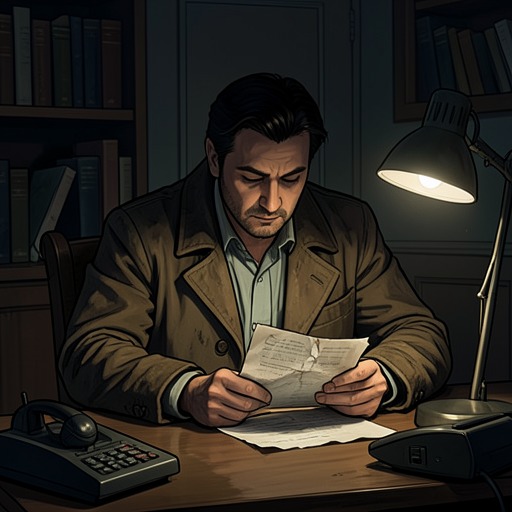
The decisive moment comes after Carl has returned home. As he sits down, he feels something poking him in the back and fishes the object out of his jacket. Recognizing it as the wooden figure from Habersaat’s coffee table, he recalls Sammy’s identification of Bjarke as its carver. The change in setting matters: away from the house and its other objects, Carl looks at the carving closely enough to see a resemblance he had not yet registered.
Carl’s recognition is gradual rather than immediate. The more he turns the figure and studies it up close, the more convinced he becomes that it shares features with the man Department Q is trying to find. He connects that man with Frank Brennan, whom some people call the Scot. The scene does not establish that the figure is a portrait, nor does it explain whether Bjarke intended anyone to recognize the likeness. Carl’s conclusion remains an investigative judgment based on resemblance and context.
The placement also takes on new weight in retrospect. Carl thinks it was probably not a coincidence that the figure had been on Habersaat’s coffee table. That thought raises the possibility that its presence there mattered, but the evidence does not establish who placed it there or what message, if any, it was meant to convey. Its route into Carl’s pocket is circumstantial rather than a clearly described act of selection: he had gathered objects from Habersaat’s home and meant to put them away later. The clue’s force comes from the combination of the object’s location, its attributed maker, and Carl’s recognition of the resemblance.
The Figure and the Alberte Inquiry
The carving enters an investigation rooted in Alberte Goldschmid’s death on Bornholm. On November 20, 1997, the roughly fifty students at Bornholm Folk High School were having what John Birkedal described as an ordinary day; they did not yet know Alberte had been killed in a traffic accident that morning. More than a day passed before her body was found high in a roadside tree by Christian Habersaat, then a uniformed police officer from Nexø. Habersaat’s subsequent, repeated interest in the case left the school community with memories that were vivid but incomplete.
Inge Dalby recalls that Habersaat repeatedly asked about a man Alberte had been seeing. She remembered Alberte mentioning an unusual-sounding name, with a short biblical first name, but could not recover it when questioned later. Inge also said the man apparently came from Copenhagen, not Bornholm or Jutland, and recalled a Volkswagen whose color and shape seemed to match a photograph without being clear enough to identify it. These fragments make the figure’s resemblance useful as a possible connecting clue, but they do not independently confirm the man’s identity.
Later, June Habersaat describes following Frank after learning that he was seeing a younger woman as well as her. She says she saw Frank and Alberte exchange notes by a large boulder outside the school, and that she confronted him at the commune at Ølene, where he told her he loved Alberte and intended to take her back to Copenhagen. This disclosure gives the search for Frank a clearer connection to Alberte and her life at the school. It strengthens the context in which Carl reads Bjarke’s carving, while remaining distinct from the carving itself: June’s account identifies a relationship and a history of contact, not the figure’s purpose.
Significance and Limits
The figure’s narrative role depends on a sequence of retrospective recognition. At Habersaat’s home it is one object among several; in Carl’s pocket it is nearly forgotten; at home, under closer examination, it becomes a possible likeness of the man central to the investigation. Its ordinary physical presence carries information that had not been apparent when Carl first encountered it. The delayed reading mirrors the wider case, where a name, a vehicle, a remembered exchange, or an old object may acquire meaning only when compared with other pieces of evidence.
Yet the carving remains a clue, not a verdict. The available evidence supports Carl’s growing conviction that it resembles Frank and his suspicion that its placement at Habersaat’s home was not accidental. It does not establish that Bjarke carved it as a portrait, that Habersaat understood its likeness, or that the figure alone proves Frank’s identity or actions. Its importance is precisely that it redirects attention: an object attributed to Bjarke brings the Habersaat household into closer relation with the search for Frank and the unresolved history of Alberte’s death.