Board Lost at Sea
The Hanging GirlThe Board Lost at Sea is a fragment of birch plywood found wedged among the rocks at Hammerknuden, whose possible connection to Alberte Goldschmid’s fatal collision turns it from coastal debris into a contested piece of evidence. Christian Habersaat believed it was involved in the collision and theorized that it had been attached to the front of the VW Kombi; yet the material comparison remained inconclusive, and the board itself later disappeared. Its importance lies in that tension between a tangible object and the limits of what investigators could establish about it.
Discovery and Physical Description
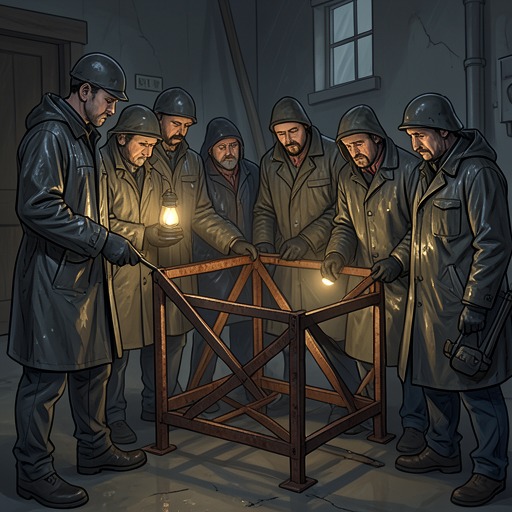
The find was recorded in one of Christian Habersaat’s homemade journals under Wednesday, August 2, 2000. Ten-year-old Peter Svendsen, from Hasle, pulled the board free while playing at Camel Head Cliffs. It was so heavy that he left it on land rather than taking it away. His father, local community officer Gorm Svendsen, then contacted Habersaat. The discovery came through a personal chain of recognition: Gorm recalled Habersaat’s appearance on local television, where he had been looking for a plywood board that might have produced a splinter recovered earlier.
The discovered piece was part of a larger board, which Habersaat estimated had probably been about one metre high and two metres wide. It was badly battered, but several layers of glue remained intact, suggesting that the plywood had originally been watertight. Two boreholes were visible, along with faint shadows on one side that might have been traces of printing or something similar. Those marks gave the damaged board details that could potentially be compared with a photograph or with a proposed position on a vehicle, although they did not, by themselves, identify its use.
Comparison with the Collision Splinter
Habersaat sought a thorough analysis of the board’s wood after obtaining authorization from his department superiors. The analysis identified birch, as it had in the previously recovered splinter, but could not determine with certainty whether the two pieces came from the same board. The shared wood type therefore supported a possible connection without proving one: birch plywood could match the suspected source, but the material result did not uniquely link the fragment to it.
Habersaat developed a more specific explanation for the difference between the pieces. Because the plywood consisted of layers glued together, he theorized that the splinter had peeled away from one of the board’s outer layers during its time in the water. In consultation with technicians, he estimated that the original board had been between 20 and 24 millimetres thick, with the middle 18 millimetres still intact. This account offered a physical mechanism by which a splinter and the recovered board might be related while differing in condition. It remained a theory, however, rather than a result confirmed by analysis.
Habersaat also requested a comparative analysis of the glue on the splinter and the plywood, a line of testing he considered neglected in the earlier inquiry. Authorization was not granted. The unavailable comparison mattered because the wood-type result alone could not settle whether the pieces shared an origin. Habersaat consequently held a strong conviction about the board’s involvement while lacking the additional test he wanted to make the connection more secure.
Suspected Role and Evidentiary Limits
Habersaat’s journal records his belief that the board was involved in the collision, but also his reservation: flotsam and jetsam were common on the island, so the matching wood types might be coincidence. That qualification keeps the board’s status unresolved. It was neither established as an unrelated piece of debris nor conclusively identified as part of the vehicle or collision scene. His certainty and his stated alternative coexist in the record, making the board a lead rather than a solved piece of forensic evidence.
Later, Carl Mørck took up the possibility that the board had been fixed to the front of the VW Kombi. He wanted a photograph showing the board and the positions of its boreholes, because those details could help assess whether it could logically have been attached to the vehicle’s special fender. The question linked the board’s physical features to a particular proposed use: the holes might help test a placement, but Carl still needed to see them in context. He asked whether investigators had ever drawn a diagram of the presumed paths of Alberte’s body and bicycle after the collision, while explaining that he was thinking along the same lines as Habersaat. These were investigative questions, not confirmation that the board had been mounted on the vehicle.
Disappearance and Significance
Under Habersaat’s journal entry, a red-ink addition states that the plywood board found on August 2, 2000, had gone missing, possibly destroyed. The note supplies no account of when or how it disappeared, and the possibility of destruction is not presented as a confirmed explanation. Its absence nevertheless changed the practical status of the object: an already inconclusive comparison could no longer be pursued by simply returning to the recovered board.
The board’s history is thus a sequence of increasing significance followed by diminishing access. A child’s discovery at the cliffs recalled Habersaat’s search for a possible source of the splinter; examination found matching birch but no definitive common origin; a proposed glue comparison was refused; and the object was later reported missing. Carl’s renewed interest in its boreholes and possible position on the VW Kombi shows that it remained relevant to reconstructing the collision, even though the decisive visual comparison had yet to be found. The board makes the investigation’s central distinction concrete: a plausible physical explanation can guide inquiry without becoming proof, especially when the object that might test it is no longer available.