Bornholm Police
The Hanging GirlBornholm Police is the island’s single police force and, in the novel, a compact institution whose close local knowledge is tested by centralizing reform, an unresolved death, and a later cross-border investigation. Its story runs from Christian Habersaat’s frustration with the changing police system to the practical cooperation that helps Carl Mørck and Assad pursue the reopened Alberte Goldschmid case.
Identity and Island Setting
Bornholm Police is described as Denmark’s smallest police district with its own police commissioner. Its force numbers around sixty, and it operates the island’s only remaining police station, staffed around the clock. The district must serve approximately 45,000 islanders as well as the roughly 600,000 tourists who visit each year. Its territory is a compact landscape of farmland, cliffs, and rocks, dotted with communities that compete to promote their local attractions.
The force’s small scale does not make its work simple. When Carl Mørck and Assad arrive on Bornholm, the station is still dealing with matters connected to an overloaded vehicle on the ferry they travelled on. That everyday interruption sits beside the case that brings them to the island: the recent suicide of their former colleague Christian Habersaat and the unsolved death he had spent years investigating. The local commissioner receives them formally, but their presence and their interest in Habersaat’s work initially appear to puzzle him.
Reform and Habersaat’s Discontent
Habersaat’s view of Bornholm Police is bound up with a complaint about what the force has become. Before the police reform, his close contact with local citizens had helped him understand events on the island’s east coast. He believed the new system replaced that proximity with repeated transport between east and west and layers of decision-making between the commission of a crime and a serious response. In his judgment, the delays wasted time, weakened leads, and allowed criminals to escape.
His criticism was not merely administrative. Habersaat resented the direction of society more broadly and rejected the idea that colleagues who supported the system, but did not know him or recognize his forty years of service, should appear to honor him at his retirement reception. The conflict helps explain why the reception is not held at the police station in Rønne, where such events were normally staged. It also gives his death an institutional setting: his final appeal to Department Q comes from a man who felt that the organization and its procedures had left both him and his case behind.
The local commissioner tells Carl that only three people from the station attended the reception: the commissioner, Police Superintendent John Birkedal, and a representative of the police union. Birkedal, who was born on the island, had known Habersaat long before the commissioner took up his post. His presence gives Department Q a link to the older local investigation, though the force’s recollections are not presented as a complete or unified account of what happened.
The Alberte Goldschmid Investigation
Birkedal recounts that Alberte was killed in a traffic accident on November 20, 1997. At Bornholm Folk High School, where around fifty students aged eighteen and over were taking winter-half-year courses in music, glasswork, painting, or pottery, it had seemed an ordinary day. The students did not yet know that Alberte, widely regarded as gentle, attractive, and popular, had died that morning. Her body was not found until more than a day later, thrown so high into a roadside tree that it was difficult to see. The person who noticed her was Christian Habersaat, then a uniformed officer from Nexø.
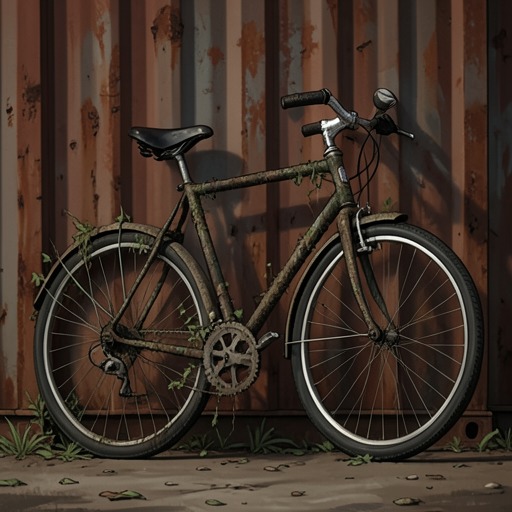
The first investigation did not produce a clear account of how she had been struck. Birkedal says that the postmortem indicated she may have remained alive for some time after being thrown into the tree; it recorded fractures and internal and external bleeding. Investigators also found Alberte’s bicycle some distance away in the thicket, mangled almost beyond recognition. When Carl asks about traces at the collision scene, Birkedal says the roads had been reasonably dry and that, as far as he knows, the report recorded no significant skid or tire marks. These details leave the mechanics of the impact uncertain rather than establishing a straightforward collision by an identifiable vehicle.
Habersaat’s continuing work preserved clues that later investigators could reconsider. Among his notes was a short wooden splint, taped to a page and described as having been found in a straight line between the recovered bicycle and the place where Alberte was apparently hit. His records identify it as plywood and propose that it came from an outer layer of a thicker birch board that had peeled away after being in water. The estimate was a board 20 to 24 millimeters thick, with the middle 18 millimeters still intact. A plan of the tree, road, and bicycle also preserves the spatial arrangement of the scene, while a separate vertical-section drawing offers another way to think through the body’s trajectory.
Those preserved materials do not settle the case. When old examinations are retrieved for review, technicians confirm that the splinter was plywood but conclude that the board later found in the water was not the board that had thrown Alberte into the tree. Its boreholes could not, as described, have secured it to a Volkswagen Kombi in a plausible way; the technicians also reason that a fender alone could not have launched her so far and that a properly adjusted shovel blade would have been required. The distinction between Habersaat’s working theory and the later technical assessment shows both the value and the limits of the evidence he kept: his records make renewed testing possible, but they do not by themselves identify the vehicle or its driver.
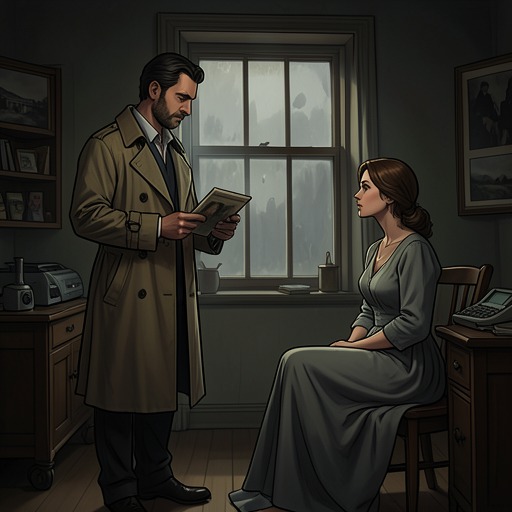
The case also survives through imperfect local recollection. Inge Dalby tells Department Q that Habersaat repeatedly asked her about the name of a man Alberte had been seeing, even though the information had already been given to police in Rønne. She remembers that the name sounded unusual, that its first part was short and biblical, and that the man was said to come from Copenhagen rather than Bornholm or Jutland. She also recalls hearing about a Volkswagen of the same color and shape as the vehicle in a photograph, while acknowledging that the image was unclear. Her account indicates how the original inquiry revisited some witnesses without necessarily turning their uncertain memories into decisive leads.
Cooperation with Department Q
When Department Q takes up the case, Bornholm Police becomes an operational partner rather than simply the institution whose earlier investigation is under scrutiny. Birkedal gives Carl and Assad access to the local history and to Habersaat’s surviving material. Later, after the investigation intensifies, the force contacts Department Q to report that a televised missing-person appeal has been well received locally. A policeman also relays that officers have begun discussing the case again in the station cafeteria.
That renewed conversation produces a specific lead: a relative of a teacher who died at the school recalls that the teacher had owned two nearly identical pistols. Habersaat used one in his suicide, while the other had never been found, including among his possessions. The recollection does not establish who held the missing pistol, but it changes what the investigators know about the weapon and adds a potentially important fact to a case increasingly connected to the school’s past.
The force’s cooperation becomes more immediate when Carl and Assad are injured and rescue services arrive. Carl gives his account while Swedish colleagues check his and Assad’s identities by telephone. Birkedal helps them continue the pursuit, and Bornholm Police agrees to remain in contact throughout the day so that the man they are seeking has no opportunity to leave the island. The ferries and airport are placed under observation. When Carl needs a vehicle and a way to reach the next location, he asks Assad to contact Birkedal and request that a police car be sent there. The sequence is practical rather than ceremonial: the small island force supplies local communication, transport, and control of departure routes at the point when the investigation can no longer be confined to old files.