Christian Habersaat's obsession with the Alberte case
The Hanging GirlChristian Habersaat’s obsession with the Alberte Goldschmid case transformed an unresolved hit-and-run into the organizing purpose of his life. He believed Alberte’s death was murder, not merely negligent manslaughter, and spent nearly two decades trying to substantiate that belief and identify the perpetrator. The investigation became at once a private archive, a challenge to the case’s official limits, and the fixation that helped destroy his domestic happiness.
The Case That Would Not End
Habersaat was a uniformed policeman, not a criminal investigator, yet he made the unsolved death his life’s work. Alberte had been killed in a hit-and-run, and the driver was never found. To some, the case seemed trivial; the loss of a young girl made it anything but trivial to Habersaat. What began as a case that had knocked him into lasting dejection became something he could not put down. His persistence was not simply an attachment to police work: the investigation had come to occupy the place of a life’s purpose.
His understanding of the crime went beyond the accepted description of an accidental collision and an unidentified driver. Habersaat regarded Alberte’s death as murder. He tried with all his might both to establish that theory and to find the person responsible, although the officers who later discussed the case did not know what evidence he had to support it. The distinction mattered: an unresolved hit-and-run might be treated as a failed investigation, but a suspected murder demanded that the circumstances be read again as evidence of intention.
An Archive Built Around Alberte
The scale of Habersaat’s commitment was made visible by his home in Listed. At first, the house seemed to have surrendered to disorder: papers and clippings occupied available floors and walls, leaving little room for ordinary domestic life. A closer examination revealed not random accumulation but a system assembled across almost two decades. The rooms had become an archive devoted to Alberte’s death, and the apparent chaos concealed a working method.
The living room served as a distribution center. Incoming material was sorted into chronological piles, while folders on the shelves registered the house’s collective contents. In the dining room, leads and hints that could not be dismissed reached what appeared to be their final station. Other rooms held distinct parts of the inquiry: the utility room contained records of parallel police inquiries; a room behind it was crowded with interview transcripts from local residents questioned in the weeks after the collision; and the upstairs bedroom belonging to his son held material from National Police Headquarters about other hit-and-run cases. A bookcase labeled for Alberte divided statements about her background, including material about friends from before her time at the folk high school.
This arrangement gave the investigation a geography of its own. Habersaat did not merely keep reminders of the case: he classified, registered, and compared them, preserving official inquiries alongside local interviews and background statements. The structure suggests how completely the unresolved death had entered daily life. The house was no longer simply where he lived; its rooms had been assigned functions by the question he could not settle.
The Cost at Home
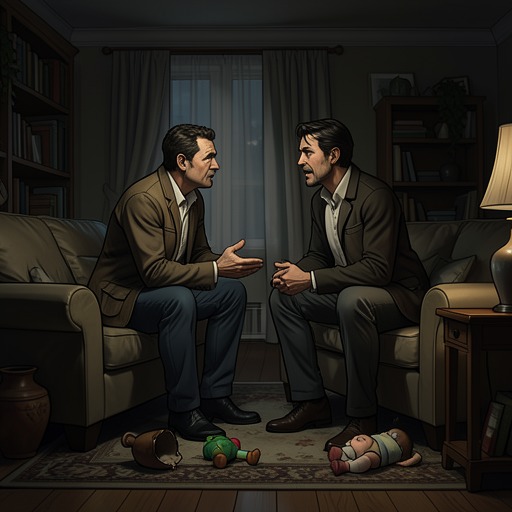
The same rooms that held the investigation also retained traces of the family life that had preceded it. Habersaat remembered making love with his wife on the sofa and crawling on the rug with his son when the boy was small. He also remembered the arguments beginning there, and his gloom taking hold and growing. The house therefore contained two incompatible histories: the intimacy he longed to recover and the work that had become inseparable from his unhappiness.
In the living room, his wife finally spat in his face and left him alone in life. Habersaat connected the rupture directly to the case, understanding it as the point at which a seemingly minor investigation had taken happiness from him. The account does not suggest that the case alone explains the marriage’s collapse, but it establishes how he experienced the loss: the old case had become the force beneath his domestic grief as surely as it had become the structure of his home.
Persistence and Meaning
When Habersaat’s death was discussed at the station, colleagues described a man who had been depressed for years, though his condition had not been obvious to them in everyday working life. They also distinguished between his work as a uniformed officer, which they did not criticize, and his private existence: divorced, living alone, and bitterly devoted to an old case. That contrast helps explain why the obsession could remain largely out of view while dominating the private space in which it was pursued.
Habersaat’s fixation joins conviction to bereavement. He could not accept the case as a closed matter of negligent manslaughter and an unknown driver; he kept looking for the proof that would make his interpretation legible to others. Yet the investigation’s survival in meticulously categorized piles did not restore the family closeness he mourned. His archive stands as both an instrument of inquiry and the material record of a life narrowed around one unresolved death: the more completely the case occupied the house, the more starkly the lost domestic life remained visible within it.