Copenhagen
The Hanging GirlCopenhagen is a destination, a possible point of origin, and a place whose significance depends on who is recalling it. For Pirjo, it is a real city reached after she flees a commune, where a precarious life on the streets leads her to Frank Brennan. For the investigators tracing the man associated with Alberte Goldschmid, it is only a remembered possibility: Inge Dalby says he apparently came from Copenhagen, but her recollection is too uncertain to establish who he was or where he went. The city thus connects an intimate personal history to an unresolved criminal investigation without resolving either one by itself.
A destination for Pirjo
Before Copenhagen becomes a turning point in Pirjo’s life, child-welfare officials are already being pressed to intervene in the commune by hostile complaints from neighbors and parents. By the time they arrive, Pirjo has left, taking every last coin from the piggy bank. With that small fortune and the hope that happiness might be close, she reaches Copenhagen, described as Denmark and Scandinavia’s least prejudiced city. The move is an escape, but not a secure rescue: the money gives her a way out of the commune without giving her a stable place in the city.
Pirjo lives in a youth house in Nørrebro, among a varied population, and soon tries stimulants that can be smoked or drunk. Her circumstances worsen after heated disputes with leading girls over which men they could have sex with; she is thrown out and becomes homeless. For a month she moves through destitution, begging for small change to pay for her next high or buzz. These details make Copenhagen more than a label on a map. It is the setting for a sharp reversal: Pirjo arrives imagining happiness just ahead, but quickly loses shelter and becomes dependent on whatever money she can beg.
The encounter with Frank
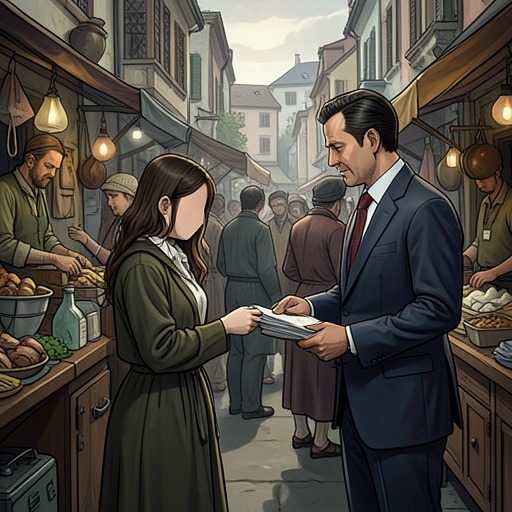
The street period ends when Pirjo meets Frank, a slightly older man with his own apartment. He is kind to her and speaks of the cultivation of the soul and its progress from one level to another as life’s strongest driving force, rather than sex or alcohol. Pirjo finds the idea strange, but listens because it seems like a possible way out of her circumstances. Their meeting in Copenhagen begins a different kind of passage: her immediate search for somewhere to live gives way to attention to Frank’s spiritual teaching.
The city therefore stands at the beginning of Pirjo’s connection to Frank and the ideas that redirect her. The circumstances matter. She has been expelled, has spent a month begging, and is looking for an alternative to a life organized around the next high or buzz. The account does not present Copenhagen as making that choice for her; rather, the city brings her to a moment when Frank’s offer of another path can matter. Her arrival and their meeting are joined by a practical need for refuge, even as his teaching points toward a much larger account of the soul.
Copenhagen as an uncertain lead
Years later, the city surfaces in the investigation into Alberte’s death through Inge Dalby’s recollections. Inge says Christian Habersaat repeatedly asked her about the name of the man Alberte had been seeing before she died, even though she and others had already told the police in Rønne. She remembers that Alberte mentioned the name once because it sounded exotic, but cannot now recall it. What remains is only a vague impression: several names joined together, the first shorter than the others, and something biblical about it.
Inge also recalls that the man apparently came from Copenhagen, rather than Bornholm or Jutland, as far as she knew. That statement gives the city a place in the case, but not the force of a verified address or identification. Inge’s memory is expressly limited, and she can offer no name that would let the investigators attach the reported origin to a particular person. Her uncertainty keeps Copenhagen in the category of a lead: relevant enough to preserve, too indistinct to settle the question.
When Assad shows Inge a photograph of the VW, she recognizes only that its color and shape are at least the same as the vehicle she and Kristoffer had discussed. She cannot see it clearly enough to make a firmer identification. The vehicle and the remembered city therefore reinforce one another only incompletely. They contribute to the investigators’ picture of a man connected to Alberte, but neither fixes his identity or his route.
A point on a map, not an answer
After the VW, the man, and Alberte have been connected, Carl Mørck and Assad still cannot say who the man is, where he came from, or where he went. Rose’s work has helped link the elements, but Carl’s response emphasizes how little that connection establishes about the man’s whereabouts. He imagines a range of possible destinations, from Malta and Jerusalem to Stonehenge, Nepal, and Machu Picchu, and even entertains the possibility that the man has abandoned his former interests and settled into an ordinary career. The possibilities are deliberately broad because the investigation has no reliable destination to follow.
Copenhagen’s significance is consequently double but asymmetrical. In Pirjo’s history, it is a specific urban setting: Nørrebro, a youth house, expulsion, a month of homelessness, and an encounter with Frank. In the Alberte case, it is an origin recalled at a distance, attached to a man whose name Inge cannot remember and whose later movements remain unknown. The contrast makes the city both a place where a life changes direction and a clue that cannot, on its own, bring an investigation to its conclusion.