Department Q
The Hanging GirlDepartment Q is the Copenhagen police unit led by Carl Mørck, a basement team whose investigation of Alberte Goldschmid’s death becomes a test of both its persistence and its judgment. It inherits Christian Habersaat’s unresolved case, turns his scattered records into a working system, and pursues leads across Bornholm. Its progress is striking, but the apparent coherence of its theories eventually gives way to a more unsettling possibility: important parts of the investigation may have been built on misleading evidence.
Mandate and reputation
Department Q occupies a deliberately marginal place in police headquarters. When a caller asks whether the unit will investigate something, Carl’s response is to direct the person to colleagues on the floors above: Department Q already has too much to do. The remark makes the unit sound overloaded and difficult to approach, while also establishing the basement as a separate working world with its own burdens and priorities.
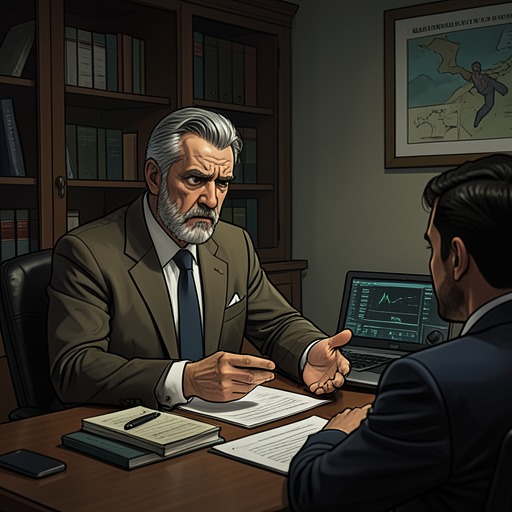
The hierarchy is made sharper by the way other officials redirect calls to the supposedly less serious unit. Department Q is treated as a convenient destination for work that can be kept away from more senior officers. Yet the staff do not simply accept that status. When a chief of homicide is dismissive, Carl answers with sarcasm, making the basement’s low standing a point of friction rather than a neutral fact.
The team’s workload is not abstract. A caller describes Department Q as a final hope, unable to bear any more. The appeal suggests why the unit matters to people who feel that ordinary channels have failed them, even as the team’s own response to such demands can be constrained by its existing caseload. Its position is therefore double-edged: under-resourced and treated as secondary, but also available to people who have nowhere else to turn.
Team and working arrangements
The Alberte investigation begins to reshape Department Q’s daily work. Rose presses Carl to travel to Bornholm and take responsibility for responding to the case. She tells him to book the ferry from Ystad to Rønne while she speaks to the police commissioner, then goes to alert Assad that he should stop painting and get ready. The exchange is practical and brisk, but it also shows Rose directing the team’s movement and coordinating with officials while Carl is pushed into action.
The investigation later acquires a dedicated situation room. Habersaat’s basic material is kept on shelves in the corridor, organized according to the arrangement used in his house but supplemented with what Rose calls professional logic. In a basement room, papers Carl had received as copies are displayed alongside appendixes on bright yellow walls. The space converts a dead officer’s private accumulation of evidence into a shared, visible investigative resource.
Rose assigns Gordon the role of case manager. His task is to build an overview of Habersaat’s documents, serve as an encyclopedia for the team, and find a system that shows how the papers connect. The arrangement leaves Rose, Carl, and Assad to follow up leads while Gordon works across the documentary archive. Assad offers to share his small office with Gordon, even though the room is little more than a broom closet. The practical decision reflects a team willing to make its cramped spaces serve the work.
That work has a human cost. Gordon waits in the situation room visibly exhausted, with one ear reddened by what appears to have been hours holding the telephone. Rose’s presence briefly revives him, but he soon falters again. The episode gives the unit’s filing and phone work a physical dimension: the overview that makes a complicated case manageable has to be assembled through repetitive, draining labour.
Reopening Habersaat’s case
Department Q’s involvement follows Christian Habersaat’s death. Carl comes to believe that Habersaat may have suspected a particular man for years without being able to find him. In this interpretation, Habersaat’s suicide was not only a way of escaping the case; it was also an attempt to ensure that someone else would continue it. The team consequently reads his death as a deliberate handoff, one that brought them to Bornholm to take over the investigation.
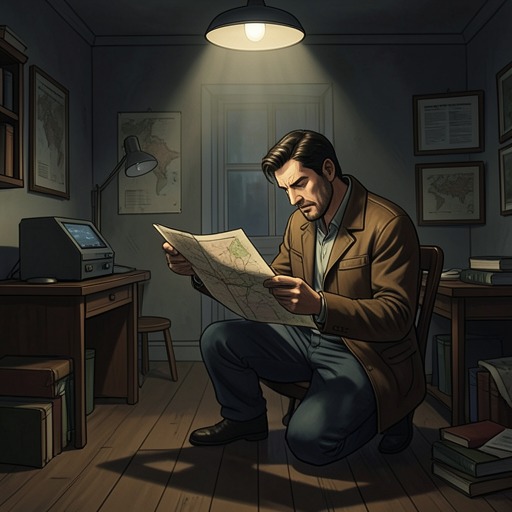
The inherited evidence initially gives the case a physical shape. Habersaat’s notes and materials include a splint located in a straight line between the recovered bicycle in a thicket and the place where it was believed to have been struck. The handwriting is Habersaat’s. A plan shows the tree, the road, and the bicycle, drawn with a precision Carl thinks may have come from the technicians rather than Habersaat himself. Another birch fragment is examined, but the analysis cannot establish with certainty whether it came from the same board. The distinction between observed object and inferred connection remains important: the fragments suggest a route into the case, but do not by themselves prove how the collision happened.
Carl reconstructs a deliberate impact as a working hypothesis. He imagines Alberte placing her bicycle on its stand beyond the bend, stepping forward, and making eye contact with the driver. In his account, she is smiling and expectant; only at the last moment does the vehicle accelerate and ram her, throwing her from the road into the branches. The vehicle then straightens, clipping the bicycle farther along and leaving it well to the right. This is a specific reconstruction of movement and position, not an established account of what happened, and Carl continues to question whether the death was necessarily traffic-related or whether the collision scene yielded any decisive trace.
The case’s central theory is tested against the material evidence. Technicians establish that the recovered splinter was plywood, but conclude that the board found in the water could not have been the board that threw Alberte into the tree. The boreholes Habersaat described do not explain how that board could have been attached to a VW Kombi Van. A proposed attachment through the area beneath the windshield wipers would, the technicians reason, have sent both the windshield and the board flying and left traces that they did not find. The investigation has to keep revising the relation between the fragment, the board, and the vehicle rather than treating their apparent association as proof.
Leads, publicity, and reversals
Department Q’s approach is not confined to the archive. After a television news conference, Carl points viewers to the unit’s direct telephone number and says they are waiting for a tip. Within about an hour, the appeal produces a response. Carl compares that speed with the seventeen years during which much of Bornholm and most of its police force had failed to achieve the same result, and anticipates presenting the development to Bjørn. The moment marks a conspicuous success in reaching people who might remember the case, even though a response is not the same as a solved crime.
The team also has to work amid hostility from elsewhere in the police. Carl hears that colleagues criticized his television conduct, called him a disgrace to headquarters, and connected their contempt to his reluctance to discuss the nail-gun case and his conduct seven years earlier. The attack ties the public appeal to an older professional conflict. Department Q’s visibility can bring information, but it also exposes Carl to judgments about his past and the unit’s place in the institution.
Later evidence forces a sharper reassessment. Carl realizes that the search for an imagined wooden board, the hunt for the VW Kombi Van, and the resources devoted to suspicions about Frank Brennan, also known as Atu Abanshamash Dumuzi, may all have followed misleading leads. The splinter Habersaat found had become the basis for an elaborate line of inquiry, but the photograph Carl sees makes him recognize that the leads they pursued may have been wrong from the beginning. He then asks whether Habersaat could have known that his son had the snowplough. The question reopens the possibility that a significant piece of the case’s history had been overlooked; it does not, on its own, settle what Habersaat knew or establish the final explanation.
Significance within the investigation
Department Q’s role in the case rests on a tension between endurance and uncertainty. The unit can take over a file that had consumed Habersaat, sort it into a shared archive, divide responsibilities, reconstruct a collision, and use television to bring forward a new lead. Its work is energetic enough to achieve in less than two weeks what the island’s police had not managed in years. But speed and organization cannot guarantee that the first persuasive explanation is correct.
The department’s basement setting gives that tension a concrete form. Files line the corridor; the situation room makes connections visible; Gordon’s exhausted phone work sustains the search; and Carl’s public appeal briefly opens the investigation to witnesses beyond the station. These methods turn isolation into collaboration, but the late recognition that key leads may have been misleading shows the cost of organizing uncertain clues around a compelling theory. Department Q is neither simply a neglected unit nor an infallible corrective to the past. Its significance lies in taking responsibility for an unfinished case—and in having to confront the possibility that its own painstaking work has followed the wrong trail.