Fateopia
The Hanging GirlFateopia is an installation by Steffen Kristoffersen, constructed around Alberte Goldschmid’s bicycle and the history of her fatal collision. The work transforms a cheap, damaged everyday object into the centre of a large assemblage of case-related images and materials. When Carl Mørck and Assad encounter it, its elaborate display makes the past materially present, but does so in a form they find disturbing and morbid.
From discarded bicycle to artwork
Alberte’s bicycle had been kept for ten years before it was thrown out on February 25, 2008. A local recognized it from newspaper coverage of the case and took it from a pile of junk, considering the bicycle special because of its history. He welded it into a scrap sculpture and named the work Fateopia. The object therefore passed from evidence associated with a death, through police disposal, into an artwork made by someone who knew the case as a public event.
Kristoffersen said he had been on Bornholm when the collision occurred. He had a summerhouse and studio in Gudhjem, where the case and the search for the responsible driver were widely discussed. He recalled that cars were searched and that National Guard members and local residents joined the search, even when they did not know what they were looking for. His account places the installation’s origins within the public attention surrounding Alberte’s death, rather than presenting the bicycle as a chance find wholly detached from its history.
The work later appeared in an exhibition in Verona and had returned to Kristoffersen’s home in Lyngby by the time of the investigators’ visit. Its movement between the island where the case unfolded, an exhibition abroad, and its maker’s home mirrors the bicycle’s changing status: first part of a case, then discarded property, then the centrepiece of an artwork, and finally an object inspected again by investigators.
Construction and materials
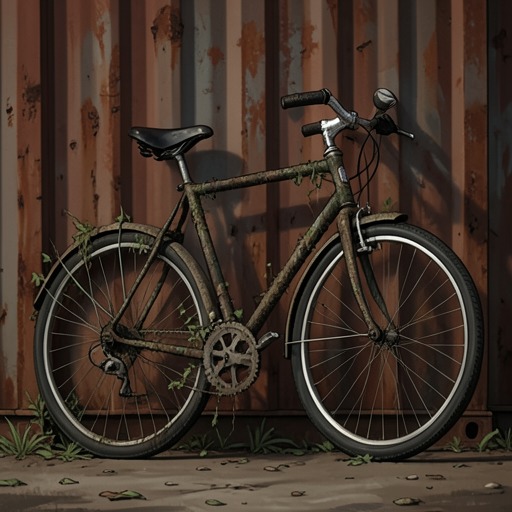
Kristoffersen unveiled Fateopia in his machine room, where two projectors lit the back wall. The installation was approximately the size of a man, but its core was recognizably a woman’s bicycle, with buckled wheels and twisted handlebars. Reinforced crossbars had been welded to its frame and pointed outward like rays; evidence relating to particular details of the case and its surrounding misery hung from their ends.
Around the bicycle, metal and brass etchings depicted imagined car accidents. The installation also included an enamel rendering of checks at the ferry, copper etchings of a pixelated image of Alberte apparently taken from a local newspaper, casts of bone remains, branches and leaves, and hands stretched out in an attempt at protection. The arrangement gathered disparate materials around the bicycle, making it less a simple display of the vehicle than a dense reconstruction of the case’s public and physical traces.
The most arresting element was a plastic vessel beneath an etching of Alberte’s smiling face. It contained pig’s blood, which Kristoffersen said had been treated to prevent it from rotting and which he changed from time to time. He also noted that it might smell sweet. The blood was not human, but its placement directly beneath Alberte’s image made the work’s use of bodily horror explicit. The investigators’ reactions register the difference between showing evidence and turning a death into spectacle: Carl found the sculpture deeply disturbing, and the narration describes the whole as a tasteless jumble, despite its competent construction.
The bicycle under inspection
Carl and Assad approached the installation as both artwork and potential source of information. Assad photographed it from every possible angle while Carl moved closer to examine the bicycle. Its ordinary particulars resisted the monumental treatment: it was a cheap bicycle, probably Chinese, with large wheels, a huge prop stand, high handlebars, rust that had eaten away most of its yellow paint, and a dangling rear rack. Carl judged it a poor-quality bike.
When asked whether it had looked that way at the time, Kristoffersen said that he had put it upright but otherwise left it as he found it. He denied taking it from the police station in Rønne, explaining that he had found it in a junk container on the road outside the station and had asked the guard for permission to take it. The office staff, he said, told him that any injury he sustained while removing it would be his own responsibility. The difference between a discarded bicycle and a retained piece of evidence thus turns on an uncertain institutional boundary: the object had been kept for years, but by the time Kristoffersen encountered it, it was in junk and available to be taken.
Function in the Alberte case
Fateopia makes the bicycle visible in a way it could not be in ordinary use. The investigators are confronted not simply with a vehicle but with an object burdened by knowledge of what happened to its rider. Carl reflects that Alberte had sat in that saddle on the last day of her life and probably expected it to be a happy day. The contrast between that likely ordinary expectation and the installation’s surrounding images of accidents, remains, and blood gives the bicycle a tragic force that its worn frame alone could not convey.
At the same time, the work does not resolve the case. It preserves and rearranges its traces, combining details linked to the investigation with the artist’s own choices of materials and imagery. Assad’s photographs and Carl’s close inspection return attention from the spectacle to the bicycle itself: its condition, its history, and the route by which it came to be incorporated into the sculpture. Fateopia consequently occupies an uneasy position between memorial, artistic appropriation, and material record. The work makes Alberte’s case impossible to overlook, yet its grotesque presentation also raises the cost of turning a real person’s death into an exhibit.