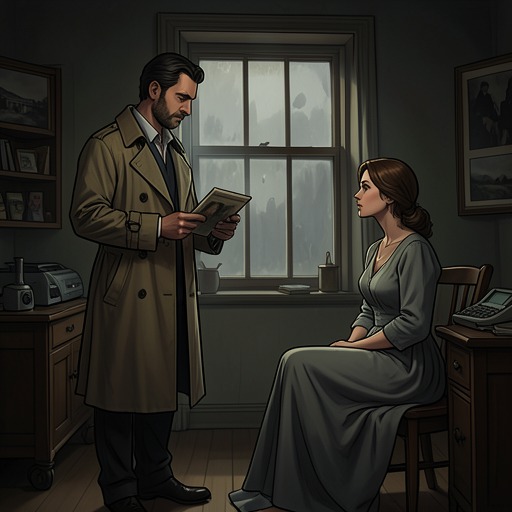
Frank's Note to Alberte
The Hanging GirlFrank's Note to Alberte is a message hidden in the earth near a school and recovered seventeen years later by Carl Mørck and Assad. Addressed to Alberte Goldschmid and signed Frank, it asks to see her again and declares boundless love. Its discovery links a private exchange between the two to the morning Alberte cycled toward her death, making the note both a material clue and a remnant of a possible turning point.
Discovery and Physical Condition
Assad finds the hiding place beneath a dark stone beside a boulder engraved with the school’s name. He has rolled away stones around the boulder’s base and uncovered a small hole. He identifies it as the place where messages were exchanged and where June Habersaat left the false note. That connection gives the concealed space an established role in the case before Carl and Assad know what this particular object contains.
Carl reaches into the hole and feels something smooth. Using his pen to loosen it from the earth, he retrieves a small clear plastic pocket of the kind used for stamps or recipes. After years underground, the plastic has become completely opaque, though it has not been buried deeply enough to disappear from reach. Inside is a folded piece of paper, still in reasonable condition but yellowed and damp. The contrast between the obscured plastic and the legible writing makes the note’s survival feel precarious: its container has lost its transparency, while its central message remains readable.
Message and Addressee
The paper opens with “Dear Alberte,” and then reverses something Frank had said the day before: “Forget what I said yesterday. I really want to see you again when you get back to Zealand from the school. My number at the commune is 439032**” The request refers to their prior conversation without explaining what Frank had said or why he had withdrawn it. Instead, the note records a change of direction: he wants another meeting after Alberte returns from school and leaves a number where she can reach him.
The last two digits of the number can no longer be read. The paper nevertheless preserves the closing, “Until next time. I love you boundlessly,” followed by the signature “Frank.” The message’s directness is significant: it is not merely a practical instruction about how to make contact, but an explicit declaration of affection. The signature and address establish whom the writer intended to reach, while the damaged number leaves one small part of the proposed contact permanently unavailable.
Timing and the Missed Possibility
After reading the note, Assad and Carl recognize its timing. They conclude that Frank must have left it on the same morning Alberte cycled out to meet her terrible fate. The message therefore places Frank’s renewed invitation alongside the last journey that ended in Alberte’s death. It does not show whether she found or read the note before she left; what survives is the message itself and the investigators’ reconstruction of when it was deposited.
The discovery prompts Carl to imagine the consequence of a different sequence. He reflects that if Frank had left his declaration of love a few minutes earlier, none of what followed would ever have happened. The thought is a counterfactual, not proof that Alberte would have escaped harm, but the note gives that regret a concrete object: a folded message, left in a hole, whose timing may have been only minutes too late.
Role in the Investigation
The note emerges from the same hidden exchange-site associated with June Habersaat’s false note, but its contents provide a different kind of evidence. Rather than another misleading message, it bears Frank’s signature and speaks directly to Alberte, revealing a wish to resume contact and a declaration of love. Its physical recovery lets Carl and Assad move from the place where messages were exchanged to a specific communication and a plausible moment of delivery.
As an object, the note carries the distance between an intimate intention and its uncertain consequences. The paper has endured underground, but neither the final digits of the number nor Alberte’s opportunity to respond can be recovered from it. The message’s survival does not undo the past; it sharpens the investigators’ sense of how close a different outcome might once have seemed.