Kristoffer Studsgaard
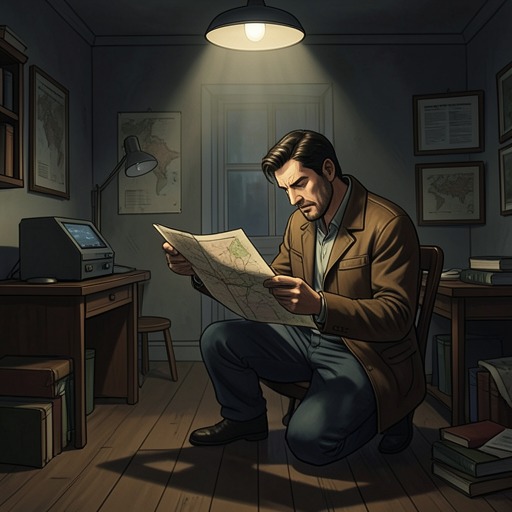
The Hanging GirlKristoffer Studsgaard is a former folk-high-school student whose brief relationship with Alberte Goldschmid links her school years to the unresolved question of who she met afterward. Questioned by Carl Mørck and Assad, he confirms the affair, explains that it overlapped with his relationship with Inge Dalby, and passes on Alberte’s report of a new man connected to the commune at Ølene. His testimony is useful but bounded: he can clarify his own past, while the person Alberte later encountered remains unidentified to him.
Identity and the Surname Discrepancy
Kristoffer first enters the investigation through a mismatch in names. While examining the names under a yearbook photograph, an investigator notices that the police copy calls him Dalby, a surname not recognized in connection with him. Kristoffer’s name in the yearbook is Studsgaard. The difference is confirmed by the man consulted about the photograph, and Kristoffer’s wife also recognizes Studsgaard as the name. The exchange makes the yearbook a corrective record: it restores the identity that connects the former student to Alberte’s school days, even as the police copy preserves a different surname.
When Carl and Assad confront him at home, they ask why he is no longer called Studsgaard and suggest that the change might have been intended to make him harder to find. Kristoffer rejects that suspicion. He says he changed his name because his wife did not want to be called Studsgaard, so he took her surname. The investigators’ pointed approach turns a routine name change into a possible concealment; his answer instead presents it as a decision made for his wife’s comfort. The account does not explain why the police copy says Dalby, leaving the record discrepancy distinct from the explanation he gives for changing his name.
Home and Present Circumstances
The questioning takes place in a home whose visible details give the exchange an ordinary domestic setting. Carl notices a photograph of two older teenagers on top of an unusually large analogue television and shelves filled with VHS cartoons. Assad asks whether Kristoffer has many children. Kristoffer says that he and his wife have two, both away at a residential school for the time being, and that his wife works as a child minder. The details establish a family life beyond the old school romance, but they do not make his account uncomplicated: he says the children are not coping well and that things at home are therefore unhappy.
That domestic strain becomes relevant when Kristoffer hesitates to discuss Alberte. He says he does not want to dig the history up, particularly at that moment, and explains that the subject is difficult in the context of his current troubles. His reluctance does not amount to a denial. Under direct questioning, he acknowledges what happened, but frames it as a painful past rather than a continuing attachment. The scene places the investigators’ demand for information against a household already under pressure, without suggesting that the family difficulties caused or explain the earlier affair.
Alberte and Inge
Kristoffer says he and Inge had begun dating in spring 1997. By the time they went to the folk high school, they had been together for almost half a year; then Alberte appeared, and Kristoffer became involved with her. He describes the affair as innocent and lasting no more than a couple of weeks. Its short duration does not mean it left no mark: he acknowledges that he betrayed Inge and that she has never forgotten it. When Assad asks whether Inge took him back, Kristoffer nods and sighs, a response that leaves the emotional cost visible without settling what he now thinks about that decision.
The episode is presented through several perspectives within the conversation. The investigators press him to say whether he was in love with Alberte, but the evidence here gives no answer to that question. What Kristoffer does affirm is more limited and more concrete: the affair happened, it interrupted an existing relationship, and Inge’s hurt persisted. This distinction matters because his account does not turn Alberte into a lasting romance or reduce the episode to a harmless school flirtation. It preserves both his description of the affair as brief and his admission of its consequences for Inge.
The Lead About Ølene
Asked whom Alberte became involved with after their affair, Kristoffer says that she mentioned someone who lived in a commune at Ølene. He was not given further information, and he does not think anyone at the school was told more. He describes the man as apparently something of a Don Juan, but offers no name or identifying detail. The remark therefore supplies a direction for inquiry, not an identification.
Carl recognizes the importance of this fragment: it explains how Christian Habersaat had found a lead about the commune. Kristoffer’s recollection connects Alberte’s later relationship, as she described it, to the same place without claiming that he knew the man himself. His role in the investigation rests on that narrow but consequential contribution. The yearbook corrects the name attached to an old school photograph; his testimony then adds a location and a suggestive description, while leaving the central figure—and the full story of Alberte’s later relationship—unresolved.