Lars Bjørn
The Hanging GirlLars Bjørn is the Chief of Homicide whose authority becomes a point of conflict when Carl Mørck tries to publicize new leads in a long-dismissed Bornholm case. Bjørn resists a televised appeal for the unidentified man in a VW Kombi, invoking the risks of an unfounded public accusation; at a later press conference, however, Carl names the suspect and describes his history before Bjørn can shut him down. Across these encounters, Bjørn represents an institution concerned with priorities, investigative responsibility, and control of information, while Carl tests how far that control can reach.
Position and Characterization
Bjørn heads the Department of Violent Crime after Marcus Jacobsen. The department’s changed atmosphere is conveyed through Carl’s comparison with the earlier days under Jacobsen: Bjørn has tried to make the workplace feel more welcoming, placing a pair of explosively abstract paintings by Annette Merrild alongside coffee cups decorated with colored dots. In Carl’s judgment, the touches do not alter the character of the department’s leadership. He sees Bjørn as a boor who can show affection only to members of his immediate family. This is a distinctly personal assessment, filtered through Carl’s hostility, rather than a neutral account of Bjørn’s private life.
The workplace around Bjørn also appears as a hierarchy in which people watch, whisper, and report upward. When Carl passes an unfamiliar person behind a desk, his secretary Lis tells him she is Bjørn’s niece, temporarily replacing Mrs. Sørensen. Later, Carl suspects that Gordon has reached Bjørn before him and complained about workload. Bjørn denies that Gordon has done so, explaining instead that, as Chief of Homicide, he speaks regularly with colleagues on Bornholm, who remain closely connected to the department in Copenhagen. His explanation establishes his access to interdepartmental information and rebuts Carl’s attempt to frame the refusal as the result of a colleague’s complaint.
The Dispute over the Bornholm Case
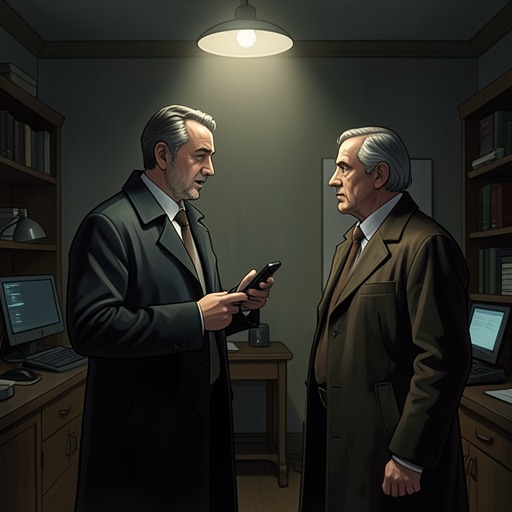
Carl enters Bjørn’s office without knocking and places a photograph of the man with the VW on the table. He asks permission to seek information about him on TV2’s Station 2, presenting the man as someone very likely to have killed a young girl on Bornholm. Bjørn recognizes the implications immediately: Carl is pursuing the 1997 case that Bornholm Police dismissed fifteen years earlier. He refuses to treat it as an established murder investigation or to endorse public suspicion of the unidentified man.
Bjørn’s objection is partly procedural and partly practical. The man in the photograph has never been charged, he says, and the image could depict almost anyone. A national appeal might generate a large volume of useless calls and consume hundreds of hours of police work. Bjørn also argues that the homicide department has more serious matters to handle. His insistence on priorities frustrates Carl, who answers that new leads have emerged and that he intends to pursue the case until someone is imprisoned for murder, manslaughter, or hit-and-run. The disagreement is therefore not simply about whether the case deserves attention: it is also about when an uncertain lead warrants public exposure and who has authority to make that decision.
Bjørn further points to the danger of a wrongful public accusation. He reminds Carl of a recent case in which tabloids presented someone as guilty of murder and then had to retract their claims, raising the prospect of compensation liability. Carl responds with sarcasm, suggesting that any resulting calls could be diverted to the supposedly less serious Department Q. Bjørn ends the meeting by waving him toward the door and making clear that he will not authorize the television appeal. The scene leaves Carl with a direct institutional refusal, not an agreed investigative plan.
Authority at the Press Conference
Bjørn later appears in a very different setting: a press conference concerning connected nail-gun murders. He introduces the assembled group, including Carl, the head of communications, and deputy assistant commissioner Terje Ploug, who has led the investigation since Carl and his team were shot. Bjørn also introduces Hans Rinus, the officer associated with a similar case in a suburb of Rotterdam, and asks Carl to recount his visit to the Netherlands. Carl describes two men killed with 90 mm Paslode nails and cocaine stuffed into their mouths, while explaining that investigators had found no link at the time and had handed the Schiedam case to Dutch colleagues as a local matter.
Ploug calls that separation a mistake and sets out the Danish crimes connected to the weapon: the murder of Anker Høyer, the permanent physical damage suffered by Hardy Henningsen, and the shooting of Carl, all on January 26, 2007. He then displays the heavy semiautomatic pistol now in police possession. Bjørn frames the press conference as a public assurance that the killing of police officers receives high priority and that investigators will continue until perpetrators are brought to trial. He also announces that the murders in Schiedam, Amager, and Sorø are now likely to be connected. His public role here is to set the official account and manage what the press is told.
The Interrupted Appeal and Its Fallout
During the same conference, Carl uses a photograph to identify the man he is pursuing in the Bornholm case. He points out the light-blue VW Kombi and its wide fender, adds that a large peace sign is painted on the roof, and says the man is called Frank and has since changed his name to something more exotic. Bjørn grips Carl’s forearm and tells him that he has said enough, attempting to redirect the conference to its announced subject. Carl frees his arm and continues: he says the man was on Bornholm in 1997, took part in excavations of timber circles, and is a sun worshipper who may still be practicing. Bjørn raises his hand toward the press and stops him, insisting that the case should wait until investigators have more to go on.
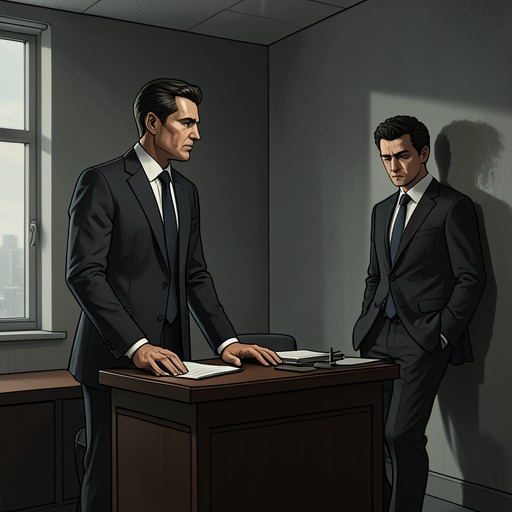
The reversal is sharp. In his office, Bjørn had prevented Carl from using television to solicit leads; at the conference, Carl turns an event Bjørn is chairing into an appeal about the same suspect. Bjørn can interrupt and close the proceedings, but he cannot prevent the information from reaching the cameras once Carl has stated it. Carl is then confronted by angry colleagues in the reception area. In Bjørn’s office, the Chief of Homicide demonstrates how close Carl is to suspension with a paper-thin gap between his fingers, then rebukes him for disloyalty, poor prioritization, disobedience, and disrespect toward colleagues. Carl remains silent, thinking instead about how many people may have watched TV2 News. Bjørn’s authority is real, and its immediate consequence is a threat to Carl’s position; the episode also shows how Carl’s public disclosure has bypassed the procedural restraint Bjørn tried to impose.