Nature Absorption Doctrine
The Hanging GirlThe Nature Absorption Doctrine is the spiritual teaching practiced at the Nature Absorption Academy: it presents nature, the universe, and solar energy as sources of bodily renewal and inner balance, made accessible through shared exercises and ritual. Its promise is both intimate and cosmic: an individual is invited to feel renewed in every cell while becoming part of the universe. In practice, that promise takes shape through the presence of Atu Abanshamash Dumuzi, the responses of his assembled disciples, and the Academy’s ordered, highly theatrical gatherings.
Definition and Promise
At the Nature Absorption Academy London Branch, Atu’s teaching is introduced not as the austere instruction of a conventional guru but as a path shown by a smiling, approachable man. He presents nature absorption as capable of renewing people so thoroughly that their bodies seem able to resist attack and to melt into the surrounding universe. The description joins physical invulnerability to spiritual belonging: renewal is imagined not as withdrawal from the world but as bodily union with it.
The universe and the sun’s energy form the central language of the teaching. In the London apartment, participants sit on the floor, breathe in rhythm with Atu’s words, and repeat his name as a chant. The practice thus translates an expansive claim about cosmic unity into a bodily routine involving breath, voice, and attention. The Academy’s presentation depends on this movement between the vastness of the universe and sensations experienced in a room among other people.
Ritual and Emotional Practice
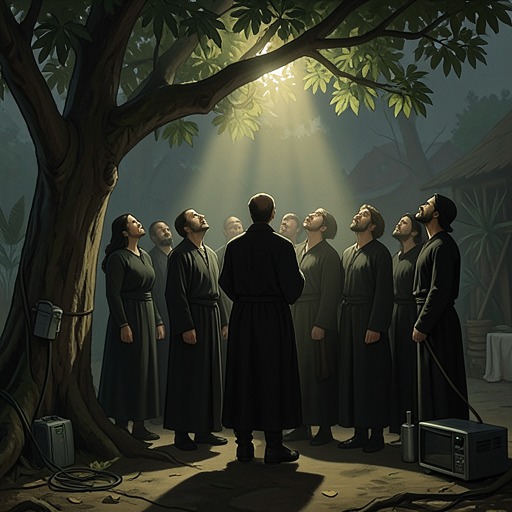
The doctrine is enacted through recurring assemblies led by Atu. At the Academy’s hall, disciples sit silently and wait for him; the sessions are treated as the day’s high point whether they occur indoors or at dawn on a beach. In one October 2013 gathering, Atu addresses the crowd collectively and says that they will feel Malena Michel and her pain, then join together to draw it out. Pirjo Abanshamash Dumuzi looks for Malena and realizes she is not present. Even so, the absent woman becomes the focus of the assembly’s shared attention.
Atu then invites disciples who remain inwardly unsettled to stretch their arms into the air and receive what he calls ablution. Nine or ten people respond. He moves his upper body in small rocking motions while keeping his arms raised, and instructs those participants to channel anxiety, anger, and broken meridian lines into his hands. They rock, breathe heavily, and collapse one by one. Some chant his name as the apparent miracle is reaffirmed. The scene shows how the doctrine makes emotional distress legible as something that can be transferred through a leader’s hands and answered by collective bodily performance.
The session concludes with instructions to return to personal refuges, gather their best energy, and direct it toward Malena. Atu also tells the disciples to seek balance and peace, draw in the world’s particles, and let light and darkness help free them from hatred and uncontrollable thoughts. The language combines inward regulation with an obligation to direct energy toward another person. The sun, nature, and communal feeling are presented not as separate subjects but as parts of one practice.
Authority, Space, and Organization
The doctrine’s force is reinforced by the way the Academy arranges its meetings. Before Atu arrives, Pirjo dresses in white and places the disciples according to rank and association. Skylight illuminates a glass-tiled area where Atu is to stand; in the October light it appears golden and captivating. When he enters in a yellow robe, the assembled disciples watch him with expectation, and his outstretched arms and welcome seem to transform the room. The ritual setting gives physical form to the followers’ reverence, while Pirjo’s work establishes the order in which that reverence is experienced.
That personal authority is sustained by regularity. Disciples are described as living for the sessions, and the same leader’s words are treated as the answer to their questions and quests. The gathering has recognizable stages: silent expectation, Atu’s arrival, collective attention and movement, and a closing greeting. The doctrine therefore operates not only as a set of beliefs about nature but also as an organized social practice, dependent on the leader’s performance and on the participants’ coordinated responses.
The Academy’s physical setting extends this presentation. When Shirley reaches the Nature Absorption Academy Ebabbar, she sees a larger complex than expected: white buildings with pyramid roofs and colored glass, solar cells, and enormous windows. From the road, the place appears self-sufficient and charged with energy, amid cultivated growth and mysterious signs. This is Shirley’s impression rather than a formal statement of doctrine, but it echoes the Academy’s emphasis on solar power, nature, and a world set apart for spiritual practice.
Names, Interpretation, and Narrative Contrast
The Academy also gives spiritual significance to names. A woman there explains that members have one or more names derived from Sumerian and interprets Atu Abanshamash Dumuzi as meaning Guardian of the sunstone, lifespirit’s son. In her account, Atu means guardian, Aban stone, Shamash sun or celestial body, Dumu son of, and zi spirit, life, or lifespirit. This explanation turns his name into a compact expression of the leader’s place within the Academy’s solar and spiritual vocabulary. Carl Mørck, hearing it, dismisses the explanation to Assad; the contrast places the Academy’s reverent interpretation beside the investigators’ skepticism.
That contrast becomes sharper when Carl and Assad observe a gathering. The assembly falls quiet as Atu spreads his arms, rocks, and chants his name; after the woman leading the séance nods, the disciples join in. The investigators recognize him as the man they have been seeking, while the scene around them remains one of collective reverence. The doctrine is consequently presented from two angles at once: from within, as a shared route to renewal and peace; from outside, as a ritualized display centered on a leader whom the police have come to identify.
Atu’s later explanation to new arrivals rejects the idea that the Academy is there to cultivate each person’s independent understanding of self or to pursue dogma and creeds. He describes its daily practices as rituals using simple, durable means to achieve peace of mind. Horus, in this account, gathers human attempts to understand origins and existence, while invoking the god expresses gratitude for life and nature as sufficient gifts. The intended outcome is compassion, love of fellow human beings, calm judgment about the future, and the ability to examine the past without regret or despair.
The doctrine’s central tension lies in the distance between those stated ends and the Academy’s visible concentration of authority in Atu. Its language emphasizes peace, nature, and human fellowship; its ceremonies repeatedly organize attention around one man, with Pirjo managing rank, space, and participants. The teaching’s appeal is not conveyed through doctrine alone: it is made persuasive through breath, chant, architecture, robes, gestures, and the disciples’ bodily responses. In this way, the narrative shows how an abstract promise of cosmic unity becomes a lived system of belief and collective discipline.