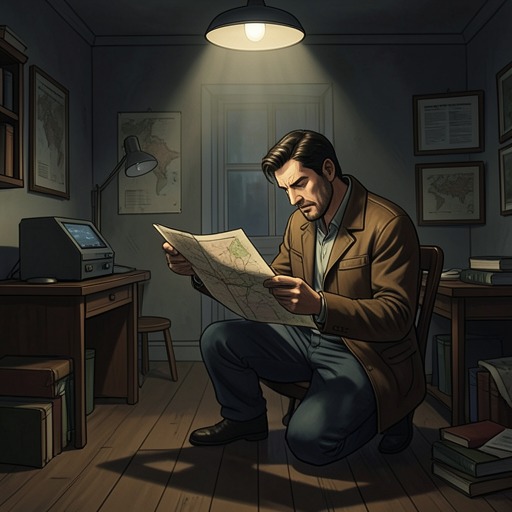
Photograph of the Man Beside the VW Kombi
The Hanging GirlThe Photograph of the Man Beside the VW Kombi is a visual lead in Department Q’s reopened investigation into Alberte Goldschmid’s death. Its importance lies less in what it conclusively shows than in what it might disclose: the identity of a man witnesses associated with Alberte and a Volkswagen van, whose possible connection to the fatal collision had never been resolved.
The Image as a Lead
During their inquiry, Carl Mørck and Assad showed Inge Dalby a photograph of a man with a VW Kombi. Inge remembered that Alberte had once mentioned a man whose name sounded exotic, though she could no longer recall it; she thought the first part was shorter and had something biblical about it. She also understood that he came from Copenhagen, rather than Bornholm or Jutland, and recalled a VW connected to him. The vehicle in the photograph seemed to her to be the same color and shape, but she could not see it clearly enough to confirm the match.
That qualified recognition made the image useful but inconclusive. Inge’s recollection linked a person, a place of origin, and a kind of vehicle, yet it did not establish that the photographed man was Alberte’s companion or that the van had been involved in her death. The photograph could direct the investigation; it could not settle it.
Efforts to Identify the Man
Carl sought a clearer version of the photograph and asked the technicians to see whether they could sharpen it. He also instructed Assad to bring them up to date on the case and to ask whether they could locate the photographer or the negative. The original might offer a better image, but Carl cautioned that the team should not depend on finding it.
The investigation also explored whether photographs taken during archaeological work might show the man in the background. When Carl asked an archaeologist whether he had pictures of him, the man said there might be a few, but could not remember and noted that such material had not necessarily been preserved. This was a search for a possible independent image, not confirmation that any such photograph had been found or that it depicted the same man.
Context in the Collision Investigation
The image was considered alongside physical evidence and competing reconstructions of Alberte’s collision. Carl asked whether the scene had yielded skid or tire marks, and whether the body’s position in a tree and the bicycle in the thicket could establish the direction or mechanics of impact. Habersaat’s records included a small wooden splinter found in a straight line between the recovered bicycle and the presumed collision point; later examination identified it as plywood, but could not establish that it came from the board found in the water.
Those separate clues prompted Department Q to test whether a board or shovel blade could have been attached to a VW Kombi and could have thrown Alberte into the tree. The inquiries show why the photograph mattered: it might help connect a particular man and vehicle to a theory that also had to withstand forensic scrutiny. But the image did not itself demonstrate that the pictured van had been modified, was present at the collision, or caused Alberte’s injuries.
Connection to Alberte and the Limits of the Evidence
Later testimony supplied a more personal context for the man’s connection to Alberte. June Habersaat said she had followed him after discovering that he was seeing a younger woman at the same time as her. She watched him and Alberte exchange small notes by a boulder outside the school, and said that he eventually told her he loved Alberte and intended to take her back to Copenhagen. June’s account explained why the man mattered to the case, but it did not by itself establish that he was the person in the photograph.
The photograph therefore remains a clue defined by the gap between recognition and proof. Inge could match the van’s general appearance to her memory but could not see it clearly; the investigators sought both a sharper image and other photographs, while separately testing the collision theory against physical evidence. Its narrative function is to make a remembered stranger potentially visible without allowing an indistinct image to substitute for identification.