Pirjo Attacks and Electrocutes Carl and Assad
The Hanging GirlPirjo’s attack on Carl Mørck and Assad turns their effort to unsettle her into a struggle for survival. With no concrete evidence or witnesses to support their suspicions, the investigators are vulnerable; Pirjo exploits that uncertainty, takes control of them, and uses the Academy’s solar equipment to threaten them into silence.
Ambush and Restraint
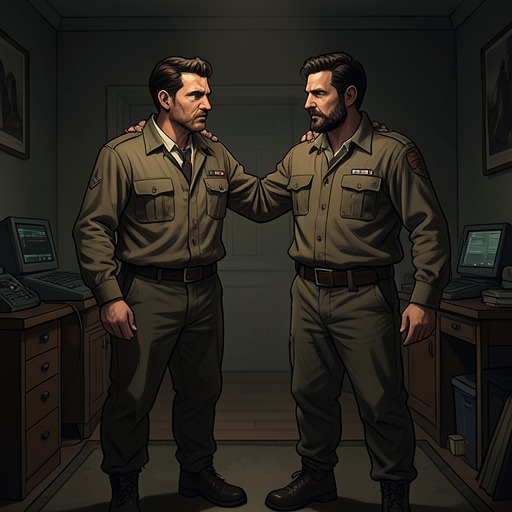
Carl and Assad are whispering about their questioning strategy. Assad believes that provoking Pirjo may expose a reaction from her or Atu, but acknowledges that they have no firm basis for a case. Carl sees a shadow only as it swings a heavy rubber mallet toward Assad. Before he can intervene, a second blow hits Carl. In a brief glimpse, he sees Pirjo bend over him and pick up the small wooden figure he had been carrying in his pocket; when she raises it to her face, he loses consciousness.
Pirjo pauses with the figure, touching it to her cheek and kissing it before a sound from the corridor draws her attention back to the men. Assad is beginning to stir, so she decides to secure both investigators first. She binds their arms and legs with cable, ties each man to a bench and wall hooks, and then connects their bound bodies together. The methodical restraints transform the control room into a place from which the two men cannot readily escape, while giving Pirjo time to prepare her next move.
The Solar-Current Threat
Pirjo takes the car keys from the larger man and checks that both investigators are securely bound. The electrician is not expected back for several days, and she believes no one else will enter the control room in the meantime. As Assad begins to recover, she has little time to act. She cuts two lengths of cable, each three meters long, and winds one around Assad’s thumb and the other around Carl’s left ankle.
The junction box gathers the cables from the solar system. Pirjo has learned from an electrician and Shirley how to use the current as a means of torture: in weak sunlight it causes only a slight sting, but stronger sun makes it more dangerous, potentially lethal. She uses an insulated screwdriver to loosen the connections leading to the inverter, then attaches the cable at Assad’s thumb to the positive pole and Carl’s ankle to the negative. When she completes the circuit, both men’s muscles contract and their legs kick forward. Carl’s kick strikes her in the stomach, forcing her to her knees; she looks up to find the men sitting with their eyes open, while she feels compelled to get out.
Pirjo nevertheless returns to the controls. She believes the center’s mission is to unite religions and bring peace, and sees the investigators as insignificant obstacles to that vision. When she reconnects the cable, both men’s legs jerk and their backs arch. She tells them that the effect is limited for now but will become much worse when the sun returns, then pulls the cable away and asks what they know. The procedure makes the solar equipment more than an improvised weapon: its danger depends on the changing light, so the threat can intensify without Pirjo changing anything but the connection.
Carl and Assad answer that they know what happened and that they are not alone in knowing it. They tell Pirjo that Atu killed a girl in a hit-and-run years earlier and that the past has caught up with him. Pirjo applies the current again, repeating the attack rather than releasing them. The accusation identifies the investigation’s real stakes: the men’s presence is not simply an intrusion into the control room, but a challenge to the history Pirjo is trying to protect.
Carl’s Experience of the Current
From Carl’s limited awareness, the attack becomes a sequence of bodily sensations rather than a clear view of the room. He can think only “not long now” as his muscles seize, his breathing falters, and flashes of light interrupt his thoughts. The changing sunlight makes the current more dangerous, and his repeated phrase registers how close he believes he is to dying. He can only intermittently remember that he and Assad are bound together. Then the current weakens abruptly. Carl gasps for air and, seeing that the room is bright, looks around in confusion; the immediate danger has lessened, though the scene does not yet explain why.
The Wooden Figure and Pirjo’s Contradiction
The small wooden figure links the encounter to a private past that briefly surfaces amid Pirjo’s decisions. She touches it to her cheek and kisses it in memory of lost innocence, a gesture of tenderness that sits uneasily beside her treatment of the investigators. The contrast does not explain her actions, but it prevents the scene from presenting her as only a calculating opponent: attachment and coercion occupy the same confined space.
The figure also marks a shift in what each character can perceive. Carl sees Pirjo pick it up just before consciousness leaves him; her response to it belongs to a moment he cannot witness. His later awareness is fragmentary, registered through bodily sensation and flashes of recognition rather than a continuous view of the room. The episode thus sets Pirjo’s deliberate control of the scene against Carl’s sharply diminished grasp of it, while leaving the significance of the figure’s remembered innocence unresolved.