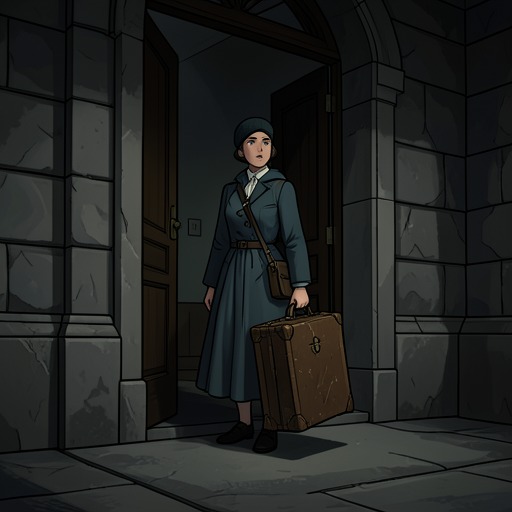
Shirley
The Hanging GirlShirley is a lonely Londoner whose hunger for friendship and a more meaningful life draws her to the Nature Absorption Academy. There, her unanswered questions about Wanda Phinn turn the hope of finding a community into a dangerous investigation: Shirley recognizes Wanda’s belt, suspects Pirjo knows what happened to her, and eventually confronts Pirjo. Imprisoned and left without water, she finds a way to signal for help by concentrating sunlight through her glasses onto paper. She is carried out alive, a survivor of the violence concealed beneath the Academy’s language of welcome and spiritual purpose.
Identity and Background
In London, Shirley’s life has narrowed into a series of disappointments. Paco Lopez, a Spaniard who had spent a week visiting her, sharing sex and homemade food, ended the relationship by producing a worn engagement ring and saying goodbye. Her employer then fired her instead of a newer cafeteria worker, and a diet that promised a ten-kilogram weight loss seemed to have the opposite effect. The account places these frustrations alongside her disappointment in Wanda, who had made grand promises but sent no postcard after leaving.
At first, Shirley worries that Wanda has simply fallen out of touch; eventually, that concern gives way to resignation. The silence becomes one more loss among many. When Shirley tries to arrange Christmas and New Year’s with other people, they do not reciprocate her interest, leaving her in a poor London apartment block, watching the holiday lights and children from the outside. Her loneliness is not an abstract condition: it is made up of failed intimacies, precarious work, money worries, and the sense that nobody is waiting for her.
Leaving London for the Academy
Wanda’s absence gives Shirley an alternative to that life, even though Shirley has little concrete knowledge of what awaits her. She imagines Wanda on the island where Atu Abanshamash Dumuzi leads the Nature Absorption Academy, and the imagined scene begins to resemble a fairy tale. Shirley knows Wanda did not have more money than she did, and as far as Shirley knows, Wanda had no invitation. Those details make leaving seem possible rather than impossible: if Wanda could make the journey, Shirley believes she can, too.
Shirley turns the decision into a test of solitaire. She promises herself that completing a game will make her seriously consider leaving; after completing several games over a weekend, she decides she will go, and the seventh game in a row settles the matter for her. She travels to the Academy expecting that the friendly people she met at a London session will welcome her, although she doubts that Wanda will. From Kalmar train station she takes a bus toward the island, then continues on foot. The trip is an act of self-invention, but it also carries her toward the unanswered question at the center of her journey: whether Wanda ever arrived.
Arrival and the Search for Wanda
Shirley arrives unannounced while Pirjo Abanshamash Dumuzi is preparing to speak with Atu about important personal news. Instead, Shirley is already in Pirjo’s office with Atu, asking to join one of the Academy’s groups. She explains that she and a friend had attended the London course and become fascinated with nature absorption. The friend, she thought, had come to the Academy months earlier; now Shirley has been told at reception that the woman never arrived. Naming Wanda Phinn and expressing worry, Shirley unknowingly introduces a question Pirjo wants kept out of circulation.
Shirley’s account establishes her as more than a newcomer seeking admission. She has come because she believes Wanda’s departure may have led to the Academy, and she is prepared to ask what happened. Pirjo gives her little reason to doubt the official denial at first. Later, however, as Pirjo tries to reduce their contact and keep questions from being asked, Shirley’s presence becomes a continuing source of risk. Pirjo’s subdued manner and Shirley’s determination to understand Wanda’s fate pull the two women into an increasingly unequal conflict.
The Belt and Growing Suspicion
A belt becomes the material clue that changes Shirley’s understanding. When she sees it, she recognizes it as one she bought as a birthday present for Wanda just before Wanda left London. It had been expensive for Shirley, who could not normally afford such a purchase, and she had obtained it more cheaply because of a long, superficial scratch. Those specific features make the belt personal evidence, not merely a resemblance between two items of clothing.
Pirjo denies recognizing it and suggests that belts can look alike. Shirley does not accept that explanation as the matter closes. She later tells Valentina the full story of how the belt appeared and what she made of it. Valentina listens as if hearing the account for the first time, then sits silently looking out the window. After Valentina tells Shirley about a dream, the two women drift apart. Shirley begins looking at the belt again with renewed suspicion, especially because Valentina has mentioned other incidents at the Academy that seem troubling.
At the same time, Pirjo watches Shirley differently: her attention seems directed toward gathering information rather than making contact. Pirjo stops speaking to her beyond an occasional nod or feigned smile. Shirley fears that Pirjo may be trying to get rid of her, but she has no easy route to Atu, since requests to him pass through Pirjo. She nevertheless decides to stay at the center, whatever the cost. Returning to London would mean unemployment, bad housing, and the old patterns she had tried to leave; even her parents have made clear that they do not want correspondence while she remains at what they regard as an unchristian place.
Confrontation and Imprisonment
When Pirjo asks Shirley to talk about the future, Shirley interprets the approach as an attempt to send her away. She tells Pirjo that she will not be stopped from telling the world Pirjo knows what happened to Wanda Phinn. Anger and fear overcome her composure and she begins to cry. Pirjo responds by treating the accusation as another fixation on the belt and inviting Shirley to come to her side of the table, promising to show her that she is wrong. The difference between them is stark: Shirley names the possibility of a crime, while Pirjo tries to recast the accusation as a misunderstanding she can manage.
Shirley is eventually locked in a house. After three days without a plausible explanation for Pirjo’s absence, she considers whether nobody knows she is there, or whether Pirjo has forgotten her. She tries to reassure herself that a person can survive weeks without food, but the water supply then stops. Searching her bag, she discovers that the shoes with large buckles, nail scissors, and file are missing. Pirjo had helped her pack it. Shirley takes their absence as evidence that the confinement is deliberate and concludes that she is not meant to come out alive. She also decides that Wanda had been at the Academy and that Pirjo made her disappear, though Shirley still does not know how or where Wanda is.
Survival and Narrative Significance
On May 16, Shirley accidentally flushes away valuable water, leaving only a small amount in the toilet. She describes the loss of hope as more devastating than any single earlier disappointment: throughout her life, one hope had replaced another, from recognition by her parents to weight loss, a partner, a close friend, or meaningful work. Now she believes she is going to die, and concentrates on ensuring that she will not die quietly and that blame will point toward Pirjo.
Her attempts to escape show the physical limits of her situation. After working for hours to loosen a board, she makes a gap in the wall but finds aluminum she cannot break through with the tools available. She then uses her reading glasses, bought cheaply at a Tiger discount store in the Southside Shopping Centre in Wandsworth, to focus the sun’s rays onto paper. The glasses, originally bought in the hope of applying makeup more successfully, become a practical means of producing a bright point of heat. When the rescue team later carries her out, Shirley is still alive; she reaches toward people as she passes, and a few stroke her fingers.
Pirjo, meanwhile, has heard faint scratching from the house but considers it unalarming. Four days after turning off the water, she expects the sounds to stop and assumes Shirley will be dead within a week. That contrast between Pirjo’s confidence and Shirley’s efforts gives the confinement its grim structure: one woman treats time as a means of erasing a problem, while the other uses what little remains to make herself heard. Shirley’s rescue does not erase the neglect and danger she has endured, but it overturns Pirjo’s expectation of silence. Her arc turns a search for friendship into a struggle to survive, while showing how a promise of belonging can be exploited to isolate someone from help.