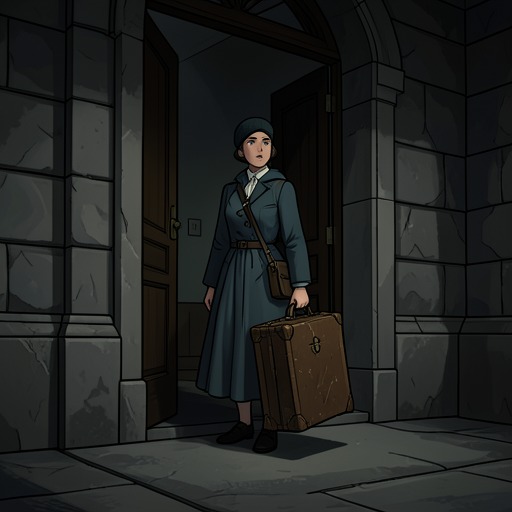
Shirley's escape from captivity
The Hanging GirlShirley’s escape from captivity turns a house where Pirjo expects her to die into the site of her rescue. Cut off from water and unable to make herself heard, Shirley uses sunlight, her glasses, and paper from a blue notebook to start a fire. The blaze draws people to the house; when rescuers carry her out, she is still alive.
Captivity and the Failed Expectation
Four days after Pirjo turned off the water to the house where Shirley was locked up, she heard faint scratching from the walls during an inspection. She did not regard the sounds as alarming. She expected them to stop within days and planned to assume Shirley was dead a week later. In the meantime, Pirjo intended to keep to herself and let time pass. Her confidence in that outcome makes Shirley’s eventual appearance among the rescued a sharp reversal: the faint sounds Pirjo dismissed were evidence that Shirley remained alive.
At the Academy on Öland, preparations outside Pirjo’s window carried on as usual. Men were building bicycle sheds, and Pirjo expected the first bikes later that week for a project intended to recruit island residents. She rose for the communal assembly while Shirley remained trapped in the house. The ordinary schedule of construction and assembly unfolds alongside a captivity Pirjo believes is nearing its end.
Sunlight, Paper, and the Fire
Shirley’s means of escape is small and improvised. She kneels, takes up her glasses, and gathers the sun’s rays into a bright point, first on the wall and then on a crumpled piece of paper from the blue notebook. The paper gradually darkens. The scene makes an everyday object—the glasses—instrumental to survival: Shirley turns them from something she wears into a means of concentrating sunlight and setting fire to paper.
After a hole opens in the skylight, Shirley screams as loudly as she can, hoping someone will hear. She stops after ten minutes; the house is so well insulated that no one has heard her. The fire therefore does not immediately end her isolation. Even with an opening above her, the building’s insulation defeats her attempt to summon help by voice.
Her response to the confinement also departs from what she thinks she ought to feel. Rather than becoming sad and afraid, she laughs briefly at the strangeness of her situation and experiences hunger and thirst as a source of euphoria, feeling light, free, and strong. That moment does not remove the danger, but it accompanies the practical effort that gives her another chance of being found.
Rescue and Reversal
The fire eventually brings people to the scene. Voices from the courtyard call out that there is a fire. By the time Carl sees the aftermath, the community is gathered around a dead woman, while white-clad men and women stand nearby, crying and disoriented. The account does not identify that dead woman as Shirley; instead, a stretcher team arrives from the fire carrying Shirley alive.
Shirley is given oxygen through a mask and an intravenous drip as rescuers hurry her past the onlookers. She reaches out to touch people’s hands, receiving only a few strokes of her fingers in return. The commander directs that she be taken in one ambulance, the dead woman in another, and the Danish officers in an emergency car. Shirley’s survival overturns Pirjo’s expectation that the scratching would cease and the captive would be dead. The fire that did not make her first cries audible ultimately makes her escape visible to the people who can carry her out.