Solar Cross
The Hanging GirlThe Solar Cross is the astronomical pattern Johannes Tausen presents as a key to religious symbolism: two intersecting axes mapped onto the sun’s apparent course and the turning points of the year. In his lecture to Carl Mørck and Assad, the cross becomes more than a diagram. Tausen treats it as a recurring sign through which solar cycles have shaped religious stories, including the Christian account of Jesus.
Definition and Astronomical Pattern
Tausen begins with the sun’s passage through the zodiac and the Earth’s daily rotation. He describes four points in that cycle—sunrise, the zenith, sunset, and the nadir—and then connects them to the solstices and equinoxes. Drawing one axis between zenith and nadir and another between ascent and descent, or between the solstices and equinoxes, produces a cross across the circles traced by the sun. This is the pattern he calls the Solar Cross.
The explanation sets ordinary observation beside astronomical abstraction. Carl reduces the four daily points to morning, noon, evening, and midnight, a dryly practical response to the professor’s terminology. The contrast does not refute the diagram, but it makes visible the distance between the phenomenon itself and the interpretive system Tausen builds around it.
Prehistoric Traces and Religious Origins
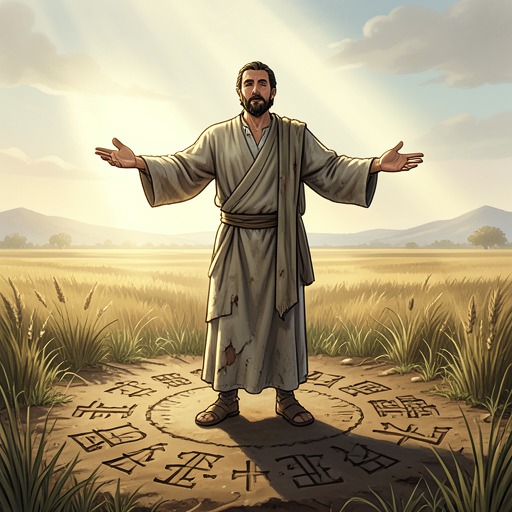
Tausen says that versions of the cross can be found carved in rocks from prehistoric times. He presents those carvings as evidence for a broader thesis: that a number of religions and religious ideas have the sun and zodiac as their point of origin. In his account, celestial patterns become stories; the sun’s life-giving properties make it a figure for the Creator, God, the light of the world, and humanity’s savior. Later religions, he argues, recast the stars and sun as sun gods and other mythological figures, producing stories he considers substantially alike across different periods and traditions.
That is Tausen’s interpretive claim, not a conclusion independently established by the scene. He offers the Solar Cross as a framework for reading religious images, linking astronomical cycles to the meanings cultures attach to them. Its force in the conversation lies in the scale of that proposal: a recurring shape in the sky is made to explain a wide field of religious narrative.
The Christian Story as Solar Myth
Tausen applies the pattern to the Christmas story and the crucifixion. He associates the three kings with a prominent star and their downward direction with sunset on December 25, reading their journey as movement toward the solstice and the symbolism of life and salvation. He also connects the constellation Virgo, called the House of Bread in his account, with Bethlehem, whose Hebrew meaning he gives as House of Bread.
His explanation of the cross turns on the winter solstice. In the northern hemisphere, he says, the sun reaches its lowest point around December 22, 23, and 24, the darkest days of the year. He describes the sun as appearing to pause there, while the constellation Crux is visible in the sky; after three days, the sun begins moving north again. Tausen reads this sequence as the divine sun hanging beneath the cross and then being resurrected, a pattern he says Jesus shares with other sun gods.
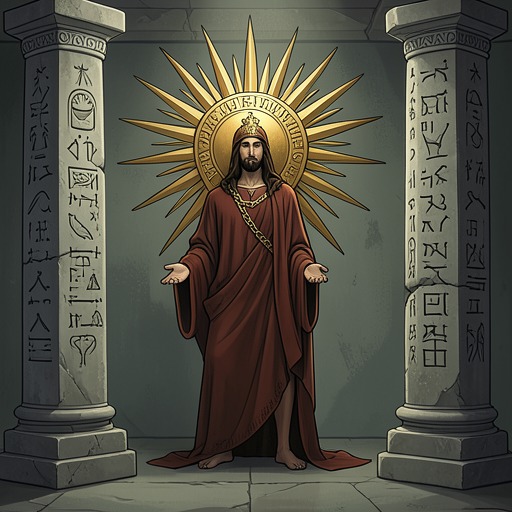
He extends the comparison to familiar Christian imagery. Jesus as giver of life and son of God, the halo around his head, and the cross behind him are presented as figurative expressions of the same solar pattern. Tausen even interprets the crown of thorns as the shadow cast when sunlight passes through treetops. The Solar Cross thus connects seasonal movement, the image of crucifixion, and the promise of renewed light within his reading.
The Lecture’s Limits and Narrative Role
Tausen delivers the theory as a condensed account of a series of lectures, and he acknowledges that it is difficult for him to accept in every respect as both a theologian and a man of faith. His admission complicates the confidence of the argument: the professor is not simply dismissing Christian belief, but describing an explanation that unsettles his own commitments. He closes by recognizing that the material may have been too concentrated for the occasion.
Carl responds with uncertainty about what to do with the knowledge, and imagines only that it might be useful in a confirmation class, where a vicar would not welcome it. Assad keeps a straight face, though the narration marks skepticism as capable of taking many forms. Their reactions leave the Solar Cross poised between an elegant unifying theory and a provocative lecture whose conclusions remain open to doubt.