Solar-Origin Theory of Religious Myths
The Hanging GirlThe Solar-Origin Theory of Religious Myths proposes that religious stories across cultures grew from astronomical patterns, especially the movements and apparent deaths and renewals of the sun. In the novel, theologian Johannes Tausen explains the theory to Carl Mørck and Assad as a way of reading familiar sacred narratives through the sky; the account also helps investigators connect Frank Brennan’s ideas to the sun-centered rituals of the Nature Absorption Academy. The theory’s force in the story lies not in proving that religions share a single origin, but in showing how a powerful interpretation of cosmic cycles can shape both personal belief and communal practice.
The Theory and Its Religious Pattern
Tausen’s central argument is that the common features of religious stories descend from astronomical and often astrological phenomena. Across traditions, he identifies recurring narrative elements: a birth associated with a virgin and a significant date, wise men or disciples, a guiding star, miracles, betrayal, crucifixion, death, and resurrection. He invokes figures and traditions including Horus, Christ, Attis, Mithra, Krishna, and Dionysus, arguing that their stories resemble one another despite differences in setting and detail. The repeated pattern, in his account, is not evidence that one religion simply copied another; it reflects the recurrence of celestial structures that human communities have interpreted in narrative form.
The sun supplies the theory’s most consequential symbol. Because it gives life and light, Tausen says, it has long served as an image of the Creator, God, and humanity’s savior. Religions then give stories and divine figures to the apparent patterns of the heavens. He describes this as a transformation: stars and the sun become sun gods and other mythological figures, while the underlying story remains recognizable across time and place. His interpretation makes religious difference look like variation on a shared celestial design.
The Sky Read as Scripture
Tausen offers a specific astronomical reading of the Christian birth story. In his explanation, Sirius, the brightest star in the northern hemisphere in December, aligns with the three stars of Orion’s Belt. The three stars can be understood as the three kings, following the star toward the winter solstice, which signifies life and salvation. He also connects the constellation Virgo, called the House of Bread, with Bethlehem, whose Hebrew meaning he presents as the same. The story’s details thus become a symbolic map of stars and seasonal change rather than a uniquely historical sequence.
He gives the crucifixion and resurrection a parallel solar reading. Around December 22, 23, and 24, the sun appears to remain at its lowest point in the year. In northern latitudes, these are the darkest days, once experienced as a kind of death because people could not know whether the sun would return. Tausen links this pause to the constellation Crux, visible in the sky, and describes the sun as hanging beneath the cross for three days before beginning to move north again. The sun’s return becomes a resurrection story, and the cross becomes an astronomical sign as well as a religious one.
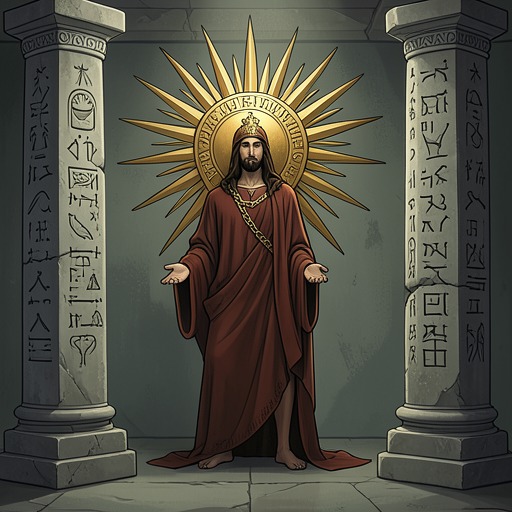
Tausen extends the reading to Christian imagery. He interprets the halo and cross behind Jesus’ head as resembling the sun cross, and the crown of thorns as a shadow formed when sunlight passes through treetops. He presents these claims as part of a concentrated lecture, acknowledging that the argument is difficult even for him as a theologian and a man of faith. That qualification matters: the book stages the theory as a challenging interpretation voiced by a character, not as an uncontested account of religion.
From Interpretation to Frank Brennan
The theory becomes relevant to the investigation when Tausen connects it to Frank Brennan. He recalls that Frank shared the premise that religions had a common origin and that the sun and stars could explain the existence of life and, in a broader sense, everything. Tausen’s lecture prompts him to remember their last conversation, turning an abstract discussion of comparative religion into a lead about Frank’s beliefs.
A former member of Frank’s commune supplies a more practical recollection. Frank had taken a university course and then talked about stars, the sun, and constellations, irritating and boring the others. He wanted the commune to build a sun temple in the back garden. He also rose with the sun to chant there; when a man who needed to get up for work objected to being woken early, Frank beat him severely. The episode places the theory beside a sharp contradiction: an account that can frame the cosmos as a source of life and shared meaning coexists with Frank’s capacity for violence. His convictions do not make his conduct benign, and the narrative does not treat spiritual language as a guarantee of compassion.
The Academy’s Ritual Use of Solar Belief
The Nature Absorption Academy gives solar belief an organized, bodily form. At its London branch, Atu Abanshamash Dumuzi leads floor-seated followers through an exercise framed around nature absorption and the energy of the sun. His repeated Abanshamash chant and his instructions to breathe well-being into the body make the teaching a shared physical practice, not just a theory about ancient texts. Followers are drawn to the promise that the study can renew them and bring the body into unity with the surrounding universe.
At the Academy’s hall, ritual and authority are carefully joined. Before Atu arrives, Pirjo, dressed in white, arranges disciples according to rank and association. The hall’s glass-tiled section, where Atu will stand, catches the light; the assembled followers sit in expectant silence, and Pirjo sees his sessions as the high point of their day. The scene shows how a teaching about nature and cosmic energy is sustained by a recognizable order: a charismatic leader, ranked disciples, repeated gatherings, and an assistant who manages the assembly.
Atu’s instruction to newcomers clarifies how the group presents its use of religious imagery. He says that Horus is central, but describes the Academy’s daily practices as rituals rather than mysticism or dogma. Invoking Horus, he explains, expresses gratitude for the gifts of life and nature; the intended outcomes include compassion, love of others, peace of mind, and the ability to assess the future and past. This teaching resonates with Tausen’s account of sun-centered myth, but it is not identical to it: the Academy turns the symbolism into a present-day discipline and communal promise.
The theory also appears in the Academy’s names and ceremonies. One member explains that the names derive from Sumerian and interprets Atu Abanshamash Dumuzi as meaning Guardian of the sunstone, lifespirit’s son. During a gathering, Atu spreads his arms, rocks back and forth, and begins the Abanshamash chant alone before the assembly joins him. The cosmic vocabulary has become a public sign of belonging, attached to a leader whose name, ritual position, and followers’ expectations reinforce one another.
Significance and Limits
The Solar-Origin Theory of Religious Myths links three levels of the novel’s material: Tausen’s comparative explanation of sacred stories, Frank Brennan’s earlier interest in celestial religion, and the Academy’s solar vocabulary and repeated practices. It gives investigators a way to recognize continuity between Frank’s past ideas and the world organized around Atu, while also showing how an interpretation can move from lecture into conduct and institution.
The theory’s recurring images—sunlight, stars, the cross, and renewal—offer a language for life, death, and salvation. Yet their meaning depends on who uses them and to what end. Tausen presents them as an explanation of religious recurrence; Atu presents Horus and nature as a basis for ritual and peace of mind; Frank’s remembered conduct exposes the gulf between a life-giving cosmology and violence. The novel therefore treats solar myth not simply as a claim about where religions began, but as an idea whose authority and consequences are revealed through the people who make it their own.