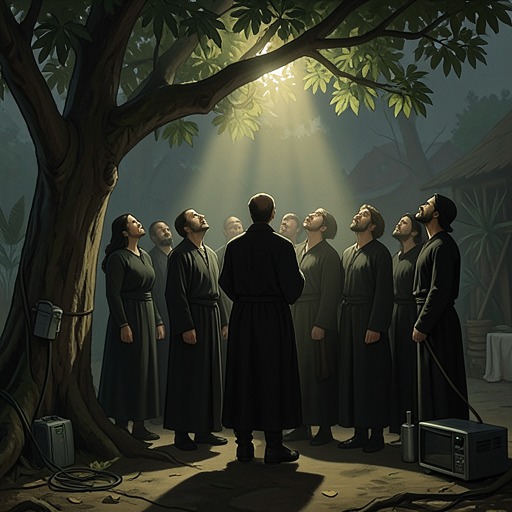
Spiritual Teachings as Self-Justification for Violence
The Hanging GirlSpiritual Teachings as Self-Justification for Violence describes the way Pirjo converts murder into an act she can call righteous. After killing Wanda Phinn, she cleans herself and the objects she has with her, then reaches for the academy’s language of inner peace, spiritual balance, and evil energy to make the killing seem necessary. The scene does not simply expose a gap between belief and action: it shows Pirjo using belief to recast violence as protection, while her pulse, red forearms, and trembling fingers register what that account cannot settle.
Violence Recast as Protection
In October 2013, Pirjo retreats to the Stable of Senses, a rose-colored building where she washes her boots and hoses down her trouser legs, spade, and scooter. The stable ordinarily serves new disciples seeking relief from depressive tendencies and bad karma: they stroke the ponies’ muzzles and breathe the scents of fresh straw and horse droppings. At this hour, while others meditate in their rooms, the space is quiet enough for Pirjo to clean undisturbed. Its ordinary atmosphere of care and unburdening forms an unsettling contrast with the violence she is trying to put behind her.
Only an hour earlier, she had murdered someone for the third time in her life. Her forearms are bright red and her heart is thumping. These physical details make the violence immediate, not an abstraction that spiritual language can simply dissolve. Pirjo tells herself to stop, think, and regard the event as insignificant in the grand scheme of things; she then whispers, “It couldn’t have been any different.” The phrase turns a choice into an inevitability. In her account, Wanda had forced her way into Pirjo’s world despite all the warnings, and Pirjo, as the academy’s high priestess, had rightly stopped her.
Status and the Language of Righteousness
Pirjo’s justification is also personal. She says the killing preserved her position once again at Atu’s side. Her claim that she acted for the academy therefore sits alongside a concrete stake in her own status and relationship. Rather than separating those interests, she folds them together: Wanda becomes a danger to what Pirjo and Atu built, and removing her becomes a defense of the collective. The passage makes this self-protective logic visible without suggesting that Pirjo is unaware of the cost. She acknowledges that each killing takes its toll, describing an attacked inner peace and an unbalanced soul, but treats those consequences as a burden that accompanies righteous action rather than evidence against it.
The possibility that Atu might discover what happened sharpens the tension between Pirjo’s private account and the academy’s public spiritual order. She worries that things must be handled properly or Atu will find out. Her concealment and her language of righteousness thus occupy the same scene: spiritual conviction does not remove the practical need to hide the act. Pirjo’s actions protect her place beside Atu, while her explanation presents them as protection for everyone at the academy from Wanda’s supposed evil energy.
Ritual and Its Failure
In the stable loft, Pirjo tries to restore her composure by chanting, “Horus, born of a virgin,” followed by an appeal for guidance and release from despondency. She repeats the chant several times, but it does not work. That failure matters because Pirjo remembers the ritual having helped on earlier occasions. Now, she is shocked that it has no effect; she wonders how she can move on if demons take over and the spirit is not with her. Her questions show that her certainty about the righteousness of the killing coexists with a loss of the inner reassurance she expects her beliefs to provide.
Pirjo next closes her eyes, presses her palms together, and breathes slowly and deeply. She asserts that she has unequivocally spared everyone at the academy from Wanda’s evil energy, and concludes that what she did cannot be wrong. The reasoning is circular: the claimed danger warrants the killing, while the conviction that she acted to remove that danger serves as proof of its righteousness. After one more chant, she feels relief as her pulse falls. She nods toward the rays entering through the skylights, gives thanks to Providence, and returns to reviewing the events with renewed energy. Calm returns, but the scene shows it arriving through a renewed interpretation of the murder, not through any change in what happened.
The Justification Returns
A later assembly shows that Pirjo’s explanation has not displaced her private fears. When Atu Abanshamash Dumuzi says, “I feel you all, and you feel me. We feel Malena today, and we feel her pain and bring ourselves together now to pull it out of her,” Pirjo notices that Malena is absent. She wonders whether Atu is referring to Malena’s presence in his chamber and fears that the two may become more attached than Pirjo can allow. She even considers whether it was a mistake not to let Wanda challenge that relationship.
Pirjo then rejects the doubt and returns to the same conclusion she reached after the murder: Wanda Phinn had to disappear; it could not have been any different. The recurrence is revealing. Her spiritual language can quiet her pulse, but it does not remove the jealousy and insecurity that reappear when Atu’s attention turns to Malena. In this passage, the language of collective feeling and healing stands beside Pirjo’s private coercion of events into a story of necessary protection. The justification persists because it shelters both her authority within the academy and her place beside Atu, even as the repeated need to reaffirm it exposes its instability.